Serhal Sarah, Armour Carol, Billot Laurent, Krass Ines, Emmerton Lynne, Saini Bandana, Bosnic-Anticevich Sinthia, Bereznicki Bonnie, Bereznicki Luke, Shan Sana, Campain Anna
Woolcock Institute of Medical Research, Sydney, NSW, Australia.
School of Pharmacy, The University of Sydney, Sydney, NSW, Australia.
Front Pharmacol. 2022 Mar 25;13:869162. doi: 10.3389/fphar.2022.869162. eCollection 2022.
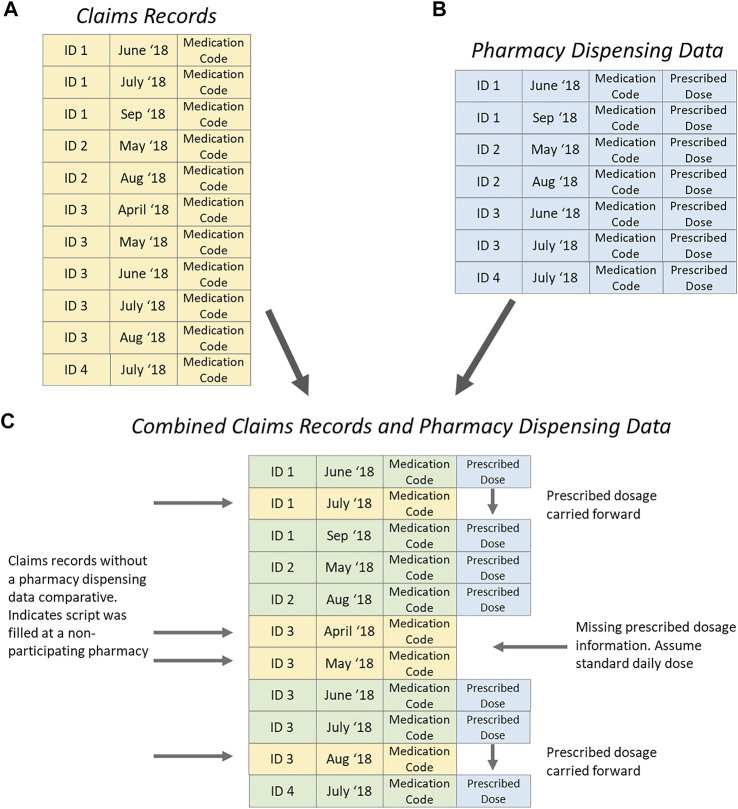
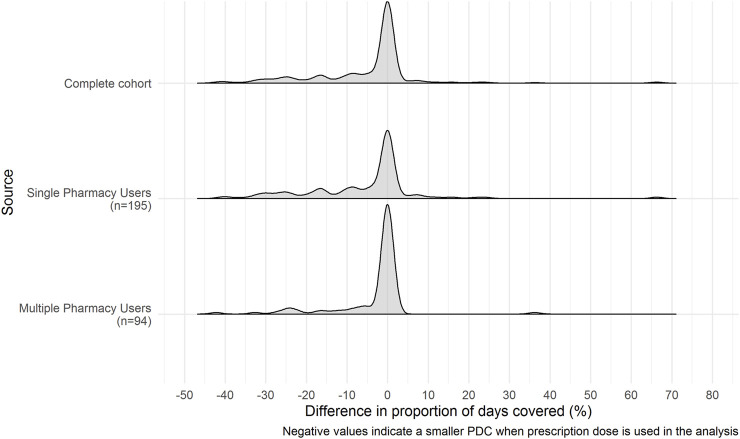
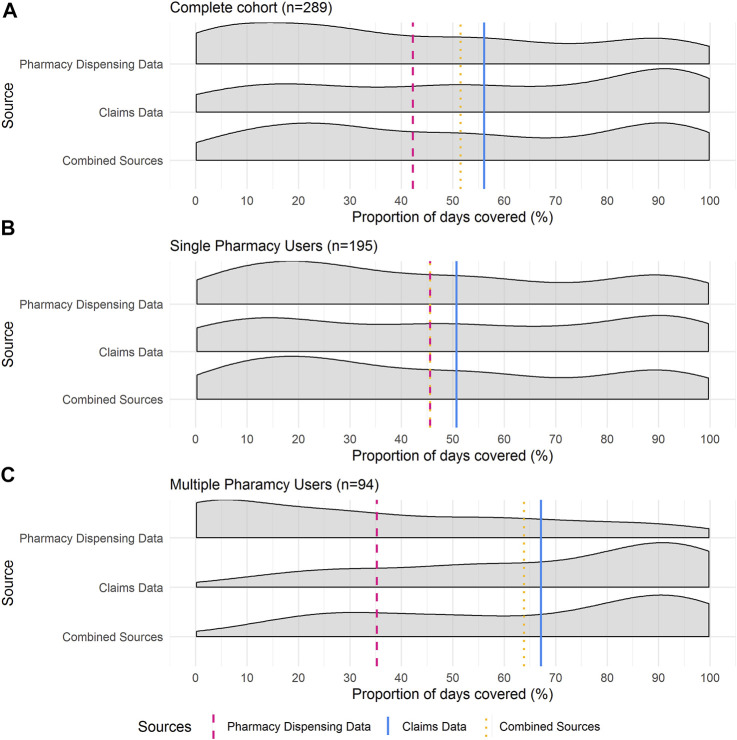
Accurate clinical assessment of patient adherence using reliable and valid measures is essential in establishing the presence of adherence issues and support practices for pharmacists. This investigation aims to conduct a novel assessment of patient adherence to asthma controller therapy by combining 1) patient-specific dosage data found in pharmacy dispensing data with 2) centrally collected administrative claims records, to determine the added value of using both sources of data. A total of 381 clinically uncontrolled asthma patients, from 95 community pharmacies across three Australian States were recruited and provided consent for the retrieval of their claims records and pharmacy dispensing data. Patients were stratified as multiple or single pharmacy users and adherence scores were calculated the proportion of days covered (PDC) method using 1) patient claims records, 2) patient pharmacy dispensing data, and 3) combined claims records and pharmacy dispensing data. Cohort and subgroup adherence estimates were then compared. Low levels of adherence were evident amongst the cohort irrespective of the data source used. PDC estimates based on claims records alone or combined claims records and pharmacy dispensing data were significantly higher than estimates based on pharmacy dispensing data for the total cohort (56%, 52%, 42% respectively, < 0.001) and more noticeably for multiple pharmacy users (67%, 64%, 35% respectively, < 0.001). PDC estimates based on combined claims records and pharmacy dispensing data were significantly lower than estimates based on claims records alone, indicating that perhaps standard daily dose is not a robust proxy for prescribed dosage to inhaled respiratory devices in adherence approximations. Poorer adherence was found amongst single pharmacy users than multiple pharmacy users when combined claims records and pharmacy dispensing data (46% compared to 64% respectively, < 0.001) or claims records alone (51% compared to 67% respectively, < 0.001) were compared. Access to routine collected data increases clinical acuity over patient adherence to asthma controller medications and is a valuable resource for health care professionals. A policy of secure accessibility of such data at the patient-pharmacist or patient-GP interface may allow real-time intervention and assist in decision making across numerous therapeutic areas.
使用可靠且有效的方法对患者依从性进行准确的临床评估,对于确定是否存在依从性问题以及为药剂师提供支持性措施至关重要。本研究旨在通过将1)药房配药数据中发现的患者特定剂量数据与2)集中收集的行政索赔记录相结合,对患者对哮喘控制疗法的依从性进行全新评估,以确定使用这两种数据源的附加价值。从澳大利亚三个州的95家社区药房招募了总共381名临床控制不佳的哮喘患者,并征得他们同意检索其索赔记录和药房配药数据。患者被分为多药房使用者或单药房使用者,并使用1)患者索赔记录、2)患者药房配药数据以及3)索赔记录与药房配药数据相结合的方式,通过覆盖天数比例(PDC)方法计算依从性得分。然后比较队列和亚组的依从性估计值。无论使用何种数据源,队列中的依从性水平都较低。仅基于索赔记录或索赔记录与药房配药数据相结合得出的PDC估计值,显著高于基于药房配药数据得出的总队列估计值(分别为56%、52%、42%,P<0.001),对于多药房使用者更为明显(分别为67%、64%、35%,P<0.001)。基于索赔记录与药房配药数据相结合得出的PDC估计值,显著低于仅基于索赔记录得出的估计值,这表明在依从性近似计算中,标准日剂量可能并非吸入式呼吸设备规定剂量的可靠替代指标。当比较索赔记录与药房配药数据相结合(分别为46%和64%,P<0.001)或仅索赔记录(分别为51%和67%,P<0.001)时,单药房使用者的依从性比多药房使用者差。获取常规收集的数据可提高对患者哮喘控制药物依从性的临床敏锐度,并且是医疗保健专业人员的宝贵资源。在患者 - 药剂师或患者 - 全科医生界面实现此类数据的安全可访问政策,可能允许进行实时干预并协助在众多治疗领域进行决策。