Department of Medicine, Faculty of Medicine, McGill University, 1140 Pine Avenue West, H3A 1A3 Montreal, Quebec, Canada.
BMC Health Serv Res. 2011 Jan 18;11:12. doi: 10.1186/1472-6963-11-12.
Public pressure has increasingly emphasized the need to ensure the continuing quality of care provided by health professionals over their careers. Health profession's regulatory authorities, mandated to be publicly accountable for safe and effective care, are revising their quality assurance programs to focus on regular evaluations of practitioner performance. New methods for routine screening of performance are required and the use of administrative data for measuring performance on quality of care indicators has been suggested as one attractive option. Preliminary studies have shown that community pharmacy claims databases contain the information required to operationalize quality of care indicators. The purpose of this project was to determine the feasibility of routine use of information from these databases by regulatory authorities to screen the quality of care provided at community pharmacies.
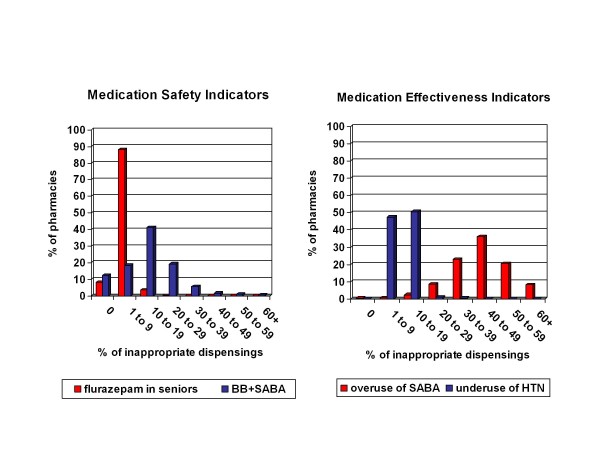
Information from the Canadian province of Quebec's medication insurance program provided data on prescriptions dispensed in 2002 by more than 5000 pharmacists in 1799 community pharmacies. Pharmacy-specific performance rates were calculated on four quality of care indicators: two safety indicators (dispensing of contra-indicated benzodiazepines to seniors and dispensing of nonselective beta-blockers to patients with respiratory disease) and two effectiveness indicators (dispensing asthma or hypertension medications to non-compliant patients). Descriptive statistics were used to summarize performance.
Reliable estimates of performance could be obtained for more than 90% of pharmacies. The average rate of dispensing was 4.3% (range 0 - 42.5%) for contra-indicated benzodiazepines, 15.2% (range 0 - 100%) for nonselective beta-blockers to respiratory patients, 10.7% (range 0 - 70%) for hypertension medications to noncompliant patients, and 43.3% (0 - 91.6%) for short-acting beta-agonists in over-use situations. There were modest correlations in performance across the four indicators. Nine pharmacies (0.5%) performed in the lowest quartile in all four of the indicators, and 5.3% (n = 95) performed in the lowest quartile on three of four indicators.
Routinely collected pharmacy claims data can be used to monitor indicators of the quality of care provided in community pharmacies, and may be useful in future to identify underperforming pharmacists, measure the impact of policy changes and determine predictors of best practices.
公众压力越来越强调,医疗保健专业人员在其职业生涯中应确保持续提供高质量的护理。负责对安全有效的护理承担公共责任的卫生专业监管当局正在修订其质量保证方案,重点是定期评估从业者的绩效。需要新的常规绩效筛选方法,并且已建议将使用行政数据来衡量护理质量指标的绩效作为一种有吸引力的选择。初步研究表明,社区药房理赔数据库包含可用于实施护理质量指标的信息。本项目的目的是确定监管机构常规使用这些数据库信息筛查社区药房提供的护理质量的可行性。
加拿大魁北克省的医疗保险计划提供的数据涵盖了 2002 年由 1799 家社区药房的 5000 多名药剂师开出的处方。根据四个护理质量指标计算了药房特定的绩效率:两个安全性指标(给老年人开禁忌的苯二氮䓬类药物和给患有呼吸道疾病的患者开非选择性β受体阻滞剂)和两个有效性指标(给不遵医嘱的患者开哮喘或高血压药物)。使用描述性统计数据总结了绩效。
可以为 90%以上的药房获得可靠的绩效估计。禁忌苯二氮䓬类药物的平均配药率为 4.3%(范围为 0 - 42.5%),给呼吸道疾病患者开非选择性β受体阻滞剂的平均配药率为 15.2%(范围为 0 - 100%),给不遵医嘱的高血压患者开高血压药物的平均配药率为 10.7%(范围为 0 - 70%),在过度使用情况下短效β激动剂的平均配药率为 43.3%(范围为 0 - 91.6%)。四个指标之间的绩效存在适度的相关性。在所有四个指标中,有 9 家(0.5%)药房的表现处于最低四分位数,有 5.3%(n = 95)在四个指标中的三个指标中处于最低四分位数。
常规收集的药房理赔数据可用于监测社区药房提供的护理质量指标,并可能有助于未来识别表现不佳的药剂师,衡量政策变化的影响以及确定最佳实践的预测因素。