Batista V, Gober M, Moura F, Webster A, Oellers M, Ramtohul M, Kügele M, Freislederer P, Buschmann M, Anastasi G, Steiner E, Al-Hallaq H, Lehmann J
Department of Radiation Oncology, Heidelberg University Hospital, Heidelberg, Germany.
Heidelberg Institute of Radiation Oncology (HIRO), National Center for Radiation Oncology (NCRO), Heidelberg, Germany.
Tech Innov Patient Support Radiat Oncol. 2022 Mar 30;22:1-8. doi: 10.1016/j.tipsro.2022.03.003. eCollection 2022 Jun.
Surface Guided Radiation Therapy (SGRT) is being increasingly implemented into clinical practice across a number of techniques and irradiation-sites. This technology, which is provided by different vendors, can be used with most simulation- and delivery-systems. However, limited guidelines and the complexity of clinical settings have led to diverse patterns of operation. With the aim to understand current clinical practice a survey was designed focusing on specifics of the clinical implementation and usage.
A 32-question survey covered: type and number of systems, quality assurance (QA), clinical workflows, and identification of strengths/limitations. Respondents from different professional groups and countries were invited to participate. The survey was distributed internationally via ESTRO-membership, social media and vendors.
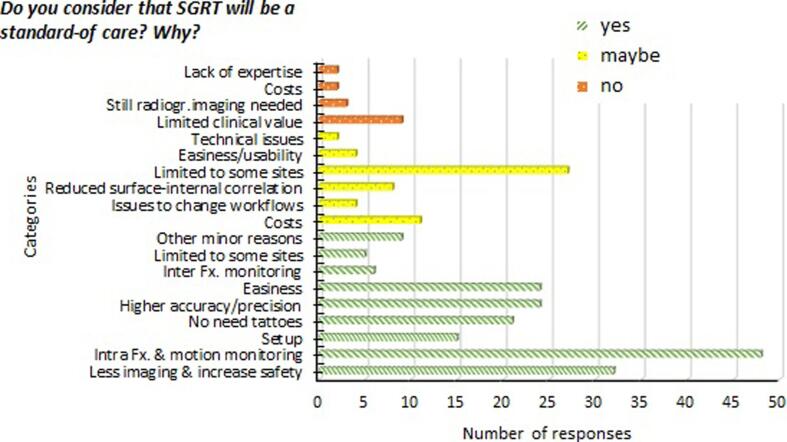
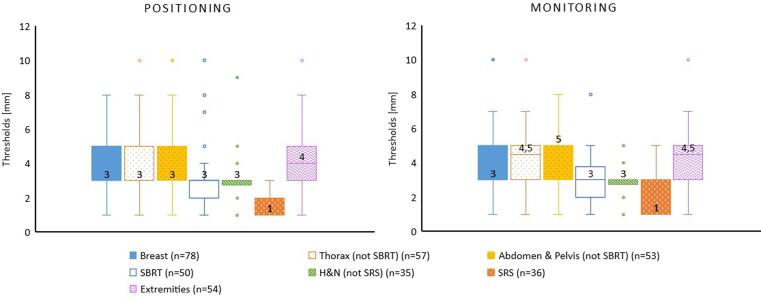
Of the 278 institutions responding, 172 had at least one SGRT-system and 136 use SGRT clinically. Implementation and QA were primarily based on the vendors' recommendations and phantoms. SGRT was mainly implemented in breast RT (116/136), with strong but diverse representation of other sites. Many (58/135) reported at least partial elimination of skin-marks and a third (43/126) used open-masks. The most common imaging protocol reported included the combination of radiographic imaging with SGRT. Patient positioning (115/136), motion management (104/136) and DIBH (99/136) were the main applications.Main barriers to broader application were cost, system integration issues and lack of demonstrated clinical value. A lack of guidelines in terms of QA of the system was highlighted.
This overview of the SGRT status has the potential to support users, vendors and organisations in the development of practices, products and guidelines.
表面引导放射治疗(SGRT)正通过多种技术和照射部位越来越多地应用于临床实践。这项由不同供应商提供的技术可与大多数模拟和输送系统配合使用。然而,有限的指南和临床环境的复杂性导致了不同的操作模式。为了了解当前的临床实践,设计了一项调查,重点关注临床实施和使用的具体情况。
一项包含32个问题的调查涵盖:系统类型和数量、质量保证(QA)、临床工作流程以及优势/局限性的识别。邀请了来自不同专业组和国家的受访者参与。该调查通过欧洲放射肿瘤学会会员、社交媒体和供应商在国际范围内分发。
在278个回复的机构中,172个至少有一个SGRT系统,136个在临床中使用SGRT。实施和QA主要基于供应商的建议和模体。SGRT主要应用于乳腺癌放疗(116/136),其他部位也有较多但不同的应用。许多机构(58/135)报告至少部分消除了皮肤标记,三分之一(43/126)使用了开放式面罩。报告的最常见成像方案包括放射成像与SGRT的结合。患者定位(115/136)、运动管理(104/136)和深吸气屏气(DIBH)(99/136)是主要应用。更广泛应用的主要障碍是成本、系统集成问题以及缺乏已证实的临床价值。突出强调了在系统QA方面缺乏指南。
对SGRT现状的这一概述有可能支持用户、供应商和组织制定实践、产品和指南。