Department of Pediatric Cardiology and Pediatric Intensive Care, Ludwig-Maximilians-University of Munich, Marchioninistr. 15, 81377, Munich, Germany.
Eur J Pediatr. 2022 Jul;181(7):2563-2573. doi: 10.1007/s00431-022-04458-z. Epub 2022 Apr 11.
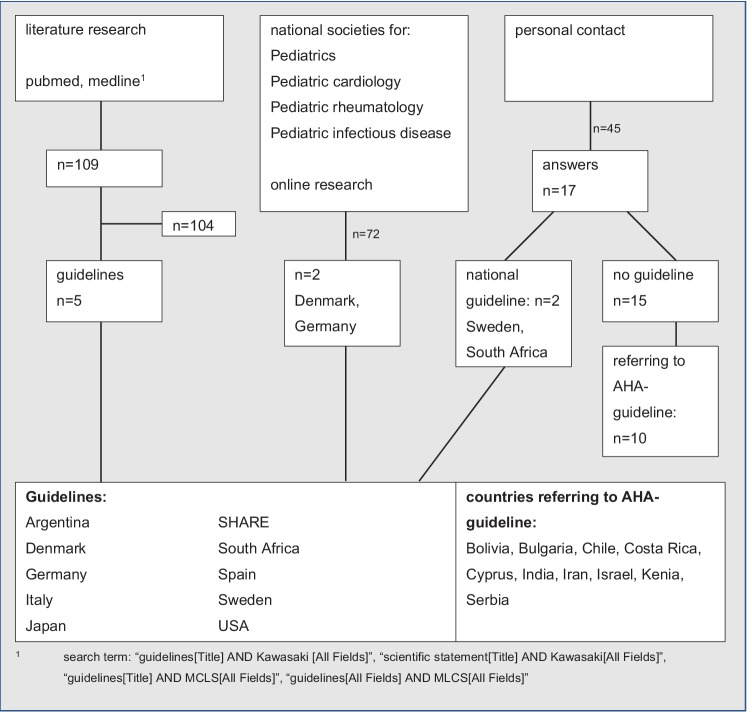
Key aspects of the medical management of Kawasaki disease (KD) are not yet supported by a high evidence level, thus making room for individual recommendations. We performed a structured comparison of existing international KD guidelines to analyze potential differences in the implementation of evidence-based KD recommendations regarding diagnosis and therapy. To identify country-specific guidelines, we took a multilateral approach including a comprehensive PubMed literature, online research, and directly contacting national pediatric associations. We then ran a structured guidelines' analysis and evaluated the diagnostic and therapeutic differences in the context of evidence-based medicine. In this structured guideline analysis, we identified nine national and one European guidelines. According to them all, the diagnosis of KD still relies on its clinical presentation with no reliable biomarker recommended. First-line treatment consistently involves only intravenous immunoglobulin (IVIG) therapy. Recommendations in terms of acetylsalicylic acid, corticosteroids, and additional therapeutic options vary considerably.
According to all guidelines, KD is diagnosed clinically with some variance in defining incomplete KD and being a non-responder to treatment. First-line treatment consistently includes IVIG. Recommendations for additional therapeutic strategies are more heterogeneous.
• The diagnosis of KD relies on the clinical presentation, entailing challenges in timely diagnosis. • Other treatment options then IVIG are not supported by a high evidence level, making room for individual recommendations.
• Definition of incomplete KD and being non-responsive to an initial treatment vary to some extent between the national guidelines. • Only IVIG is consistently proposed throughout all guidelines, further therapeutic recommendations vary between the national recommendations.
川崎病(KD)的医学管理的关键方面尚未得到高证据水平的支持,因此为个人建议留出了空间。我们对现有的国际 KD 指南进行了结构化比较,以分析在基于证据的 KD 建议的诊断和治疗方面实施潜在差异。为了确定具有国家特定性的指南,我们采用了一种多边方法,包括全面的 PubMed 文献、在线研究以及直接联系国家儿科协会。然后,我们进行了结构化指南分析,并在循证医学的背景下评估了诊断和治疗差异。在这种结构化的指南分析中,我们确定了九条国家指南和一条欧洲指南。根据所有这些指南,KD 的诊断仍然依赖于其临床表现,没有推荐任何可靠的生物标志物。一线治疗始终仅涉及静脉注射免疫球蛋白(IVIG)治疗。关于乙酰水杨酸、皮质类固醇和其他治疗选择的建议差异很大。
根据所有指南,KD 的临床诊断存在一定差异,包括不完全 KD 的定义和对治疗无反应。一线治疗始终包括 IVIG。其他治疗策略的建议更加多样化。
• KD 的诊断依赖于临床表现,这在及时诊断方面带来了挑战。• 其他治疗选择(除 IVIG 外)缺乏高证据水平的支持,为个人建议留出了空间。
• 不完全 KD 的定义和对初始治疗无反应在国家指南之间存在一定程度的差异。• 所有指南都一致建议使用 IVIG,进一步的治疗建议在国家指南之间存在差异。