Unidad de Gestión Clínica de Endocrinología y Nutrición, Hospital Regional Universitario de Málaga, 29007 Malaga, Spain.
Instituto de Investigación Biomédica de Málaga (IBIMA), 29010 Malaga, Spain.
Nutrients. 2022 Apr 2;14(7):1484. doi: 10.3390/nu14071484.
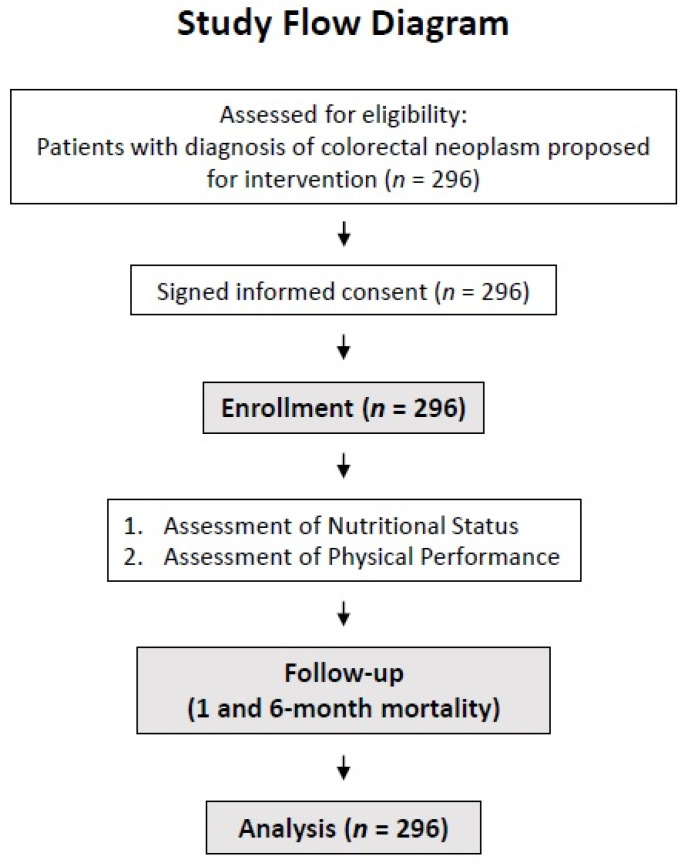
Introduction: Poor physical performance has been shown to be a good predictor of complications in some pathologies. The objective of our study was to evaluate, in patients with colorectal neoplasia prior to surgery, physical performance and its relationship with postoperative complications and in-hospital mortality, at 1 month and at 6 months. Methods: We conducted a prospective study on patients with preoperative colorectal neoplasia, between October 2018 and July 2021. Physical performance was evaluated using the Short Physical Performance Battery (SPPB) test and hand grip strength (HGS). For a decrease in physical performance, SPPB < 10 points or HGS below the EWGSOP2 cut-off points was considered. Nutritional status was evaluated using subjective global assessment (SGA). The prevalence of postoperative complications and mortality during admission, at 1 month, and at 6 months was evaluated. Results: A total of 296 patients, mean age 60.4 ± 12.8 years, 59.3% male, were evaluated. The mean BMI was 27.6 ± 5.1 kg/m2. The mean total SPPB score was 10.57 ± 2.07 points. A total of 69 patients presented a low SPPB score (23.3%). Hand grip strength showed a mean value of 33.1 ± 8.5 kg/m2 for men and 20.7 ± 4.3 kg/m2 for women. A total of 58 patients presented low HGS (19.6%). SGA found 40.2% (119) of patients with normal nourishment, 32.4% (96) with moderate malnutrition, and 27.4% (81) with severe malnutrition. Postoperative complications were more frequent in patients with a low SPPB score (60.3% vs. 38.6%; p = 0.002) and low HGS (64.9% vs. 39.3%, p = 0.001). A low SPPB test score (OR 2.57, 95% CI 1.37−4.79, p = 0.003) and low HGS (OR 2.69, 95% CI 1.37−5.29, p = 0.004) were associated with a higher risk of postoperative complications after adjusting for tumor stage and age. Patients with a low SPPB score presented an increase in in-hospital mortality (8.7% vs. 0.9%; p = 0.021), at 1 month (8.7% vs. 1.3%; p = 0.002) and at 6 months (13.1% vs. 2.2%, p < 0.001). Patients with low HGS presented an increase in mortality at 6 months (10.5% vs. 3.3%; p = 0.022). Conclusions: The decrease in physical performance, evaluated by the SPPB test or hand grip strength, was elevated in patients with colorectal cancer prior to surgery and was related to an increase in postoperative complications and mortality.
在某些疾病中,较差的身体表现已被证明是并发症的良好预测指标。我们的研究目的是评估术前结直肠肿瘤患者的身体表现及其与术后并发症和住院期间死亡率的关系,分别在术后 1 个月和 6 个月进行评估。
我们进行了一项前瞻性研究,纳入了 2018 年 10 月至 2021 年 7 月期间术前患有结直肠肿瘤的患者。使用简短身体表现电池(SPPB)测试和握力(HGS)评估身体表现。对于身体表现下降,SPPB < 10 分或 HGS 低于 EWGSOP2 截止点被认为是身体表现下降。使用主观整体评估(SGA)评估营养状况。评估术后并发症和住院期间、术后 1 个月和术后 6 个月的死亡率。
共评估了 296 名患者,平均年龄 60.4 ± 12.8 岁,59.3%为男性,平均 BMI 为 27.6 ± 5.1 kg/m2。总 SPPB 评分平均为 10.57 ± 2.07 分。共有 69 名患者 SPPB 评分较低(23.3%)。握力男性平均为 33.1 ± 8.5 kg/m2,女性为 20.7 ± 4.3 kg/m2。共有 58 名患者 HGS 较低(19.6%)。SGA 发现 40.2%(119 名)患者营养正常,32.4%(96 名)患者存在中度营养不良,27.4%(81 名)患者存在严重营养不良。低 SPPB 评分(60.3% vs. 38.6%;p = 0.002)和低 HGS 评分(64.9% vs. 39.3%;p = 0.001)的患者术后并发症更常见。低 SPPB 测试评分(OR 2.57,95% CI 1.37−4.79,p = 0.003)和低 HGS(OR 2.69,95% CI 1.37−5.29,p = 0.004)与术后并发症风险增加相关,调整肿瘤分期和年龄后。低 SPPB 评分患者住院期间死亡率增加(8.7% vs. 0.9%;p = 0.021),术后 1 个月(8.7% vs. 1.3%;p = 0.002)和术后 6 个月(13.1% vs. 2.2%,p < 0.001)。低 HGS 患者术后 6 个月死亡率增加(10.5% vs. 3.3%;p = 0.022)。
术前结直肠肿瘤患者的身体表现,通过 SPPB 测试或握力评估,下降幅度较大,与术后并发症和死亡率增加有关。