• 文献检索
  • 文档翻译
  • 深度研究
  • 学术资讯
  • Suppr Zotero 插件Zotero 插件
  • 邀请有礼
  • 套餐&价格
  • 历史记录
应用&插件
Suppr Zotero 插件Zotero 插件浏览器插件Mac 客户端Windows 客户端微信小程序
定价
高级版会员购买积分包购买API积分包
服务
文献检索文档翻译深度研究API 文档MCP 服务
关于我们
关于 Suppr公司介绍联系我们用户协议隐私条款
关注我们

Suppr 超能文献

核心技术专利:CN118964589B侵权必究
粤ICP备2023148730 号-1Suppr @ 2026

文献检索

告别复杂PubMed语法,用中文像聊天一样搜索,搜遍4000万医学文献。AI智能推荐,让科研检索更轻松。

立即免费搜索

文件翻译

保留排版,准确专业,支持PDF/Word/PPT等文件格式,支持 12+语言互译。

免费翻译文档

深度研究

AI帮你快速写综述,25分钟生成高质量综述,智能提取关键信息,辅助科研写作。

立即免费体验

铁(III)-单宁酸纳米颗粒对大鼠的全身毒性、遗传毒性及早期肝癌致癌性评估

Assessment of Systemic Toxicity, Genotoxicity, and Early Phase Hepatocarcinogenicity of Iron (III)-Tannic Acid Nanoparticles in Rats.

作者信息

Hlaing Chi Be, Chariyakornkul Arpamas, Pilapong Chalermchai, Punvittayagul Charatda, Srichairatanakool Somdet, Wongpoomchai Rawiwan

机构信息

Department of Biochemistry, Faculty of Medicine, Chiang Mai University, Chiang Mai 50200, Thailand.

Center of Excellence for Molecular Imaging (CEMI), Department of Radiologic Technology, Faculty of Associated Medical Sciences, Chiang Mai University, Chiang Mai 50200, Thailand.

出版信息

Nanomaterials (Basel). 2022 Mar 22;12(7):1040. doi: 10.3390/nano12071040.

DOI:10.3390/nano12071040
PMID:35407158
原文链接:https://pmc.ncbi.nlm.nih.gov/articles/PMC9000733/
Abstract

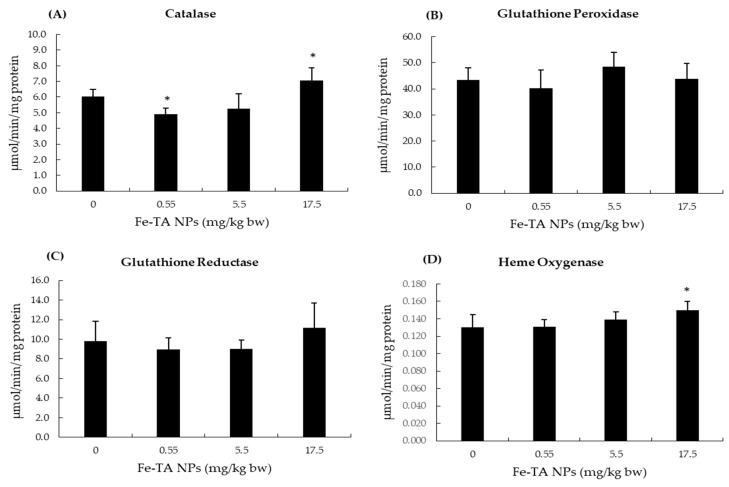
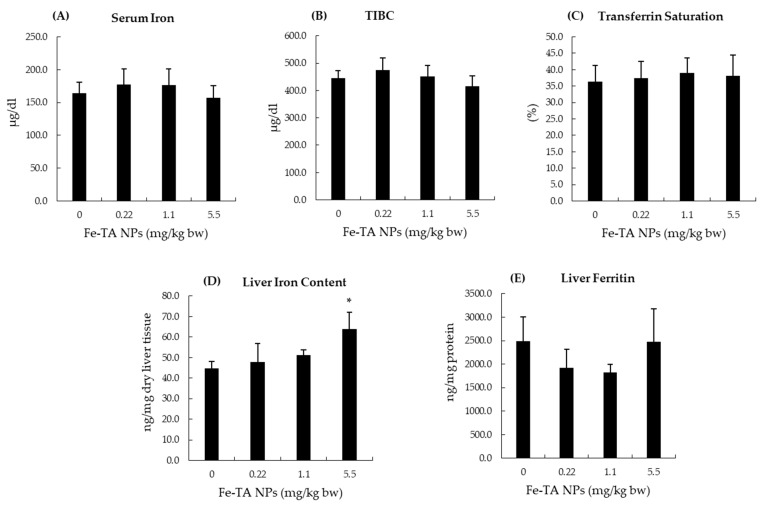
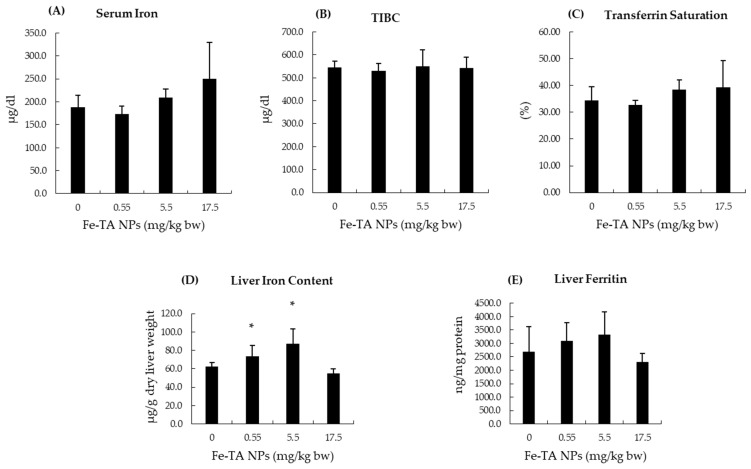
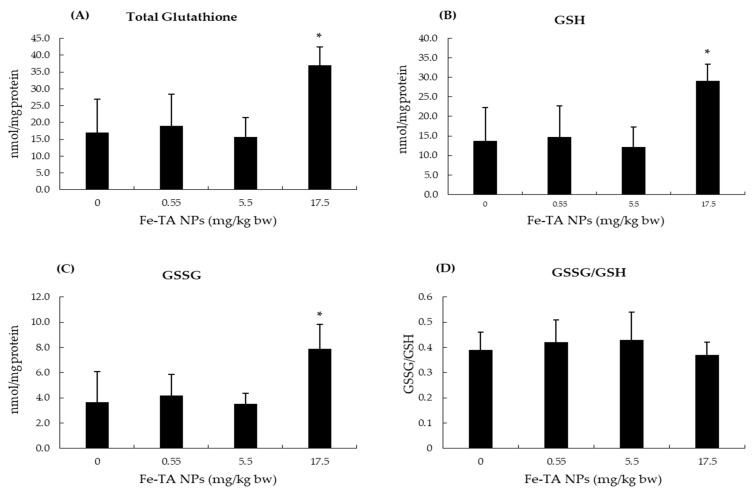
Iron-tannic acid nanoparticles (Fe-TA NPs) presented MRI contrast enhancement in both liver cancer cells and preneoplastic rat livers, while also exhibiting an anti-proliferative effect via enhanced autophagic death of liver cancer cells. Hence, a toxicity assessment of Fe-TA NPs was carried out in the present study. Acute and systemic toxicity of intraperitoneal Fe-TA NPs administration was investigated via a single dose of 55 mg/kg body weight (bw). Doses were then repeated 10 times within a range of 0.22 to 5.5 mg/kg bw every 3 days in rats. Furthermore, clastogenicity was assessed by rat liver micronucleus assay. Carcinogenicity was evaluated by medium-term carcinogenicity assay using glutathione -transferase placental form positive foci as a preneoplastic marker, while three doses ranging from 0.55 to 17.5 mg/kg bw were administered 10 times weekly via intraperitoneum. Our study found that the LD value of Fe-TA NPs was greater than 55 mg/kg bw. Repeated dose administration of Fe-TA NPs over a period of 28 days and 10 weeks revealed no obvious signs of systemic toxicity, clastogenicity, and hepatocarcinogenicity. Furthermore, Fe-TA NPs did not alter liver function or serum iron status, however, increased liver iron content at certain dose in rats. Notably, antioxidant response was observed when a dose of 17.5 mg/kg bw was given to rats. Accordingly, our study found no signs of toxicity, genotoxicity, and early phase hepatocarcinogenicity of Fe-TA NPs in rats.

摘要

铁-单宁酸纳米颗粒(Fe-TA NPs)在肝癌细胞和癌前大鼠肝脏中均表现出磁共振成像(MRI)对比增强作用,同时还通过增强肝癌细胞的自噬性死亡发挥抗增殖作用。因此,本研究对Fe-TA NPs进行了毒性评估。通过腹腔注射55 mg/kg体重(bw)的单剂量来研究腹腔注射Fe-TA NPs的急性和全身毒性。然后在大鼠中每3天以0.22至5.5 mg/kg bw的剂量重复给药10次。此外,通过大鼠肝脏微核试验评估致断裂性。使用胎盘型谷胱甘肽转移酶阳性灶作为癌前标志物,通过中期致癌性试验评估致癌性,同时每周通过腹腔注射给予0.55至17.5 mg/kg bw的三种剂量,共10次。我们的研究发现Fe-TA NPs的半数致死量(LD)值大于55 mg/kg bw。在28天和10周的时间内重复给药Fe-TA NPs未发现明显的全身毒性、致断裂性和肝癌致癌性迹象。此外,Fe-TA NPs未改变肝功能或血清铁状态,然而,在大鼠中某些剂量下会增加肝脏铁含量。值得注意的是,当给大鼠注射17.5 mg/kg bw的剂量时观察到了抗氧化反应。因此,我们的研究未发现Fe-TA NPs在大鼠中存在毒性 signs、遗传毒性和早期肝癌致癌性的迹象。
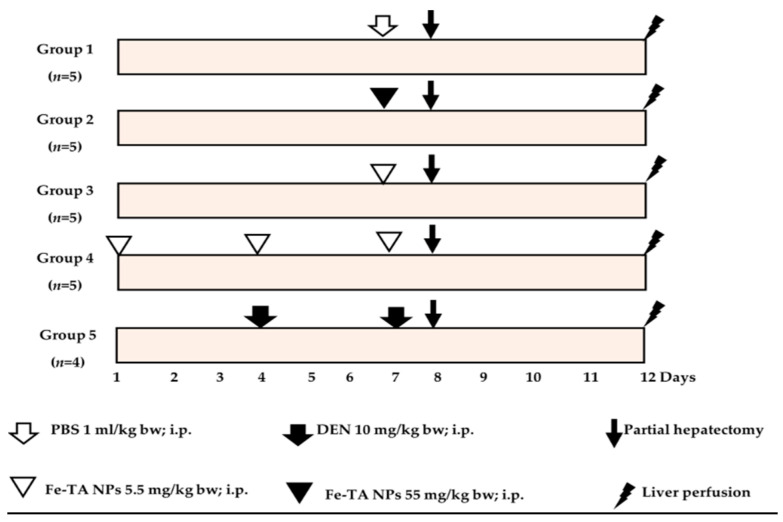
https://cdn.ncbi.nlm.nih.gov/pmc/blobs/c2b5/9000733/892f97119fd5/nanomaterials-12-01040-g005.jpg
https://cdn.ncbi.nlm.nih.gov/pmc/blobs/c2b5/9000733/798b672ef847/nanomaterials-12-01040-g001.jpg
https://cdn.ncbi.nlm.nih.gov/pmc/blobs/c2b5/9000733/8348af03bdcc/nanomaterials-12-01040-g002.jpg
https://cdn.ncbi.nlm.nih.gov/pmc/blobs/c2b5/9000733/f8942b430127/nanomaterials-12-01040-g003.jpg
https://cdn.ncbi.nlm.nih.gov/pmc/blobs/c2b5/9000733/ff1efd3e5d11/nanomaterials-12-01040-g004.jpg
https://cdn.ncbi.nlm.nih.gov/pmc/blobs/c2b5/9000733/892f97119fd5/nanomaterials-12-01040-g005.jpg
https://cdn.ncbi.nlm.nih.gov/pmc/blobs/c2b5/9000733/798b672ef847/nanomaterials-12-01040-g001.jpg
https://cdn.ncbi.nlm.nih.gov/pmc/blobs/c2b5/9000733/8348af03bdcc/nanomaterials-12-01040-g002.jpg
https://cdn.ncbi.nlm.nih.gov/pmc/blobs/c2b5/9000733/f8942b430127/nanomaterials-12-01040-g003.jpg
https://cdn.ncbi.nlm.nih.gov/pmc/blobs/c2b5/9000733/ff1efd3e5d11/nanomaterials-12-01040-g004.jpg
https://cdn.ncbi.nlm.nih.gov/pmc/blobs/c2b5/9000733/892f97119fd5/nanomaterials-12-01040-g005.jpg

相似文献

1
Assessment of Systemic Toxicity, Genotoxicity, and Early Phase Hepatocarcinogenicity of Iron (III)-Tannic Acid Nanoparticles in Rats.铁(III)-单宁酸纳米颗粒对大鼠的全身毒性、遗传毒性及早期肝癌致癌性评估
Nanomaterials (Basel). 2022 Mar 22;12(7):1040. doi: 10.3390/nano12071040.
2
MRI contrast enhancement of liver pre-neoplasia using iron-tannic nanoparticles.使用铁-单宁酸纳米颗粒对肝脏癌前病变进行MRI对比增强
RSC Adv. 2020 Sep 24;10(58):35419-35425. doi: 10.1039/d0ra07308c. eCollection 2020 Sep 21.
3
Effect of tannic acid-templated mesoporous silica nanoparticles on iron-induced oxidative stress and liver toxicity in rats.单宁酸模板介孔二氧化硅纳米颗粒对大鼠铁诱导的氧化应激和肝毒性的影响。
Toxicol Rep. 2021 Oct 1;8:1721-1728. doi: 10.1016/j.toxrep.2021.09.005. eCollection 2021.
4
Iron(III)-Tannic Molecular Nanoparticles Enhance Autophagy effect and T MRI Contrast in Liver Cell Lines.铁(III)-单宁酸分子纳米颗粒增强肝细胞系的自噬作用和 T1 MRI 对比。
Sci Rep. 2018 Apr 27;8(1):6647. doi: 10.1038/s41598-018-25108-1.
5
Characterization and cellular studies of molecular nanoparticle of iron (III)-tannic complexes; toward a low cost magnetic resonance imaging agent.铁(III)-单宁复合物分子纳米颗粒的表征及细胞研究;迈向低成本磁共振成像剂
Biointerphases. 2017 Jun 7;12(2):021005. doi: 10.1116/1.4985002.
6
Toxicity assessment of manganese oxide micro and nanoparticles in Wistar rats after 28 days of repeated oral exposure.锰氧化物微纳米颗粒重复经口染毒 28 天后对 Wistar 大鼠的毒性评价。
J Appl Toxicol. 2013 Oct;33(10):1165-79. doi: 10.1002/jat.2887. Epub 2013 May 24.
7
Early Detection of Hepatocarcinogenicity in Rats Using MRI with Ferric-Tannic Nanoparticles.使用铁单宁纳米颗粒的 MRI 技术早期检测大鼠肝癌。
Anal Chem. 2023 Jul 11;95(27):10241-10248. doi: 10.1021/acs.analchem.3c00541. Epub 2023 Jun 26.
8
NTP Toxicology and Carcinogenesis Studies of Coumarin (CAS No. 91-64-5) in F344/N Rats and B6C3F1 Mice (Gavage Studies).香豆素(CAS编号91-64-5)在F344/N大鼠和B6C3F1小鼠中的NTP毒理学和致癌性研究(灌胃研究)
Natl Toxicol Program Tech Rep Ser. 1993 Sep;422:1-340.
9
Toxicological evaluation of Oviductus ranae: Acute, sub-acute and genotoxicity studies in mice and rats.林蛙油的毒理学评价:小鼠和大鼠的急性、亚急性及遗传毒性研究
J Ethnopharmacol. 2017 May 5;203:101-109. doi: 10.1016/j.jep.2017.03.032. Epub 2017 Mar 22.
10
Genotoxicity assessment of cerium oxide nanoparticles in female Wistar rats after acute oral exposure.急性经口暴露后雌性Wistar大鼠中氧化铈纳米颗粒的遗传毒性评估
Mutat Res Genet Toxicol Environ Mutagen. 2014 Dec;775-776:7-19. doi: 10.1016/j.mrgentox.2014.09.009. Epub 2014 Oct 2.

引用本文的文献

1
Recent developments in cancer diagnosis and treatment using nanotechnology.利用纳米技术进行癌症诊断与治疗的最新进展。
Ann Med Surg (Lond). 2024 Jun 17;86(8):4541-4554. doi: 10.1097/MS9.0000000000002271. eCollection 2024 Aug.
2
Nanotechnology in Cancer Diagnosis and Treatment.癌症诊断与治疗中的纳米技术
Pharmaceutics. 2023 Mar 22;15(3):1025. doi: 10.3390/pharmaceutics15031025.
3
Iron(III)-Quercetin Complexes' Safety for MRI Cell Tracking in Cell Therapy Applications: Cytotoxic and Genotoxic Assessment.铁(III)-槲皮素复合物在细胞治疗应用中用于MRI细胞追踪的安全性:细胞毒性和遗传毒性评估

本文引用的文献

1
MRI contrast enhancement of liver pre-neoplasia using iron-tannic nanoparticles.使用铁-单宁酸纳米颗粒对肝脏癌前病变进行MRI对比增强
RSC Adv. 2020 Sep 24;10(58):35419-35425. doi: 10.1039/d0ra07308c. eCollection 2020 Sep 21.
2
Pharmacokinetic/Pharmacodynamic Determinations of Iron-tannic Molecular Nanoparticles with its Implication in MR Imaging and Enhancement of Liver Clearance.铁单宁分子纳米颗粒的药代动力学/药效学测定及其在磁共振成像和肝脏清除增强中的应用。
Nanotheranostics. 2022 Jan 1;6(2):195-204. doi: 10.7150/ntno.63310. eCollection 2022.
3
Metal-phenolic networks for cancer theranostics.
Nanomaterials (Basel). 2022 Aug 13;12(16):2776. doi: 10.3390/nano12162776.
金属-酚醛网络用于癌症治疗。
Biomater Sci. 2021 Apr 21;9(8):2825-2849. doi: 10.1039/d0bm02064h. Epub 2021 Mar 10.
4
Global Cancer Statistics 2020: GLOBOCAN Estimates of Incidence and Mortality Worldwide for 36 Cancers in 185 Countries.《全球癌症统计数据 2020:全球 185 个国家和地区 36 种癌症的发病率和死亡率估计》。
CA Cancer J Clin. 2021 May;71(3):209-249. doi: 10.3322/caac.21660. Epub 2021 Feb 4.
5
Low-dose ionizing radiation as a hormetin: experimental observations and therapeutic perspective for age-related disorders.低剂量电离辐射作为一种赫美汀:与年龄相关疾病的实验观察和治疗前景。
Biogerontology. 2021 Apr;22(2):145-164. doi: 10.1007/s10522-020-09908-5. Epub 2021 Jan 9.
6
Progress of Cancer Nanotechnology as Diagnostics, Therapeutics, and Theranostics Nanomedicine: Preclinical Promise and Translational Challenges.癌症纳米技术作为诊断、治疗和诊疗一体化纳米医学的进展:临床前前景与转化挑战
Pharmaceutics. 2020 Dec 24;13(1):24. doi: 10.3390/pharmaceutics13010024.
7
Organ-specific toxicity of magnetic iron oxide-based nanoparticles.基于磁性氧化铁的纳米颗粒的器官特异性毒性。
Nanotoxicology. 2021 Mar;15(2):167-204. doi: 10.1080/17435390.2020.1842934. Epub 2020 Nov 20.
8
Nanoparticle Toxicology.纳米颗粒毒理学。
Annu Rev Pharmacol Toxicol. 2021 Jan 6;61:269-289. doi: 10.1146/annurev-pharmtox-032320-110338. Epub 2020 Aug 25.
9
Nanocarrier-Based Therapeutics and Theranostics Drug Delivery Systems for Next Generation of Liver Cancer Nanodrug Modalities.基于纳米载体的治疗学和治疗药物传递系统用于下一代肝癌纳米药物模式。
Int J Nanomedicine. 2020 Mar 3;15:1437-1456. doi: 10.2147/IJN.S236927. eCollection 2020.
10
Biphasic Dose-Response Induced by Phytochemicals: Experimental Evidence.植物化学物质诱导的双相剂量反应:实验证据
J Clin Med. 2020 Mar 6;9(3):718. doi: 10.3390/jcm9030718.