Zhou Hualu, McClements David Julian
Biopolymers and Colloids Laboratory, Department of Food Science, University of Massachusetts, Amherst, MA 01003, USA.
Nanomaterials (Basel). 2022 Mar 27;12(7):1099. doi: 10.3390/nano12071099.
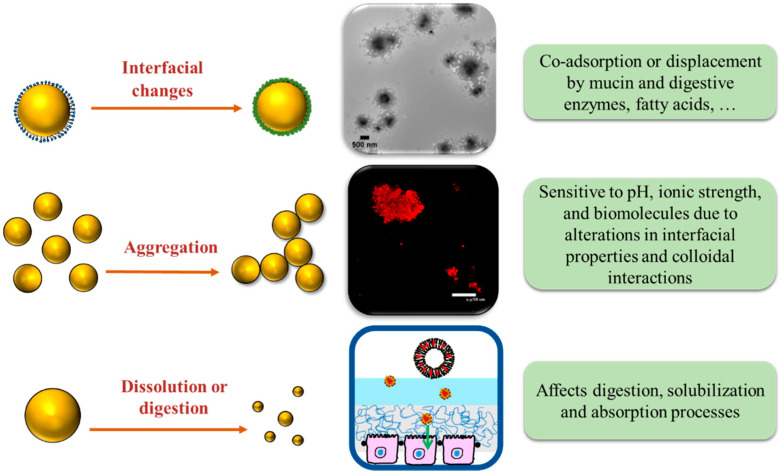
Inorganic or organic nanoparticles are often incorporated into foods to enhance their quality, stability, nutrition, or safety. When they pass through the gastrointestinal environment, the properties of these nanoparticles are altered, which impacts their biological effects and potential toxicity. Consequently, there is a need to understand how different kinds of nanoparticles behave within the gastrointestinal tract. In this article, the current understanding of the gastrointestinal fate of nanoparticles in foods is reviewed. Initially, the fundamental physicochemical and structural properties of nanoparticles are discussed, including their compositions, sizes, shapes, and surface chemistries. Then, the impact of food matrix effects and gastrointestinal environments on the fate of ingested nanoparticles is discussed. In particular, the influence of nanoparticle properties on food digestion and nutraceutical bioavailability is highlighted. Finally, future research directions are highlighted that will enable the successful utilization of nanotechnology in foods while also ensuring they are safe.
无机或有机纳米颗粒常被添加到食品中,以提高其品质、稳定性、营养性或安全性。当它们通过胃肠道环境时,这些纳米颗粒的性质会发生改变,这会影响它们的生物学效应和潜在毒性。因此,有必要了解不同种类的纳米颗粒在胃肠道内的行为。本文综述了目前对食品中纳米颗粒胃肠道命运的认识。首先,讨论了纳米颗粒的基本物理化学和结构性质,包括它们的组成、大小、形状和表面化学性质。然后,讨论了食品基质效应和胃肠道环境对摄入纳米颗粒命运的影响。特别强调了纳米颗粒性质对食物消化和营养保健品生物利用度的影响。最后,强调了未来的研究方向,这将使纳米技术在食品中得到成功应用,同时确保食品的安全性。