Lima Thais S M, Souza Wanderson, Geaquinto Luths R O, Sanches Priscila L, Stepień Ewa L, Meneses João, Fernández-de Gortari Eli, Meisner-Kober Nicole, Himly Martin, Granjeiro José M, Ribeiro Ana R
Directory of Life Sciences Applied Metrology, National Institute of Metrology Quality and Technology, Rio de Janeiro 25250-020, Brazil.
Postgraduate Program in Biotechnology, National Institute of Metrology Quality and Technology, Rio de Janeiro 25250-020, Brazil.
Nanomaterials (Basel). 2022 Apr 6;12(7):1231. doi: 10.3390/nano12071231.
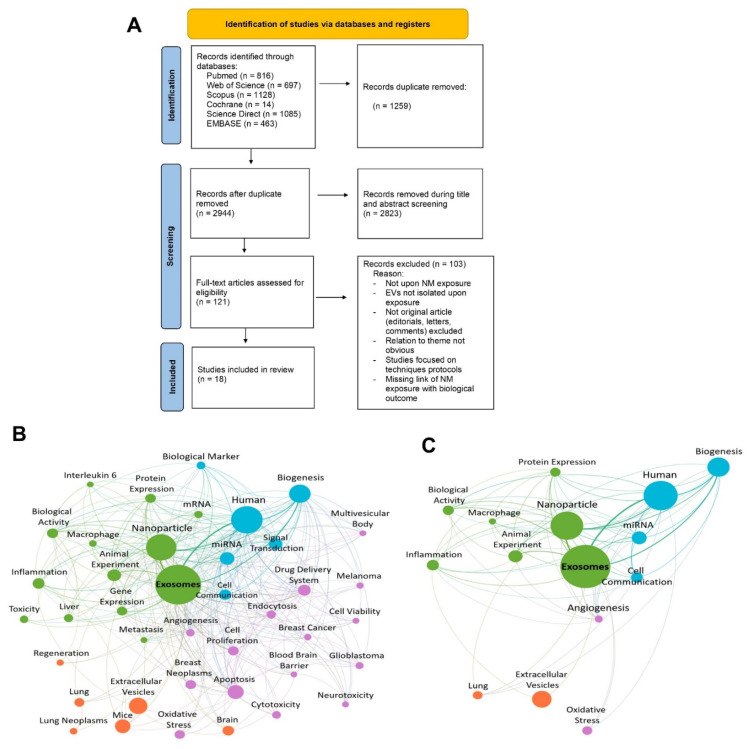
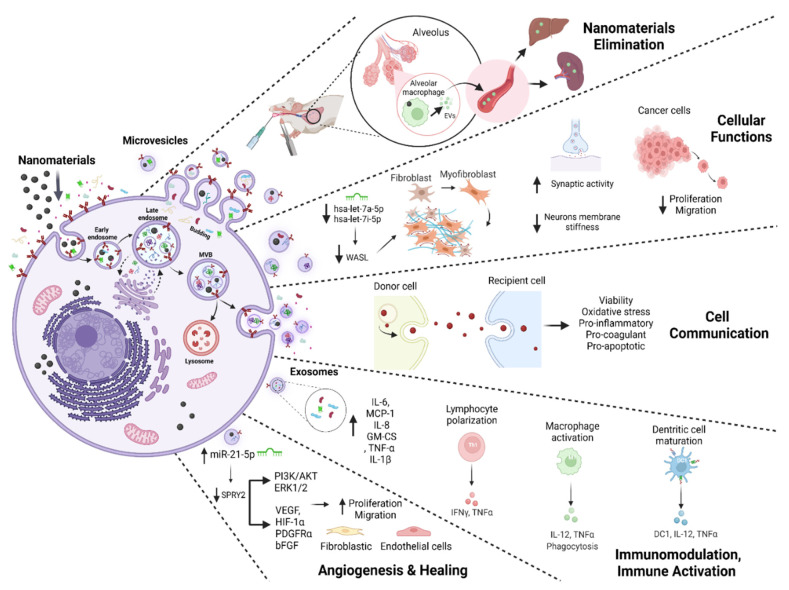
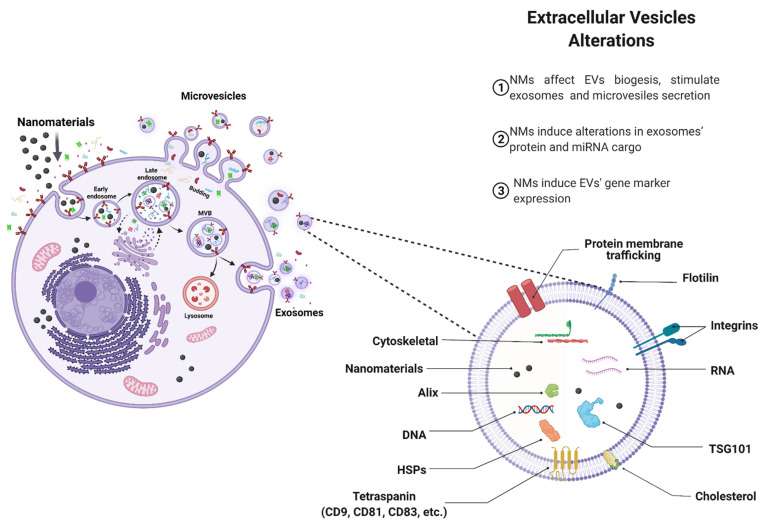
The progressively increasing use of nanomaterials (NMs) has awakened issues related to nanosafety and its potential toxic effects on human health. Emerging studies suggest that NMs alter cell communication by reshaping and altering the secretion of extracellular vesicles (EVs), leading to dysfunction in recipient cells. However, there is limited understanding of how the physicochemical characteristics of NMs alter the EV content and their consequent physiological functions. Therefore, this review explored the relevance of EVs in the nanotoxicology field. The current state of the art on how EVs are modulated by NM exposure and the possible regulation and modulation of signaling pathways and physiological responses were assessed in detail. This review followed the manual for reviewers produced by The Joanna Brigs Institute for Scoping Reviews and the PRISMA extension for Scoping Reviews (PRISMA-ScR): checklist and explanation. The research question, "Do NMs modulate cellular responses mediated by EVs?" was analyzed following the PECO model (P (Population) = EVs, E (Exposure) = NMs, C (Comparator) = EVs without exposure to NMs, O (Outcome) = Cellular responses/change in EVs) to help methodologically assess the association between exposure and outcome. For each theme in the PECO acronym, keywords were defined, organized, and researched in PubMed, Science Direct, Scopus, Web of Science, EMBASE, and Cochrane databases, up to 30 September 2021. In vitro, in vivo, ex vivo, and clinical studies that analyzed the effect of NMs on EV biogenesis, cargo, and cellular responses were included in the analysis. The methodological quality assessment was conducted using the ToxRTool, ARRIVE guideline, Newcastle Ottawa and the EV-TRACK platform. The search in the referred databases identified 2944 articles. After applying the eligibility criteria and two-step screening, 18 articles were included in the final review. We observed that depending on the concentration and physicochemical characteristics, specific NMs promote a significant increase in EV secretion as well as changes in their cargo, especially regarding the expression of proteins and miRNAs, which, in turn, were involved in biological processes that included cell communication, angiogenesis, and activation of the immune response, etc. Although further studies are necessary, this work suggests that molecular investigations on EVs induced by NM exposure may become a potential tool for toxicological studies since they are widely accessible biomarkers that may form a bridge between NM exposure and the cellular response and pathological outcome.
纳米材料(NMs)的使用日益增加,引发了与纳米安全性及其对人类健康潜在毒性影响相关的问题。新兴研究表明,纳米材料通过重塑和改变细胞外囊泡(EVs)的分泌来改变细胞通讯,从而导致受体细胞功能障碍。然而,对于纳米材料的物理化学特性如何改变细胞外囊泡的内容物及其相应的生理功能,人们的了解还很有限。因此,本综述探讨了细胞外囊泡在纳米毒理学领域的相关性。详细评估了纳米材料暴露对细胞外囊泡的调节作用以及信号通路和生理反应的可能调节情况的当前研究现状。本综述遵循了乔安娜·布里格斯循证综述机构制定的综述撰写手册以及循证综述的系统评价和Meta分析扩展版(PRISMA-ScR):清单及解释。按照PECO模型(P(总体)=细胞外囊泡,E(暴露)=纳米材料,C(对照)=未暴露于纳米材料的细胞外囊泡,O(结果)=细胞反应/细胞外囊泡变化)分析了研究问题“纳米材料是否调节由细胞外囊泡介导的细胞反应?”,以帮助从方法学上评估暴露与结果之间的关联。对于PECO首字母缩写中的每个主题,在PubMed、Science Direct、Scopus、Web of Science、EMBASE和Cochrane数据库中定义、组织并研究了关键词,截至2021年9月30日。分析纳米材料对细胞外囊泡生物发生(即细胞外囊泡的产生过程)、货物(即细胞外囊泡内部包含的各种物质,如蛋白质、核酸等)和细胞反应影响的体外、体内、离体和临床研究都纳入了分析。使用ToxRTool、ARRIVE指南、纽卡斯尔渥太华量表和EV-TRACK平台进行方法学质量评估。在所提及的数据库中搜索到2944篇文章。应用纳入标准并经过两步筛选后,最终综述纳入了18篇文章。我们观察到,根据浓度和物理化学特性,特定的纳米材料会促使细胞外囊泡分泌显著增加,其货物也会发生变化,尤其是蛋白质和微小RNA(miRNAs)的表达,这些蛋白质和微小RNA又参与了包括细胞通讯、血管生成和免疫反应激活等在内的生物学过程。尽管还需要进一步研究,但这项工作表明,对纳米材料暴露诱导的细胞外囊泡进行分子研究可能成为毒理学研究的潜在工具,因为它们是广泛可获取的生物标志物,可能在纳米材料暴露与细胞反应及病理结果之间架起一座桥梁。