Division of Molecular and Medical Genetics, Center for Gene and Cell Therapy, The Institute of Medical Science, University of Tokyo, Minato-ku 108-8639, Tokyo, Japan.
Administrative Section of Radiation Protection, National Institute of Neuroscience, National Center of Neurology and Psychiatry, Kodaira 187-8551, Tokyo, Japan.
Int J Mol Sci. 2022 Jun 9;23(12):6480. doi: 10.3390/ijms23126480.
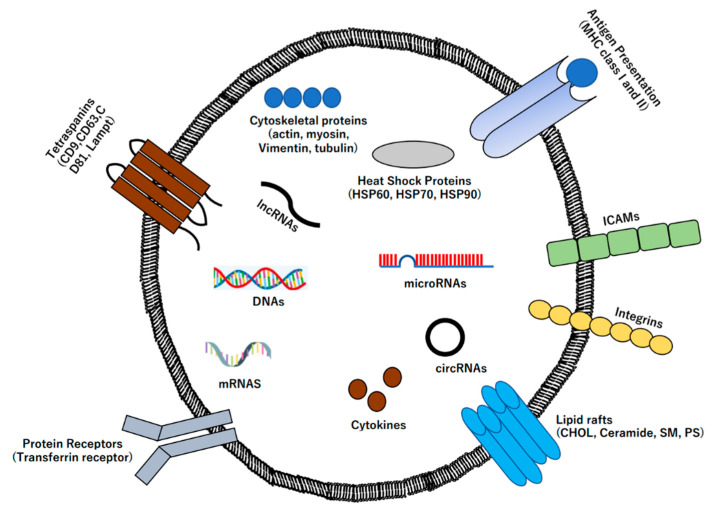
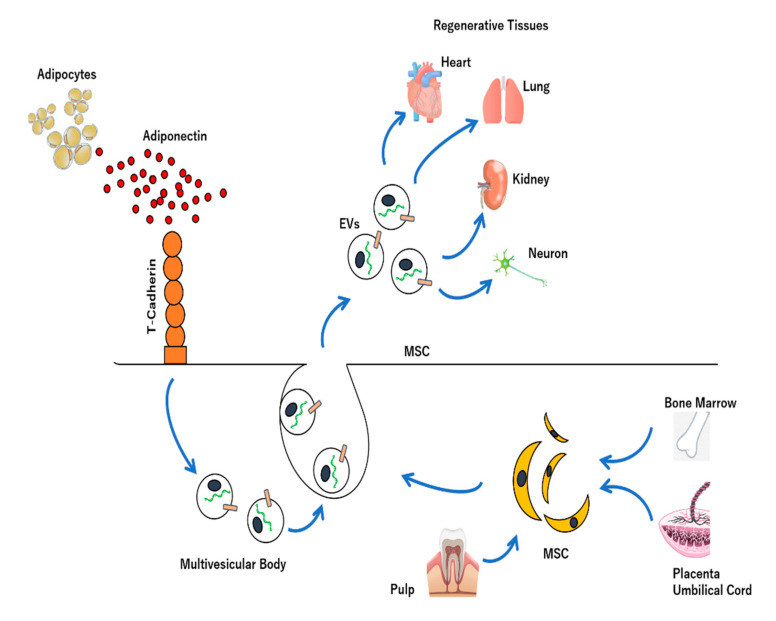
Extracellular vesicles (EVs) are lipid bilayer membrane particles that play critical roles in intracellular communication through EV-encapsulated informative content, including proteins, lipids, and nucleic acids. Mesenchymal stem cells (MSCs) are pluripotent stem cells with self-renewal ability derived from bone marrow, fat, umbilical cord, menstruation blood, pulp, etc., which they use to induce tissue regeneration by their direct recruitment into injured tissues, including the heart, liver, lung, kidney, etc., or secreting factors, such as or insulin-like growth factor. Recently, MSC-derived EVs have been shown to have regenerative effects against various diseases, partially due to the post-transcriptional regulation of target genes by miRNAs. Furthermore, EVs have garnered attention as novel drug delivery systems, because they can specially encapsulate various target molecules. In this review, we summarize the regenerative effects and molecular mechanisms of MSC-derived EVs.
细胞外囊泡(EVs)是脂质双层膜颗粒,通过 EV 包裹的信息内容(包括蛋白质、脂质和核酸)在细胞内通讯中发挥关键作用。间充质干细胞(MSCs)是多能干细胞,具有自我更新能力,来源于骨髓、脂肪、脐带、月经血、牙髓等,它们通过直接招募到受损组织中,包括心脏、肝脏、肺、肾脏等,或分泌因子,如胰岛素样生长因子,来诱导组织再生。最近,MSC 衍生的 EV 已被证明对各种疾病具有再生作用,部分原因是 miRNA 对靶基因的转录后调控。此外,EV 作为新型药物递送系统受到关注,因为它们可以专门包裹各种靶分子。在这篇综述中,我们总结了 MSC 衍生的 EV 的再生作用和分子机制。