Center for Thrombosis and Hemostasis, University Medical Center Mainz, D-55131 Mainz, Germany.
Aix Marseille University, INSERM 1263, Institut National de la Recherche pour l'Agriculture, l'alimentation et l'Environnement (INRAE) 1260, Center for CardioVascular and Nutrition Research (C2VN), F-13380 Marseille, France.
Int J Mol Sci. 2021 Aug 27;22(17):9317. doi: 10.3390/ijms22179317.
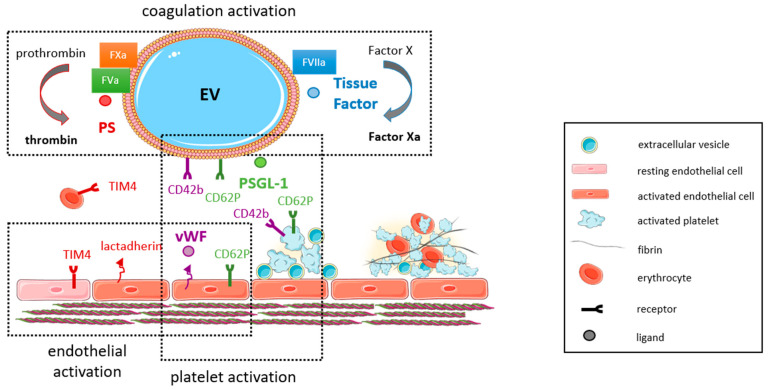
Extracellular vesicles (EVs) compose a heterogenous group of membrane-derived particles, including exosomes, microvesicles and apoptotic bodies, which are released into the extracellular environment in response to proinflammatory or proapoptotic stimuli. From earlier studies suggesting that EV shedding constitutes a cellular clearance mechanism, it has become evident that EV formation, secretion and uptake represent important mechanisms of intercellular communication and exchange of a wide variety of molecules, with relevance in both physiological and pathological situations. The putative role of EVs in hemostasis and thrombosis is supported by clinical and experimental studies unraveling how these cell-derived structures affect clot formation (and resolution). From those studies, it has become clear that the prothrombotic effects of EVs are not restricted to the exposure of tissue factor (TF) and phosphatidylserines (PS), but also involve multiplication of procoagulant surfaces, cross-linking of different cellular players at the site of injury and transfer of activation signals to other cell types. Here, we summarize the existing and novel clinical and experimental evidence on the role and function of EVs during arterial and venous thrombus formation and how they may be used as biomarkers as well as therapeutic vectors.
细胞外囊泡 (EVs) 是一组异质性的膜衍生颗粒,包括外泌体、微泡和凋亡小体,它们在受到促炎或促凋亡刺激时被释放到细胞外环境中。早期的研究表明,EV 的脱落构成了一种细胞清除机制,现在已经很明显,EV 的形成、分泌和摄取代表了细胞间通讯和广泛的分子交换的重要机制,在生理和病理情况下都具有相关性。EV 在止血和血栓形成中的潜在作用得到了临床和实验研究的支持,这些研究揭示了这些细胞来源的结构如何影响血栓形成(和溶解)。从这些研究中可以清楚地看出,EV 的促血栓形成作用不仅限于组织因子 (TF) 和磷脂酰丝氨酸 (PS) 的暴露,还涉及促凝表面的增殖、损伤部位不同细胞成分的交联以及激活信号向其他细胞类型的传递。在这里,我们总结了关于 EV 在动脉和静脉血栓形成过程中的作用和功能的现有和新的临床和实验证据,以及它们如何可用作生物标志物和治疗载体。