Jiang Li, Liu Jiyan
Department of Biotherapy, The State Key Laboratory of Biotherapy, West China Hospital, Sichuan University, Chengdu, Sichuan 610041, P.R. China.
Oncol Lett. 2022 May;23(5):165. doi: 10.3892/ol.2022.13285. Epub 2022 Mar 28.
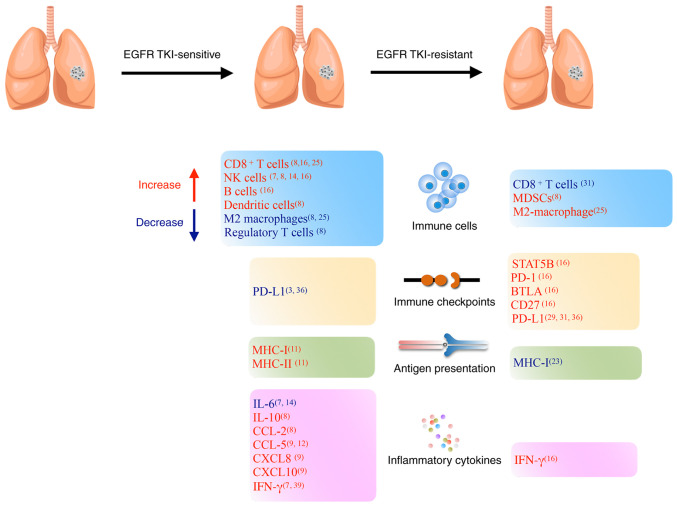
Acquired resistance to tyrosine kinase inhibitors (TKIs) limits the duration of antitumor effects and impairs the survival of patients with oncogene-driven non-small cell lung cancer (NSCLC). At present, little is known about the immunomodulatory ability of TKIs during the entire treatment period, including the drug-sensitive and drug-resistant periods. The present review aimed to comprehensively explore the dynamic changes in the tumor microenvironment (TME) during TKI treatment in NSCLC. Previous clinical and preclinical studies from medical and health databases related to NSCLC are reviewed. During the response period, cytotoxic immune cells accumulate in the TME and contribute to the formation of an inflammatory microenvironment. During the resistance period, the number of immunosuppressive cells increases, as does the expression of immune checkpoint proteins, which are critical mechanisms for tumor progression. The combination of targeted therapy and immunotherapy has been explored in multiple studies, and preliminary data showed controversial results. Extensive studies are needed to confirm the criteria of the selected patient subgroups and the toxicity profiles of EGFR TKIs and immune checkpoint inhibitors (ICIs). At present, the reagents targeting other immune cells, cytokines and related pathways remain underexplored compared with the revolutionary effect of ICIs in lung cancer. In the future, the precisely selected regimens for combination treatment should be further investigated in carefully designed xenograft models and clinical trials.
对酪氨酸激酶抑制剂(TKIs)产生的获得性耐药限制了抗肿瘤效应的持续时间,并损害了致癌基因驱动的非小细胞肺癌(NSCLC)患者的生存期。目前,对于TKIs在整个治疗期间(包括药物敏感和耐药期)的免疫调节能力知之甚少。本综述旨在全面探讨NSCLC患者接受TKI治疗期间肿瘤微环境(TME)的动态变化。对医学和健康数据库中与NSCLC相关的既往临床和临床前研究进行了综述。在反应期,细胞毒性免疫细胞在TME中积聚,并有助于形成炎症微环境。在耐药期,免疫抑制细胞数量增加,免疫检查点蛋白的表达也增加,这是肿瘤进展的关键机制。多项研究探讨了靶向治疗与免疫治疗的联合应用,初步数据显示结果存在争议。需要进行广泛的研究,以确认所选患者亚组的标准以及表皮生长因子受体酪氨酸激酶抑制剂(EGFR TKIs)和免疫检查点抑制剂(ICIs)的毒性特征。目前,与ICIs在肺癌中的革命性作用相比,针对其他免疫细胞、细胞因子和相关途径的试剂仍未得到充分研究。未来,应在精心设计的异种移植模型和临床试验中进一步研究精确选择的联合治疗方案。