Instituto de Psiquiatria, Universidade Federal do Rio de Janeiro, Rio de Janeiro, Brazil.
Transl Psychiatry. 2022 Apr 16;12(1):162. doi: 10.1038/s41398-022-01927-9.
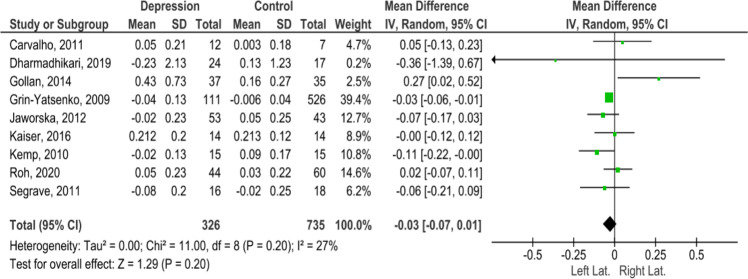
From a neurobiological perspective, diverse studies have associated emotional regulation with cognitive deficits. Structural and/or metabolic changes in the frontal cortex are often inferred from dysfunction in cognitive-emotional processing. In addition, electroencephalographic findings support the idea that alpha band oscillations are responses to these same processes. Thus, the objective of this meta-analytical literature review is to verify whether the possible hemispheric lateralization attributed to frontal alpha asymmetry (FAA) correlates with emotional regulation and the cognitive deficits underlying depression. The data included in our meta-analysis are from articles published from 2009 to July 2020, which utilized DSM or ICD criteria to diagnose depression or anxiety disorders and included a control group. For statistical analysis, the measurements obtained through the 10-20 electroencephalography system were used. The frontal alpha asymmetry index was calculated from the difference between the logarithm of the absolute spectral values in the alpha rhythm observed from the F4 and F3 electrodes that were fixed to the scalp of the frontal region of the right and left hemispheres (ln µV² RH-ln µV² LH) = (F4-F3). Eighteen articles were included in the systematic review. Of these, 9 were homogeneous enough for statistical analyses (total N: 1061; N: 326; N: 735). Nine others could not be statistically analyzed due to the absence of FAA measurements from the F4 and F3 electrodes. A random effects meta-analysis revealed low heterogeneity (Qt = 11,00, df = 8, p = 0.20, I = 27%) and an average effect size of the studies equal to -0.03 (CI = [-0.07 to 0.01]). The results, although not significant, suggested a slight tendency toward left lateralization in the depression group. Although the effects shown in these data did not confirm hemispherical lateralization in depressed patients, it was found that emotional regulation and cognitive processes share similar neural circuits. Therefore, future research on this complex relationship is encouraged, especially studies that are focused on the search for quantitative biological markers in depression.
从神经生物学的角度来看,许多研究将情绪调节与认知缺陷联系起来。额皮质的结构和/或代谢变化通常是从认知-情绪加工功能障碍推断出来的。此外,脑电图研究结果支持这样一种观点,即α波段振荡是对这些相同过程的反应。因此,本文献综述的目的是验证前额α不对称(FAA)的可能偏侧化是否与情绪调节和抑郁相关的认知缺陷相关。我们的元分析中包含的数据分析来自于 2009 年至 2020 年 7 月期间发表的文章,这些文章使用 DSM 或 ICD 标准诊断抑郁症或焦虑症,并包括对照组。为了进行统计分析,使用通过 10-20 脑电图系统获得的测量值。前额α不对称指数是通过计算固定在右半球和左半球额区头皮上的 F4 和 F3 电极处观察到的α节律的绝对谱值的对数之间的差异得出的(lnµV²RH-lnµV²LH)=(F4-F3)。18 篇文章被纳入系统综述。其中,9 篇文章具有足够的同质性进行统计分析(总 N:1061;N:326;N:735)。另外 9 篇文章由于缺少 F4 和 F3 电极的 FAA 测量值而无法进行统计学分析。随机效应元分析显示异质性较低(Qt=11.00,df=8,p=0.20,I=27%),研究的平均效应大小等于-0.03(CI=[-0.07 到 0.01])。虽然结果不显著,但表明抑郁组有轻微的左侧化倾向。虽然这些数据中显示的影响并没有证实抑郁患者的半球偏侧化,但发现情绪调节和认知过程共享相似的神经回路。因此,鼓励对这种复杂关系进行进一步研究,特别是针对抑郁症中定量生物学标志物的研究。