Trunfio Mattia, Richiardi Lorenzo, Alladio Francesca, Staffilano Elena, Longo Bianca, Venuti Francesco, Ghisetti Valeria, Burdino Elisa, Bonora Stefano, Vineis Paolo, Di Perri Giovanni, Calcagno Andrea
Infectious Diseases Unit, Amedeo di Savoia Hospital, Department of Medical Sciences, University of Turin, Turin, Italy.
Cancer Epidemiology Unit, Department of Medical Sciences, University of Turin, Turin, Italy.
Front Microbiol. 2022 Apr 1;13:829393. doi: 10.3389/fmicb.2022.829393. eCollection 2022.
Identifying determinants of the novel severe acute respiratory syndrome coronavirus-2 (SARS-CoV-2) transmission in settings of contagion is fundamental to inform containment strategies. We assessed SARS-CoV-2 cycle threshold value (Ct) from the first diagnostic nasal-pharyngeal swab of symptomatic index cases and which demographic or clinical characteristics among cases and contacts are associated with transmission risk within households.
This is a retrospective prevalence study on secondary SARS-CoV-2 cases (SC) among the household contacts of symptomatic adult index cases randomly sampled from all the SARS-CoV-2-positive diagnostic nasopharyngeal swabs analyzed at our regional referral hospital (Amedeo di Savoia Hospital, Turin, Italy) in March, 2020. Index cases underwent a telephone survey to collect their demographic and clinical data and all their household contacts. The Ct value of RdRp gene from the first diagnostic swab of index cases was recorded and index cases were grouped according to Ct tertiles (A < first tertile, first ≤ B ≤ second tertile, C ≥ second tertile). analysis was performed in SC as well as contacts that did not undergo SARS-CoV-2 testing but developed compatible signs and symptoms. Non-parametric tests and generalized linear models were run.
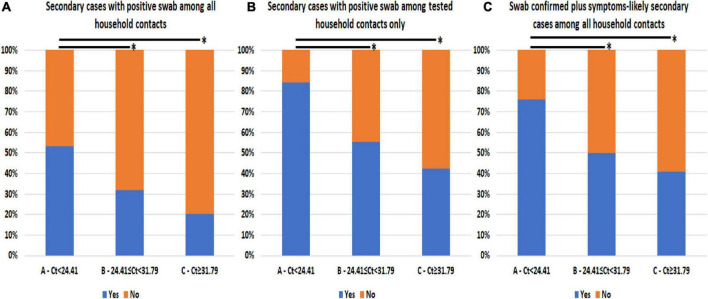
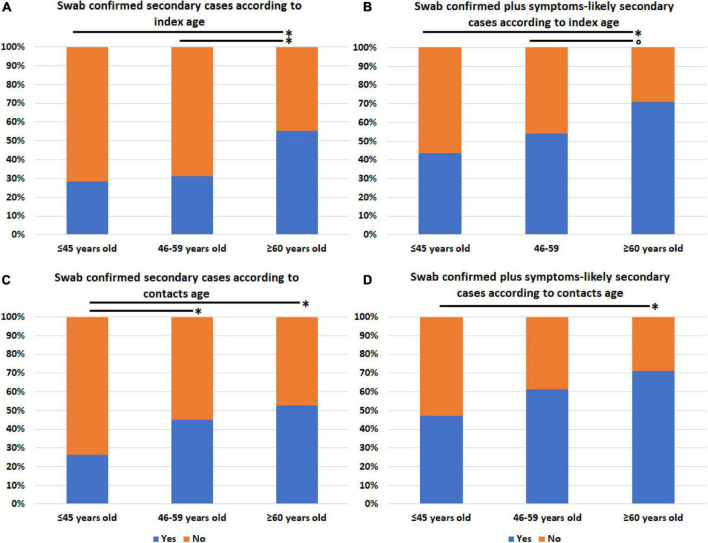
Index ( = 72) and contact ( = 164) median age was 54 (48-63) and 32 (20-56) years, respectively. A total of 60, 50, and 54 subjects were contacts of group A, B, and C index cases, respectively; 35.9% of contacts were SC. Twenty-four further subjects (14.6%) met the criteria for symptom-based likely positive SC. The secondary attack rate was 36.0% (28.6-43.4), assuming a mean incubation period of 5 days and a maximum infectious period of 20 days. SC prevalence differed between Ct groups (53.3% A, 32.0% B, 20.4% C; < 0.001). No difference in SC was found according to sex, presence of signs/symptoms, and COVID-19 severity of index cases, or according to contacts' sex and number per household. The age of both index cases [aOR 4.52 (1.2-17.0) for 60 vs. ≤45 years old] and contacts [aOR 3.66 (1.3-10.6) for 60 vs. ≤45years old] and the Ct of the index [aOR 0.17 (0.07-0.4) for Ct ≥ 31.8 vs. Ct < 24.4] independently associated with SC risk. Sensitivity analysis including symptoms-based likely positive SC supported all the previous results.
In confined transmission settings such as households, PCR Ct values may inform on the contagiousness of infected subjects and age may modulate transmission/contagion risk.
确定新型严重急性呼吸综合征冠状病毒2(SARS-CoV-2)在传染环境中的传播决定因素对于制定防控策略至关重要。我们评估了有症状的索引病例首次诊断性鼻咽拭子的SARS-CoV-2循环阈值(Ct),以及病例和接触者中的哪些人口统计学或临床特征与家庭内传播风险相关。
这是一项关于2020年3月在我们地区转诊医院(意大利都灵阿梅代奥·迪·萨沃亚医院)分析的所有SARS-CoV-2阳性诊断鼻咽拭子中随机抽取的有症状成年索引病例的家庭接触者中的继发性SARS-CoV-2病例(SC)的回顾性患病率研究。索引病例接受电话调查以收集其人口统计学和临床数据以及所有家庭接触者。记录索引病例首次诊断拭子中RdRp基因的Ct值,并根据Ct三分位数对索引病例进行分组(A<第一个三分位数,第一个三分位数≤B≤第二个三分位数,C≥第二个三分位数)。对SC以及未进行SARS-CoV-2检测但出现相符体征和症状的接触者进行了分析。进行了非参数检验和广义线性模型分析。
索引病例(n = 72)和接触者(n = 164)的中位年龄分别为54(48 - 63)岁和32(20 - 56)岁。分别有60、50和54名受试者是A、B和C组索引病例的接触者;35.9%的接触者为SC。另有24名受试者(14.6%)符合基于症状的可能阳性SC标准。假设平均潜伏期为5天,最大传染期为20天,继发感染率为36.0%(28.6 - 43.4)。SC患病率在Ct组之间存在差异(A组为53.3%,B组为32.0%,C组为20.4%;P<0.001)。根据索引病例的性别、体征/症状的存在情况、COVID-19严重程度,或根据接触者的性别和每户人数,在SC中未发现差异。索引病例的年龄[60岁与≤45岁相比,调整后比值比(aOR)为4.52(1.2 - 17.0)]和接触者的年龄[60岁与≤45岁相比,aOR为3.66(1.3 - 10.6)]以及索引病例的Ct值[Ct≥31.8与Ct<24.4相比,aOR为0.17(0.07 - 0.4)]与SC风险独立相关。包括基于症状的可能阳性SC的敏感性分析支持了所有先前的结果。
在家庭等封闭传播环境中,PCR Ct值可反映受感染个体的传染性,年龄可能调节传播/传染风险。