Bardelli Serena, Del Corso Giulio, Ciantelli Massimiliano, Del Pistoia Marta, Lorenzoni Francesca, Fossati Nicoletta, Scaramuzzo Rosa T, Cuttano Armando
Centro di Formazione e Simulazione Neonatale "NINA," U.O. Neonatologia, Dipartimento Materno-Infantile, AOUP, Pisa, Italy.
Department of Mathematics, Gran Sasso Science Institute (GSSI), L'Aquila, Italy.
Front Pediatr. 2022 Apr 1;10:842302. doi: 10.3389/fped.2022.842302. eCollection 2022.
Serious games, and especially digital game based learning (DGBL) methodologies, have the potential to strengthen classic learning methodology in all medical procedures characterized by a flowchart (e.g., neonatal resuscitation algorithm). However, few studies have compared short- and long-term knowledge retention in DGBL methodologies with a control group undergoing specialist training led by experienced operators. In particular, resident doctors' learning still has limited representation in simulation-based education literature.
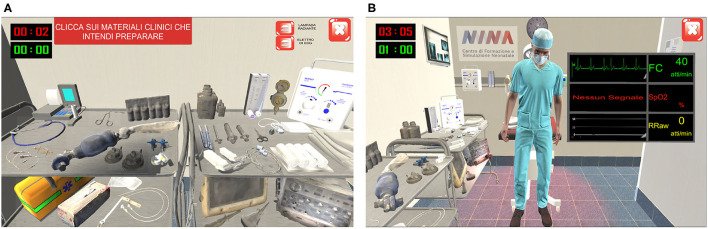
A serious computer game DIANA (gital pplication in ewborn ssessment) was developed, according to newborn resuscitation algorithm, to train pediatric/neonatology residents in neonatal resuscitation algorithm knowledge and implementation (from procedure knowledge to ventilation/chest compressions rate). We analyzed user learning curves after each session and compared knowledge retention against a classic theoretical teaching session.
Pediatric/neonatology residents of the Azienda Ospedaliera Universitaria Pisana (AOUP) were invited to take part in the study and were split into a game group or a control group; both groups were homogeneous in terms of previous training and baseline scores. The control group attended a classic 80 min teaching session with a neonatal trainer, while game group participants played four 20 min sessions over four different days. Three written tests (pre/immediately post-training and at 28 days) were used to evaluate and compare the two groups' performances.
Forty-eight pediatric/neonatology residents participated in the study. While classic training by a neonatal trainer demonstrated an excellent effectiveness in short/long-term knowledge retention, DGBL methodology proved to be equivalent or better. Furthermore, after each game session, DGBL score improved for both procedure knowledge and ventilation/chest compressions rate.
In this study, DGBL was as effective as classic specialist training for neonatal resuscitation in terms of both algorithm memorization and knowledge retention. User appreciation for the methodology and ease of administration, including remotely, support the use of DGBL methodologies for pediatric/neonatology residents education.
严肃游戏,尤其是基于数字游戏的学习(DGBL)方法,有潜力强化所有以流程图为特征的医疗程序(如新生儿复苏算法)中的传统学习方法。然而,很少有研究将DGBL方法与由经验丰富的操作人员进行专业培训的对照组在短期和长期知识保留方面进行比较。特别是,住院医生的学习在基于模拟的教育文献中的代表性仍然有限。
根据新生儿复苏算法开发了一款严肃电脑游戏DIANA(新生儿评估中的数字应用),以培训儿科/新生儿科住院医生掌握新生儿复苏算法知识及实施方法(从程序知识到通气/胸外按压频率)。我们分析了每个环节后的用户学习曲线,并将知识保留情况与传统理论教学环节进行比较。
邀请比萨大学综合医院(AOUP)的儿科/新生儿科住院医生参与研究,并将他们分为游戏组或对照组;两组在先前培训和基线分数方面保持一致。对照组参加由新生儿培训师进行的80分钟传统教学课程,而游戏组参与者在四天内分四个20分钟的时段进行游戏。通过三次书面测试(培训前/培训后即刻以及28天后)来评估和比较两组的表现。
48名儿科/新生儿科住院医生参与了该研究。虽然由新生儿培训师进行的传统培训在短期/长期知识保留方面显示出卓越的效果,但DGBL方法被证明与之相当或更优。此外,在每个游戏环节后,DGBL在程序知识和通气/胸外按压频率方面的得分均有所提高。
在本研究中,就算法记忆和知识保留而言,DGBL在新生儿复苏方面与传统专业培训同样有效。用户对该方法的认可以及管理的便利性,包括远程管理,支持将DGBL方法用于儿科/新生儿科住院医生的教育。