
探索机器学习:一种使用文献计量学和VOSviewer的科学计量学方法。
Exploring machine learning: a scientometrics approach using bibliometrix and VOSviewer.
作者信息
Oyewola David Opeoluwa, Dada Emmanuel Gbenga
机构信息
Department of Mathematics and Computer Science, Faculty of Science, Federal University of Kashere, P.M.B 0182, Gombe, Nigeria.
Department of Mathematical Sciences, Faculty of Science, University of Maiduguri, Maiduguri, Nigeria.
出版信息
SN Appl Sci. 2022;4(5):143. doi: 10.1007/s42452-022-05027-7. Epub 2022 Apr 11.
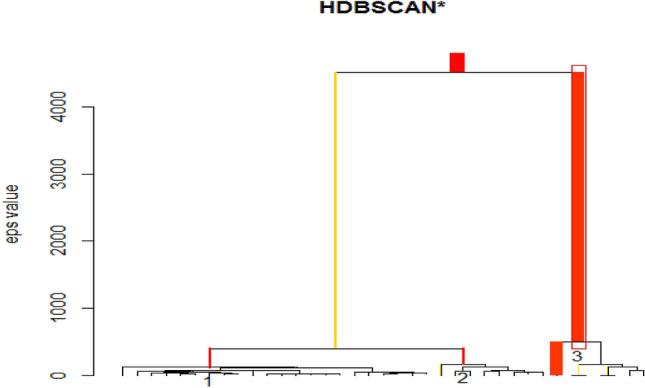
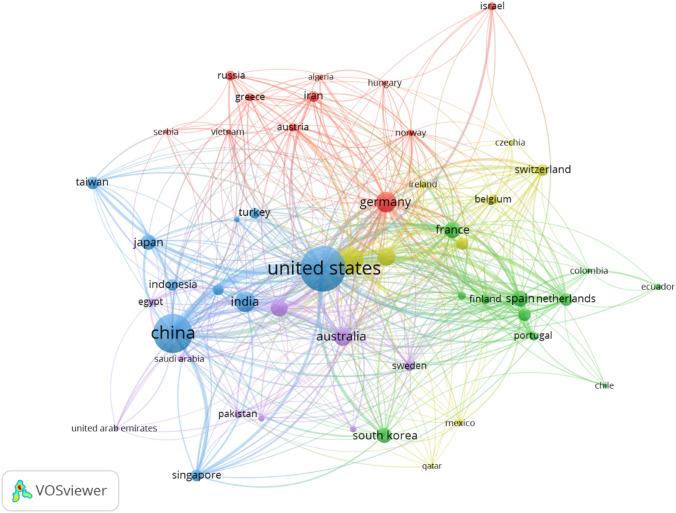
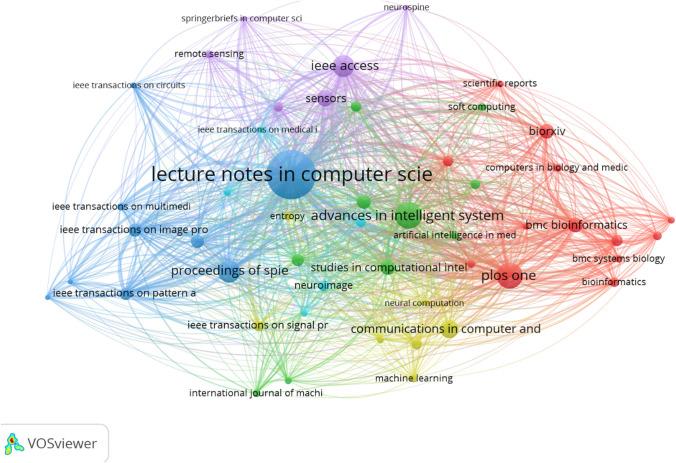
Machine Learning has found application in solving complex problems in different fields of human endeavors such as intelligent gaming, automated transportation, cyborg technology, environmental protection, enhanced health care, innovation in banking and home security, and smart homes. This research is motivated by the need to explore the global structure of machine learning to ascertain the level of bibliographic coupling, collaboration among research institutions, co-authorship network of countries, and sources coupling in publications on machine learning techniques. The Hierarchical Density-Based Spatial Clustering of Applications with Noise (HDBSCAN) was applied to clustering prediction of authors dominance ranking in this paper. Publications related to machine learning were retrieved and extracted from the Dimensions database with no language restrictions. Bibliometrix was employed in computation and visualization to extract bibliographic information and perform a descriptive analysis. VOSviewer (version 1.6.16) tool was used to construct and visualize structure map of source coupling networks of researchers and co-authorship. About 10,814 research papers on machine learning published from 2010 to 2020 were retrieved for the research. Experimental results showed that the highest degree of betweenness centrality was obtained from cluster 3 with 153.86 from the University of California and Harvard University with 24.70. In cluster 1, the national university of Singapore has the highest degree betweenness of 91.72. Also, in cluster 5, the University of Cambridge (52.24) and imperial college London (4.52) having the highest betweenness centrality manifesting that he could control the collaborative relationship and that they possessed and controlled a large number of research resources. Findings revealed that this work has the potential to provide valuable guidance for new perspectives and future research work in the rapidly developing field of machine learning.
机器学习已在人类活动的不同领域中得到应用,用于解决复杂问题,如智能游戏、自动交通、半机械人技术、环境保护、强化医疗保健、银行创新与家庭安全以及智能家居等。本研究旨在探索机器学习的全球结构,以确定文献耦合程度、研究机构之间的合作情况、各国的共同作者网络以及机器学习技术出版物中的来源耦合情况。本文应用基于密度的带噪声应用层次聚类(HDBSCAN)对作者优势排名进行聚类预测。从Dimensions数据库中检索并提取了与机器学习相关的出版物,无语言限制。使用Bibliometrix进行计算和可视化,以提取文献信息并进行描述性分析。使用VOSviewer(版本1.6.16)工具构建并可视化研究人员的来源耦合网络和共同作者的结构图。本研究检索了2010年至2020年发表的约10,814篇关于机器学习的研究论文。实验结果表明,第3聚类的中介中心性最高,来自加利福尼亚大学和哈佛大学,分别为153.86和24.70。在第1聚类中,新加坡国立大学的中介度最高,为91.72。此外,在第5聚类中,表示能够控制合作关系且拥有并控制大量研究资源的剑桥大学(52.24)和伦敦帝国学院(4.52)具有最高的中介中心性。研究结果表明,这项工作有可能为快速发展的机器学习领域的新视角和未来研究工作提供有价值的指导。



 Zotero 插件