Department of Computational Medicine & Bioinformatics, University of Michigan, Ann Arbor, MI, USA.
Department of Computer Science & Engineering, University of Michigan, Ann Arbor, MI, USA.
Nat Commun. 2022 Apr 19;13(1):2054. doi: 10.1038/s41467-022-29695-6.
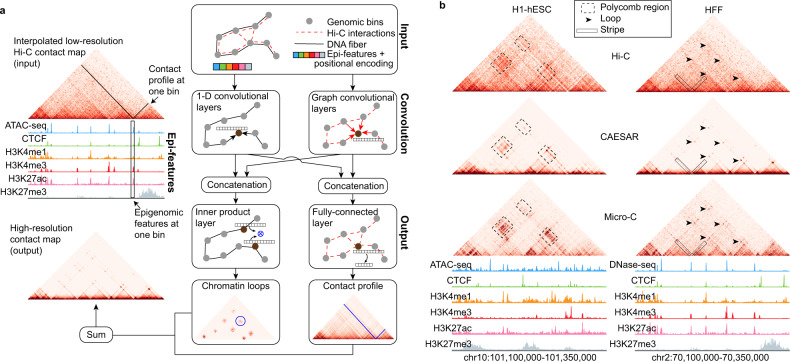
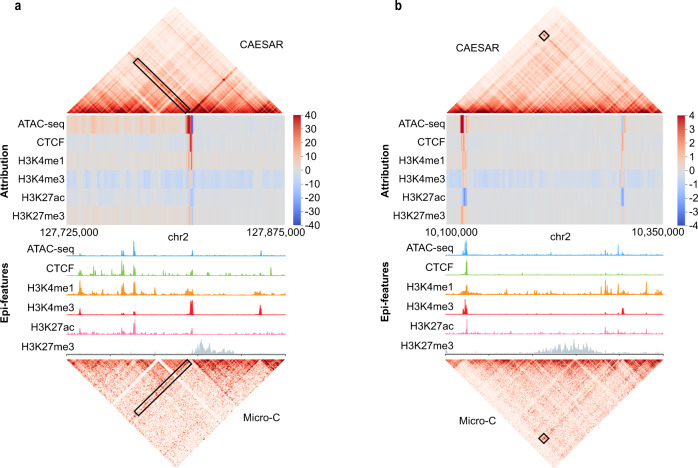
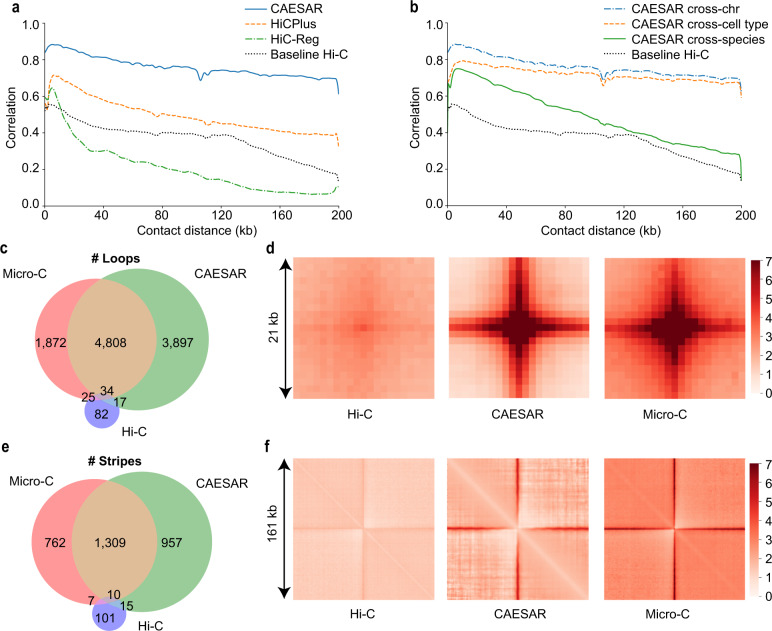
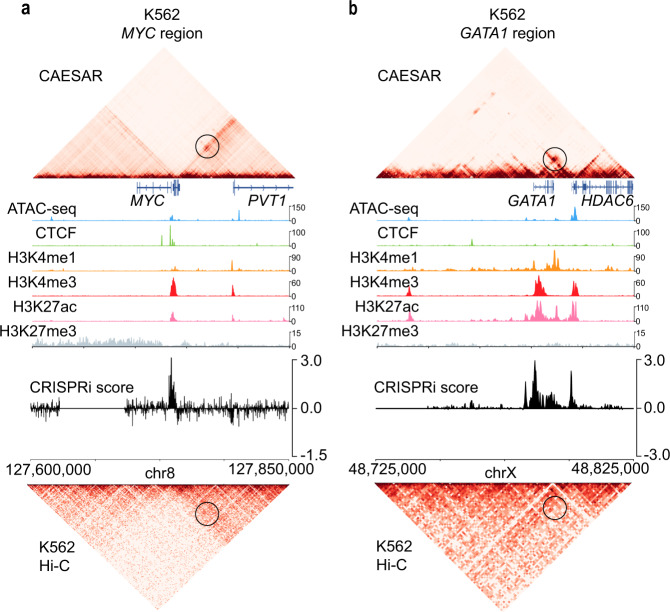
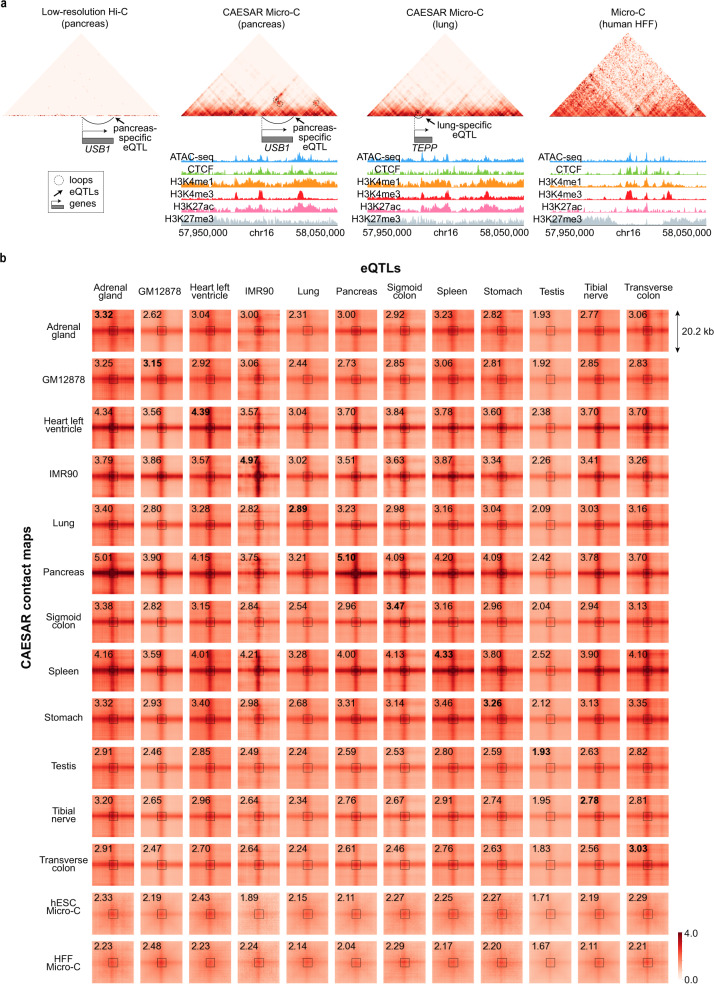
The resolution of chromatin conformation capture technologies keeps increasing, and the recent nucleosome resolution chromatin contact maps allow us to explore how fine-scale 3D chromatin organization is related to epigenomic states in human cells. Using publicly available Micro-C datasets, we develop a deep learning model, CAESAR, to learn a mapping function from epigenomic features to 3D chromatin organization. The model accurately predicts fine-scale structures, such as short-range chromatin loops and stripes, that Hi-C fails to detect. With existing epigenomic datasets from ENCODE and Roadmap Epigenomics Project, we successfully impute high-resolution 3D chromatin contact maps for 91 human tissues and cell lines. In the imputed high-resolution contact maps, we identify the spatial interactions between genes and their experimentally validated regulatory elements, demonstrating CAESAR's potential in coupling transcriptional regulation with 3D chromatin organization at high resolution.
染色质构象捕获技术的分辨率不断提高,最近的核小体分辨率染色质接触图谱使我们能够探索精细的 3D 染色质组织如何与人类细胞中的表观基因组状态相关。我们使用公开的 Micro-C 数据集,开发了一种深度学习模型 CAESAR,从表观基因组特征到 3D 染色质组织学习映射函数。该模型能够准确预测 Hi-C 无法检测到的精细结构,如短距离染色质环和条带。利用 ENCODE 和 Roadmap Epigenomics 项目现有的表观基因组数据集,我们成功地为 91 个人类组织和细胞系推断出高分辨率的 3D 染色质接触图谱。在推断出的高分辨率接触图谱中,我们确定了基因与其实验验证的调控元件之间的空间相互作用,证明了 CAESAR 具有在高分辨率下将转录调控与 3D 染色质组织联系起来的潜力。