Department of Animal Ecology, Netherlands Institute of Ecology (NIOO-KNAW), Wageningen, The Netherlands.
Department of Evolutionary Genetics, Leibniz Institute for Zoo and Wildlife Research (IZW), Berlin, Germany.
Nat Commun. 2022 Apr 19;13(1):2112. doi: 10.1038/s41467-022-29635-4.
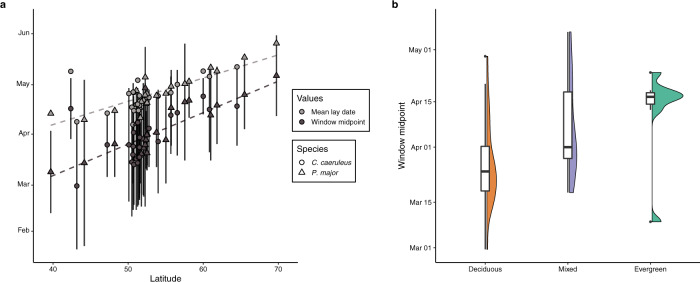
The phenology of many species shows strong sensitivity to climate change; however, with few large scale intra-specific studies it is unclear how such sensitivity varies over a species' range. We document large intra-specific variation in phenological sensitivity to temperature using laying date information from 67 populations of two co-familial European songbirds, the great tit (Parus major) and blue tit (Cyanistes caeruleus), covering a large part of their breeding range. Populations inhabiting deciduous habitats showed stronger phenological sensitivity than those in evergreen and mixed habitats. However, populations with higher sensitivity tended to have experienced less rapid change in climate over the past decades, such that populations with high phenological sensitivity will not necessarily exhibit the strongest phenological advancement. Our results show that to effectively assess the impact of climate change on phenology across a species' range it will be necessary to account for intra-specific variation in phenological sensitivity, climate change exposure, and the ecological characteristics of a population.
许多物种的物候表现出对气候变化的强烈敏感性;然而,由于缺乏大规模的种内研究,尚不清楚这种敏感性在物种分布范围内会如何变化。我们利用来自欧洲两种亲缘关系密切的鸣禽——大山雀(Parus major)和蓝山雀(Cyanistes caeruleus)的 67 个种群的产卵日期信息,记录了其对温度的物候敏感性的大规模种内变化,这些种群涵盖了它们的大部分繁殖范围。生活在落叶林栖息地的种群比常绿林和混交林栖息地的种群表现出更强的物候敏感性。然而,具有较高敏感性的种群往往经历了过去几十年间气候变化的幅度较小,因此具有较高物候敏感性的种群不一定表现出最强的物候提前。我们的研究结果表明,要在物种分布范围内有效评估气候变化对物候的影响,就必须考虑物候敏感性、气候变化暴露和种群生态特征的种内变异。