Department of Respiratory and Critical Care Medicine, The First Hospital of China Medical University, 110000, Shenyang, China.
NPJ Prim Care Respir Med. 2022 Apr 19;32(1):15. doi: 10.1038/s41533-022-00275-x.
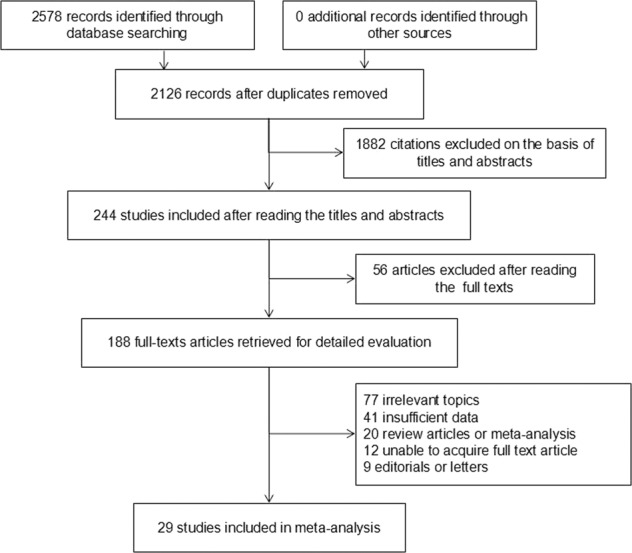
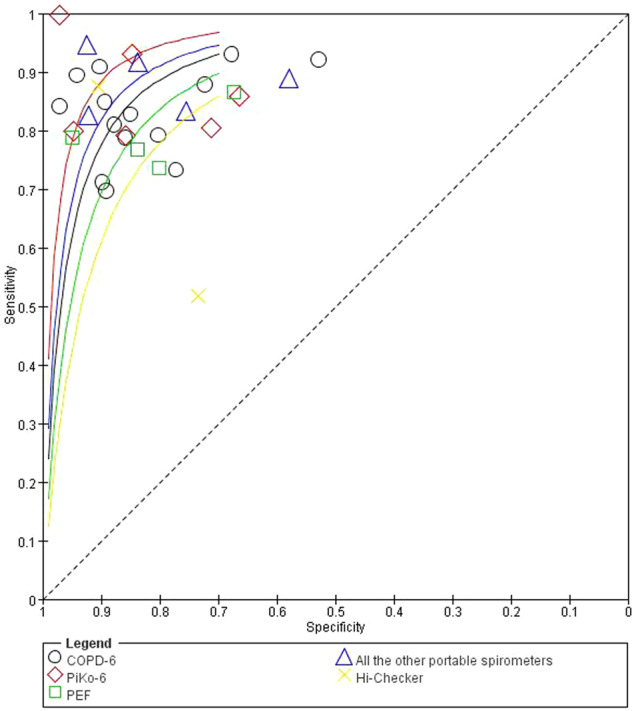
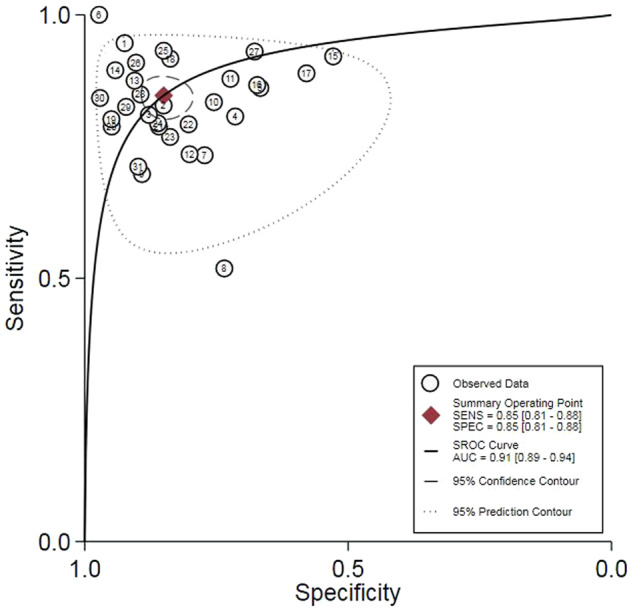
Portable spirometers has been approved for diagnosing chronic obstructive pulmonary disease (COPD). However, their diagnostic accuracy has not been reviewed. Therefore, the purpose of this study was to systematically evaluate the diagnostic value of portable spirometers in detecting COPD. A comprehensive literature search for relevant studies was conducted in PubMed, Embase, CNKI, Wan Fang, and Web of Science databases. Pooled sensitivity, specificity, summary receiver operating characteristic (SROC), area under the curve (AUC), and other related indices were calculated using the bivariate mixed-effect model. Subgroup analysis was performed to explore the source of heterogeneity. Thirty one studies were included in the meta-analysis. The pooled sensitivity, specificity, positive likelihood ratio (PLR), negative likelihood ratio (NLR), diagnostic ratio (DOR), SROC, and AUC of the SROC of portable spirometers were 0.85 (0.81-0.88), 0.85 (0.81-0.88), 5.6 (4.4-7.3), 0.18 (0.15-0.22), 31 (21-46) and 0.91 (0.89-0.94), respectively. Among the three commonly used types of portable spirometers, the accuracy of PIKO-6 was higher (0.95) than that of COPD-6 (0.91) and PEF (0.82). Subgroup analysis indicated that the accuracy of a multi-indices portable spirometer was higher than that of a single-index one (P < 0.05). In addition, portable spirometry performed by professional technicians in tertiary hospitals was more accurate than for those conducted by trained technicians in primary care facilities and communities (P < 0.05). Moreover, the accuracy of studies conducted in developing country was superior to developed country (P < 0.05). Portable spirometers have high accuracy in the diagnosis of COPD. Multi-index COPD-6 and PIKO-6 displayed higher accuracy than others. Standardized training of instrument operators should be considered to achieve reliable results.
便携式肺活量计已被批准用于诊断慢性阻塞性肺疾病(COPD)。然而,其诊断准确性尚未得到评估。因此,本研究旨在系统评估便携式肺活量计在检测 COPD 方面的诊断价值。通过在 PubMed、Embase、CNKI、万方和 Web of Science 数据库中进行全面的文献检索,筛选出相关研究。使用双变量混合效应模型计算合并的敏感度、特异度、汇总受试者工作特征曲线(SROC)、曲线下面积(AUC)和其他相关指标。进行亚组分析以探讨异质性的来源。共有 31 项研究纳入荟萃分析。便携式肺活量计的 SROC 汇总敏感度、特异度、阳性似然比(PLR)、阴性似然比(NLR)、诊断比值比(DOR)、SROC 和 AUC 分别为 0.85(0.81-0.88)、0.85(0.81-0.88)、5.6(4.4-7.3)、0.18(0.15-0.22)、31(21-46)和 0.91(0.89-0.94)。在三种常用的便携式肺活量计中,PIKO-6 的准确性(0.95)高于 COPD-6(0.91)和 PEF(0.82)。亚组分析表明,多指标便携式肺活量计的准确性高于单指标的(P<0.05)。此外,三级医院专业技术人员进行的便携式肺功能检查比初级保健设施和社区中经过培训的技术人员进行的更准确(P<0.05)。此外,发展中国家研究的准确性优于发达国家(P<0.05)。便携式肺活量计在 COPD 的诊断中具有较高的准确性。多指标 COPD-6 和 PIKO-6 的准确性高于其他指标。应考虑对仪器操作人员进行标准化培训,以获得可靠的结果。