Department of Civil Engineering, Indian Institute of Technology Hyderabad, Kandi, Sangareddy, India.
Department of Civil Engineering, École Centrale School of Engineering, Mahindra University, India.
Bioengineered. 2022 Apr;13(4):10412-10453. doi: 10.1080/21655979.2022.2056823.
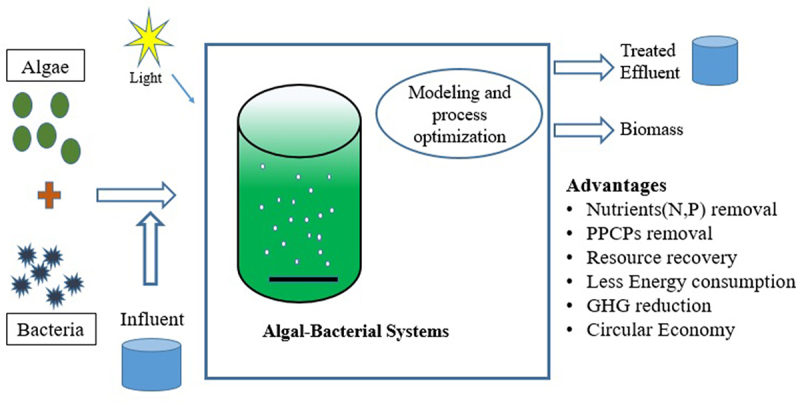
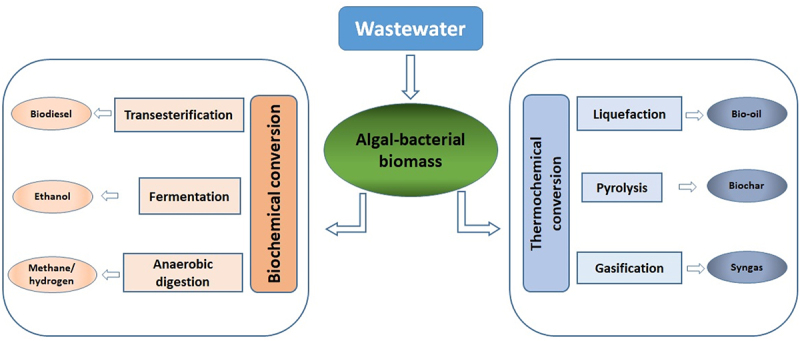
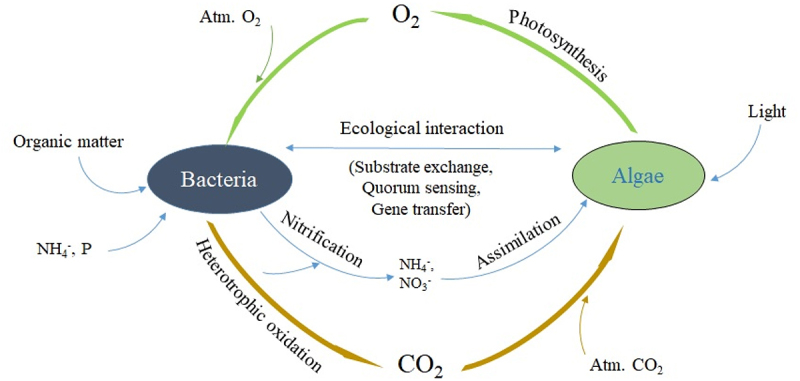
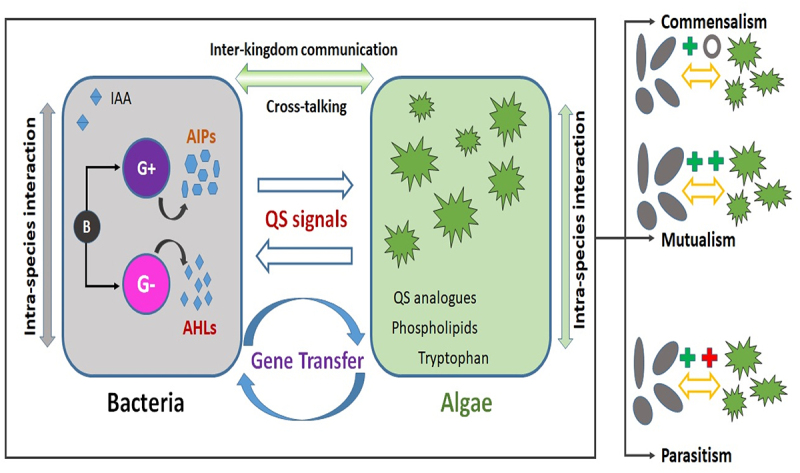
The scarcity of water resources and environmental pollution have highlighted the need for sustainable wastewater treatment. Existing conventional treatment systems are energy-intensive and not always able to meet stringent disposal standards. Recently, algal-bacterial systems have emerged as environmentally friendly sustainable processes for wastewater treatment and resource recovery. The algal-bacterial systems work on the principle of the symbiotic relationship between algae and bacteria. This paper comprehensively discusses the most recent studies on algal-bacterial systems for wastewater treatment, factors affecting the treatment, and aspects of resource recovery from the biomass. The algal-bacterial interaction includes cell-to-cell communication, substrate exchange, and horizontal gene transfer. The quorum sensing (QS) molecules and their effects on algal-bacterial interactions are briefly discussed. The effect of the factors such as pH, temperature, C/N/P ratio, light intensity, and external aeration on the algal-bacterial systems have been discussed. An overview of the modeling aspects of algal-bacterial systems has been provided. The algal-bacterial systems have the potential for removing micropollutants because of the diverse possible interactions between algae-bacteria. The removal mechanisms of micropollutants - sorption, biodegradation, and photodegradation, have been reviewed. The harvesting methods and resource recovery aspects have been presented. The major challenges associated with algal-bacterial systems for real scale implementation and future perspectives have been discussed. Integrating wastewater treatment with the algal biorefinery concept reduces the overall waste component in a wastewater treatment system by converting the biomass into a useful product, resulting in a sustainable system that contributes to the circular bioeconomy.
水资源短缺和环境污染突出了可持续废水处理的必要性。现有的传统处理系统能源密集,且并不总是能够满足严格的处理标准。最近,藻类-细菌系统作为一种环保的可持续废水处理和资源回收方法已经出现。藻类-细菌系统基于藻类和细菌共生关系的原理运作。本文全面讨论了最近关于藻类-细菌系统处理废水的研究,影响处理的因素,以及从生物质中回收资源的各个方面。藻类-细菌相互作用包括细胞间通信、基质交换和水平基因转移。简要讨论了群体感应 (QS) 分子及其对藻类-细菌相互作用的影响。讨论了 pH 值、温度、C/N/P 比、光照强度和外部曝气等因素对藻类-细菌系统的影响。提供了藻类-细菌系统建模方面的概述。由于藻类-细菌之间可能存在多种相互作用,藻类-细菌系统具有去除微污染物的潜力。综述了微污染物的去除机制——吸附、生物降解和光降解。介绍了收获方法和资源回收方面。讨论了与实际规模实施相关的主要挑战和未来展望。将废水处理与藻类生物炼制概念相结合,通过将生物质转化为有用的产品,减少废水处理系统中的整体废物成分,从而形成一个可持续的系统,为循环生物经济做出贡献。