Rory Meyers College of Nursing, Hartford Institute for Geriatric Nursing, New York University, New York, New York, USA.
Department of Human Development, Cornell University, Ithaca, New York, USA.
J Am Geriatr Soc. 2022 Jul;70(7):2134-2145. doi: 10.1111/jgs.17802. Epub 2022 Apr 20.
Hospice care was initially designed for seriously ill individuals with cancer. Thus, the model and clinicians were geared toward caring for this population. Despite the proportion of persons living with dementia (PLWD) receiving hospice care substantially increased over the past 10 years, and their longer lengths of stay, established hospice interventions for this population are scarce. No systematic review has previously evaluated those interventions that do exist. We synthesized hospice intervention studies for PLWD, their families, and hospice professionals by describing the types of interventions, participants, outcomes, and results; assessing study quality; and identifying promising intervention strategies.
A systematic review was conducted using a comprehensive search of five databases through March 2021 and follow-up hand searches. Included studies were peer-reviewed, available in English, and focused on hospice interventions for persons with dementia, and/or care partners, and clinicians. Using pre-determined inclusion and exclusion criteria, data was extracted guided by the Cochrane Checklist, and quality was assessed using a 26-item Consolidated Standards of Reporting Trials (CONSORT) Checklist.
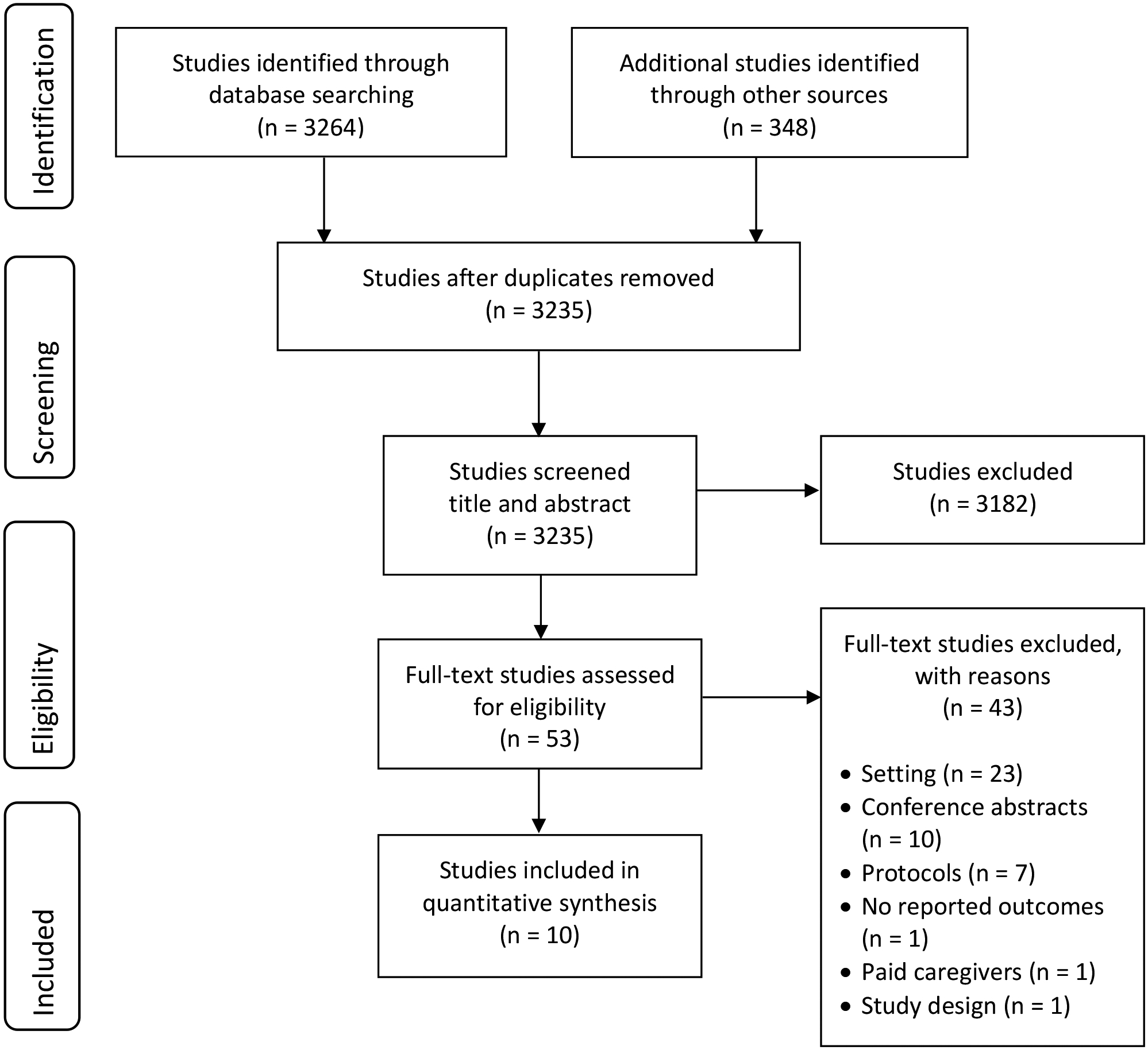
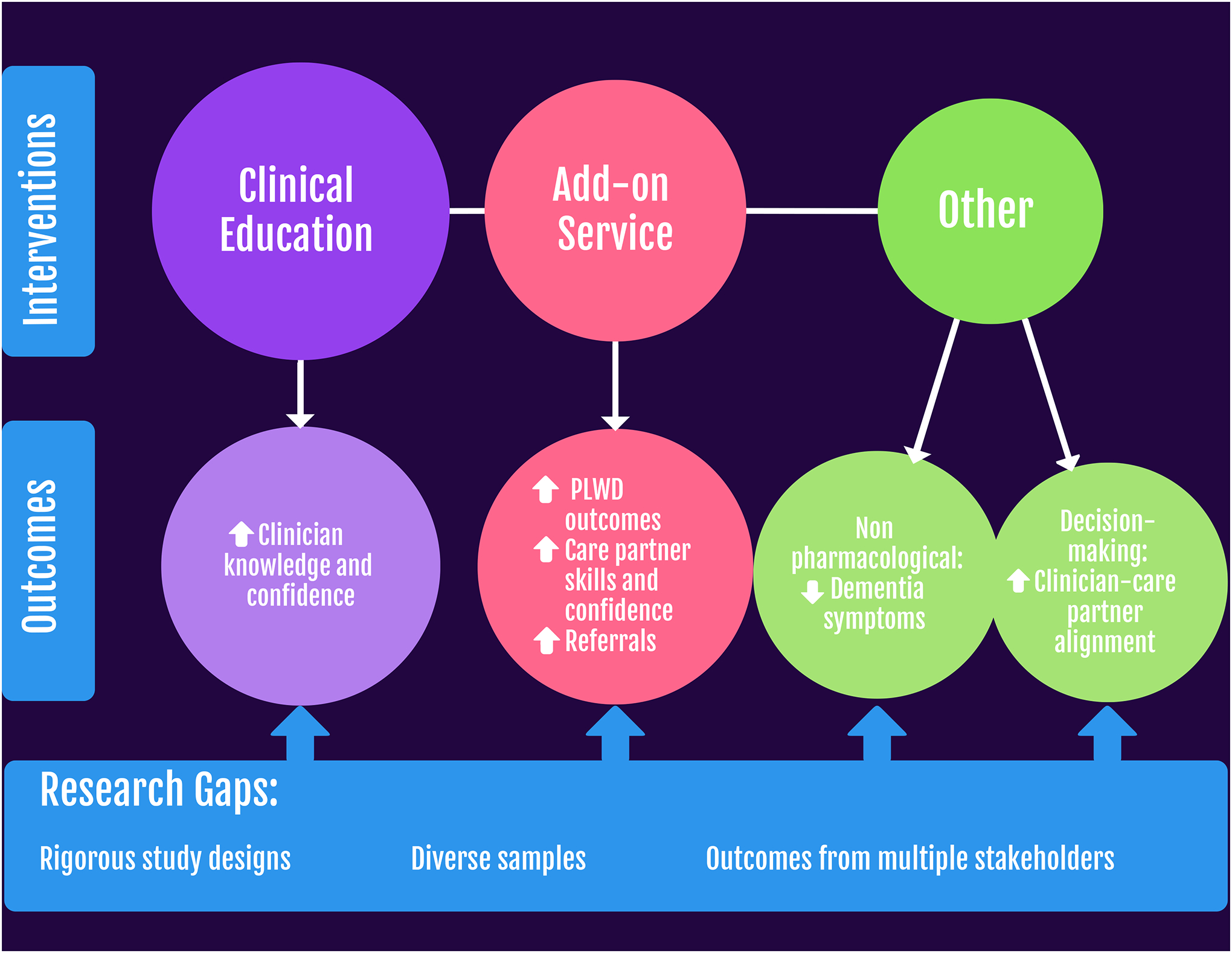
The search identified 3235 unique studies in total, of which 10 studies met inclusion criteria. The search revealed three types of interventions: clinical education and training, usual care plus care add-on services, and "other" delivered to 707 participants (mostly clinicians). Five studies included underrepresented racial and ethnic groups. Outcomes measured knowledge and skills, psychosocial and health outcomes, feasibility, and acceptability, with significant improvements in six studies. Study quality was reflective of early-stage research with clinical education and training strategies showing deliberate progression towards real-world efficacy testing.
Hospice interventions for PLWD are sparse and in early-phase research. More research is needed with rigorous designs, diverse samples, and outcomes considering the concordance of care.
临终关怀最初是为患有癌症的重病患者设计的。因此,该模式和临床医生的服务对象是这一人群。尽管过去 10 年来,接受临终关怀的痴呆症患者(PLWD)的比例大幅增加,且他们的住院时间延长,但针对这一人群的既定临终关怀干预措施却很少。以前没有系统的评价评估过这些干预措施。我们通过描述干预措施的类型、参与者、结局和结果,评估研究质量,确定有前途的干预策略,对针对 PLWD、其家属和临终关怀专业人员的临终关怀干预措施进行了综合研究。
通过 2021 年 3 月之前对五个数据库进行全面检索,并进行后续的手工检索,进行了系统评价。纳入的研究为同行评议、英文发表、并专注于痴呆症患者和/或护理伙伴和临床医生的临终关怀干预措施。根据预先确定的纳入和排除标准,使用 Cochrane 清单指导数据提取,并使用 26 项 CONSORT 清单评估质量。
总共检索到 3235 项独特的研究,其中 10 项研究符合纳入标准。该检索结果揭示了三种干预措施:临床教育和培训、常规护理加护理附加服务,以及针对 707 名参与者(主要是临床医生)的“其他”措施。五项研究纳入了代表性不足的种族和族裔群体。测量知识和技能、心理社会和健康结局、可行性和可接受性的结局,其中六项研究有显著改善。研究质量反映了临床教育和培训策略的早期研究阶段,朝着现实世界的疗效测试方向进行了精心规划。
针对 PLWD 的临终关怀干预措施很少,处于早期研究阶段。需要更多具有严格设计、多样化样本和考虑到护理一致性的结局的研究。