Department of Home Science, University of Delhi, Delhi, India.
Department of Home Science, Lakshmibai College, University of Delhi, Delhi, India.
Eur J Clin Nutr. 2022 Sep;76(9):1332-1338. doi: 10.1038/s41430-022-01111-8. Epub 2022 Apr 20.
Lifestyle intervention is the mainstay therapy for Non-Alcoholic Fatty Liver Disease (NAFLD). We aimed to assess the efficacy of an intensive (9 contact points in 6 months) weight-loss intervention among patients with obesity (BMI 25-39.9 kg/m) and NAFLD in north India.
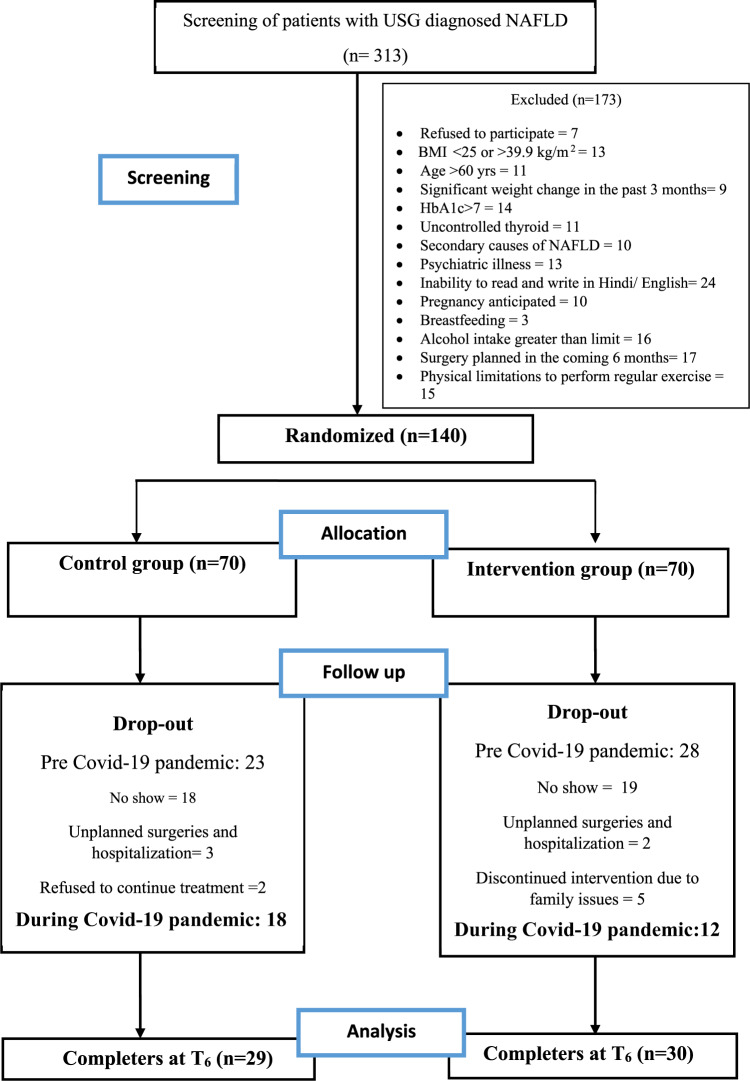
A total of 140 patients (18-60 years) with obesity and NAFLD were randomized into intervention (n = 70) and control (n = 70) groups, at a tertiary-care hospital. Weight, anthropometric parameters, Controlled Attenuation Parameter (CAP), Liver Stiffness Measurement (LSM), liver enzymes, grade of fatty liver and HOMA-IR were measured at baseline (T) and 6 months (T). There was a high drop-out, exacerbated by the Covid-19 pandemic. Completers comprised of 59 participants (n = 30 intervention, n = 29 control). Intention to treat analysis was done.
At T, ALT normalized in significantly higher (p = 0.03) number of cases in the intervention arm (66.7%) versus control arm (18.2%). No significant improvement was seen in other metabolic, ultrasound or anthropometric outcomes. Weight (p < 0.001), AST (p = 0.01), ALT (p = 0.02), body fat% (p < 0.001), WC (p < 0.001) and CAP (p < 0.001) significantly improved within the intervention arm along with a trend of improvement in steatosis and HOMA-IR. Control group showed significant decrease in weight (p < 0.001), WC (p < 0.001) and CAP (p = 0.02). Twice the number of patients in intervention arm (46.7%) lost ≥5% weight, compared to control arm (24.1%) (p = 0.07).
The intensive weight-loss intervention was not effective in improving the treatment outcomes among patients with obesity and NAFLD. However, given the potential of our intervention, we recommend larger trials with more intensive weight-loss interventions.
生活方式干预是非酒精性脂肪性肝病(NAFLD)的主要治疗方法。我们旨在评估在印度北部肥胖(BMI 25-39.9 kg/m)和 NAFLD 患者中强化(6 个月内 9 个接触点)减肥干预的疗效。
在一家三级保健医院,共纳入 140 名肥胖和 NAFLD 患者(18-60 岁),随机分为干预组(n=70)和对照组(n=70)。在基线(T)和 6 个月(T)时测量体重、人体测量参数、受控衰减参数(CAP)、肝硬度测量(LSM)、肝酶、脂肪肝程度和 HOMA-IR。由于新冠疫情的影响,脱落率很高,且不断加剧。完成者由 59 名参与者组成(n=30 名干预组,n=29 名对照组)。进行意向治疗分析。
在 T 时,干预组(66.7%)的 ALT 正常化比例显著高于对照组(18.2%)(p=0.03)。其他代谢、超声或人体测量学结果未见明显改善。干预组的体重(p<0.001)、AST(p=0.01)、ALT(p=0.02)、体脂肪%(p<0.001)、WC(p<0.001)和 CAP(p<0.001)显著改善,且肝脂肪变性和 HOMA-IR 有改善趋势。对照组的体重(p<0.001)、WC(p<0.001)和 CAP(p=0.02)显著下降。干预组有两倍(46.7%)的患者体重减轻≥5%,而对照组(24.1%)(p=0.07)。
强化减肥干预对肥胖和 NAFLD 患者的治疗结果无效。然而,鉴于我们干预措施的潜力,我们建议进行更大规模的试验,采用更强化的减肥干预措施。