Zhao Qing, Gao Yixue, Jin Xin, Han Fei, Chen Kai, Chen Chen
Department of Endodontics, The Affiliated Stomatological Hospital of Nanjing Medical University, Jiangsu Province Key Laboratory of Oral Diseases, Jiangsu Province Engineering Research Center of Stomatological Translational Medicine, Nanjing, 210029, People's Republic of China.
Department of Prosthodontics, The Affiliated Stomatological Hospital of Nanjing Medical University, Jiangsu Province Key Laboratory of Oral Diseases, Jiangsu Province Engineering Research Center of Stomatological Translational Medicine, Nanjing, 210029, People's Republic of China.
Int J Nanomedicine. 2022 Apr 13;17:1695-1709. doi: 10.2147/IJN.S357823. eCollection 2022.
This study aimed to investigate the hydrolytic stability of 10-methacryloyloxydecyl dihydrogen phosphate calcium (MDP-Ca) salts with nanolayered and amorphous structures in different pH environments.
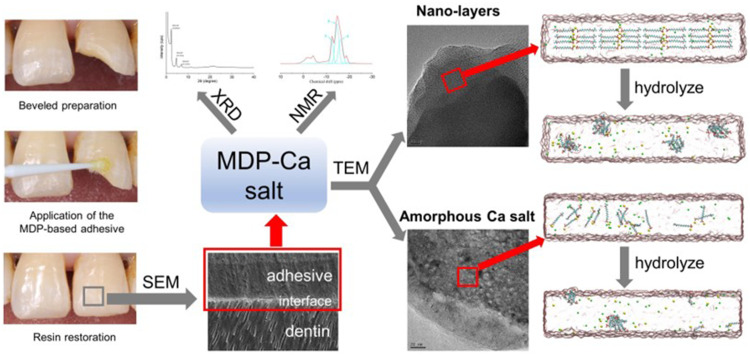
The MDP-Ca salts were synthesized from MDP and calcium chloride and characterized by X-ray diffraction (XRD), nuclear magnetic resonance (NMR), and transmission electron microscopy (TEM). Inductively coupled plasma-mass spectrometry (ICP-MS) was used to quantify the release of calcium from the synthesized MDP-Ca salt, MDP-treated hydroxyapatite (MDP-HAp), and untreated HAp after soaking in acidic and neutral solutions for 1, 7, and 30 days. To study the hydrolytic process, we carried out molecular dynamics (MD) simulations of the nanolayered MCS-MD (monocalcium salt of the MDP dimer) and DCS-MD (dicalcium salt of the MDP dimer) structures, as well as of the amorphous-phase MCS-MM (monocalcium salt of the MDP monomer).
The TEM images showed that the nanolayered structures were partially degraded by acid attack. Based on the ICP-MS results, the hydrolysis rate of the MDP-Ca salt in acidic and neutral environments followed the order HAp > MDP-HAp > MDP-Ca salt. The MD simulations showed that, in acidic environments, clusters of MDP remained aggregated and all Ca ions separated from the MDP monomer to interact with water molecules in aqueous solution. In neutral environments, Ca ions always interacted with phosphate groups, OH ions, and water molecules to form clusters centered on Ca ions.
MDP-Ca presented higher hydrolysis rates in acidic than neutral environments. Nanolayered MCS-MD possessed the highest resistance to acidic hydrolysis, followed by amorphous MCS-MM and DCS-MD.
本研究旨在探究具有纳米层状和无定形结构的10-甲基丙烯酰氧基癸基磷酸二氢钙(MDP-Ca)盐在不同pH环境中的水解稳定性。
由MDP和氯化钙合成MDP-Ca盐,并通过X射线衍射(XRD)、核磁共振(NMR)和透射电子显微镜(TEM)进行表征。使用电感耦合等离子体质谱(ICP-MS)对合成的MDP-Ca盐、MDP处理的羟基磷灰石(MDP-HAp)和未处理的HAp在酸性和中性溶液中浸泡1、7和30天后钙的释放量进行定量分析。为了研究水解过程,我们对纳米层状的MCS-MD(MDP二聚体的单钙盐)和DCS-MD(MDP二聚体的二钙盐)结构以及无定形相的MCS-MM(MDP单体的单钙盐)进行了分子动力学(MD)模拟。
TEM图像显示纳米层状结构因酸侵蚀而部分降解。基于ICP-MS结果,MDP-Ca盐在酸性和中性环境中的水解速率顺序为HAp>MDP-HAp>MDP-Ca盐。MD模拟表明,在酸性环境中,MDP簇保持聚集状态,所有Ca离子从MDP单体中分离出来与水溶液中的水分子相互作用。在中性环境中,Ca离子总是与磷酸基团、OH离子和水分子相互作用形成以Ca离子为中心的簇。
MDP-Ca在酸性环境中的水解速率高于中性环境。纳米层状的MCS-MD对酸性水解的抗性最高,其次是无定形的MCS-MM和DCS-MD。