Xi Yufeng, Ju Rong, Wang Yujia
Department of Neonatology, Chengdu Women's and Children's Central Hospital, School of Medicine, University of Electronic Science and Technology of China, Chengdu, China.
Department of Dermatology, State Key Laboratory of Biotherapy, West China Hospital, Sichuan University, Chengdu, China.
Front Pediatr. 2022 Apr 4;10:852034. doi: 10.3389/fped.2022.852034. eCollection 2022.
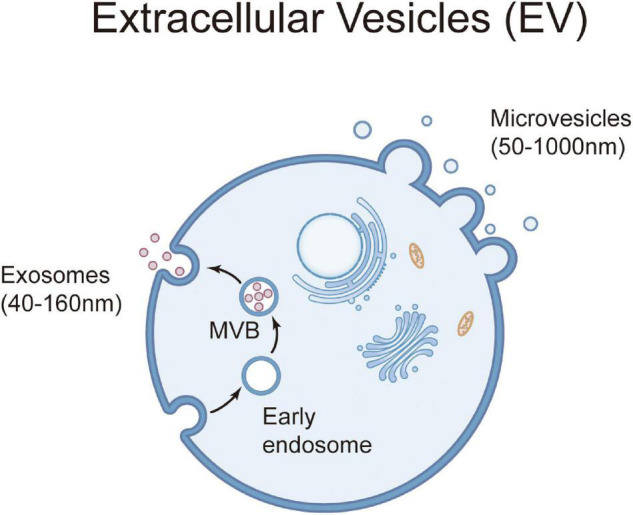
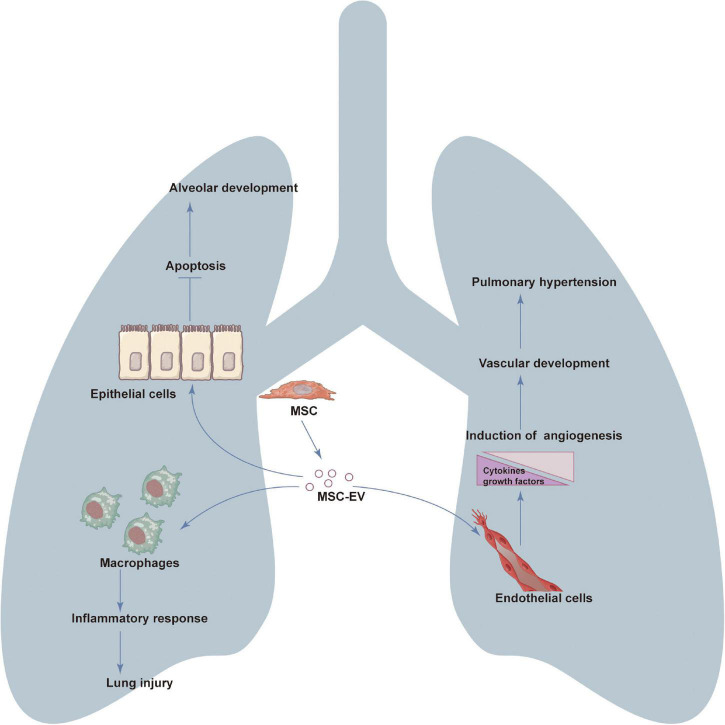
Bronchopulmonary dysplasia (BPD) is the most common chronic respiratory disease in premature infants. However, there is a lack of effective treatment. Mesenchymal stromal cells derived extracellular vesicles (MSC-EVs), as nano- and micron-sized heterogeneous vesicles secreted by MSCs, are the main medium for information exchange between MSCs and injured tissue and organ, playing an important role in repairing tissue and organ injury. EVs include exosomes, microvesicles and so on. They are rich with various proteins, nucleic acids, and lipids. Now, EVs are considered as a new way of cell-to-cell communication. EVs mainly induce regeneration and therapeutic effects in different tissues and organs through the biomolecules they carry. The surface membrane protein or loaded protein and nucleic acid molecules carried by EVs, can activate the signal transduction of target cells and regulate the biological behavior of target cells after binding and cell internalization. MSC-EVs can promote the development of pulmonary vessels and alveoli and reduce pulmonary hypertension (PH) and inflammation and play an important role in the repair of lung injury in BPD. The regeneration potential of MSC-EVs is mainly due to the regulation of cell proliferation, survival, migration, differentiation, angiogenesis, immunoregulation, anti-inflammatory, mitochondrial activity and oxidative stress. As a new type of cell-free therapy, MSC-EVs have non-immunogenic, and are small in size and go deep into most tissues. What's more, it has good biological stability and can be modified and loaded with drugs of interest. Obviously, MSC-EVs have a good application prospect in the treatment of lung injury and BPD. However, there are still many challenges to make MSC-EVs really enter clinical application.
支气管肺发育不良(BPD)是早产儿最常见的慢性呼吸系统疾病。然而,目前缺乏有效的治疗方法。间充质基质细胞衍生的细胞外囊泡(MSC-EVs)是间充质基质细胞分泌的纳米级和微米级异质性囊泡,是间充质基质细胞与受损组织和器官之间信息交换的主要介质,在修复组织和器官损伤中发挥着重要作用。细胞外囊泡包括外泌体、微囊泡等。它们富含各种蛋白质、核酸和脂质。现在,细胞外囊泡被认为是一种细胞间通讯的新方式。细胞外囊泡主要通过其所携带的生物分子在不同组织和器官中诱导再生和治疗作用。细胞外囊泡表面的膜蛋白或所携带的负载蛋白和核酸分子,在结合和细胞内化后可激活靶细胞的信号转导并调节靶细胞的生物学行为。MSC-EVs可促进肺血管和肺泡的发育,降低肺动脉高压(PH)和炎症反应,在BPD肺损伤修复中发挥重要作用。MSC-EVs的再生潜能主要归因于其对细胞增殖、存活、迁移、分化、血管生成、免疫调节、抗炎、线粒体活性和氧化应激的调控。作为一种新型的无细胞疗法,MSC-EVs具有非免疫原性,体积小且能深入大多数组织。此外,它具有良好的生物稳定性,并且可以进行修饰并负载感兴趣的药物。显然,MSC-EVs在治疗肺损伤和BPD方面具有良好的应用前景。然而,要使MSC-EVs真正进入临床应用仍面临许多挑战。