Ferreira Ana Rita, Gouveia Ana, Magalhães Ana Cristina, Valença Isabel, Marques Mariana, Kagan Jonathan C, Ribeiro Daniela
Institute of Biomedicine (iBiMED), Department of Medical Sciences, University of Aveiro, Aveiro, Portugal.
Division of Gastroenterology, Hepatology and Nutrition, Boston Children's Hospital and Harvard Medical School, Boston, MA, United States.
Front Cell Dev Biol. 2022 Apr 4;10:871977. doi: 10.3389/fcell.2022.871977. eCollection 2022.
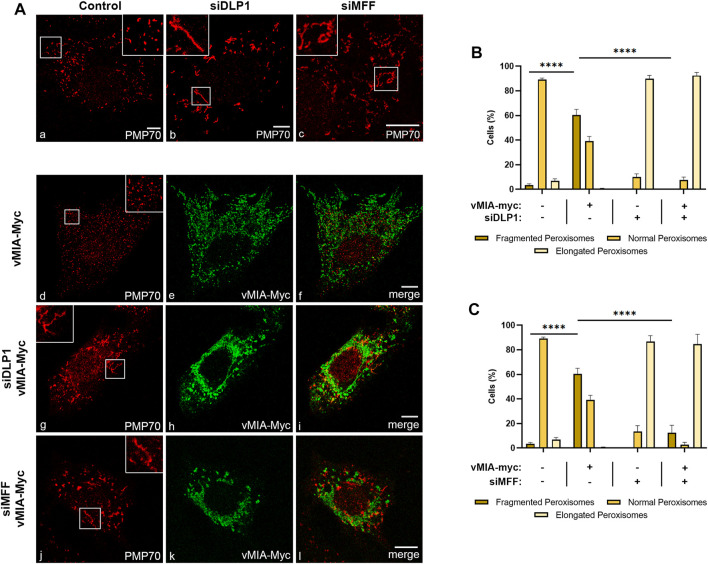
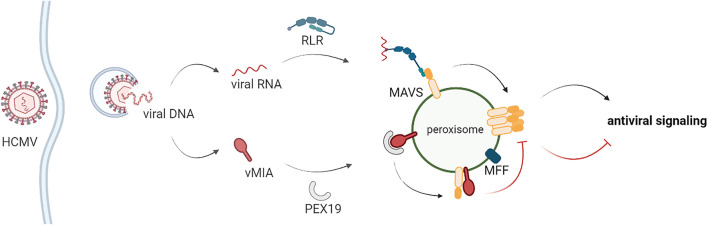
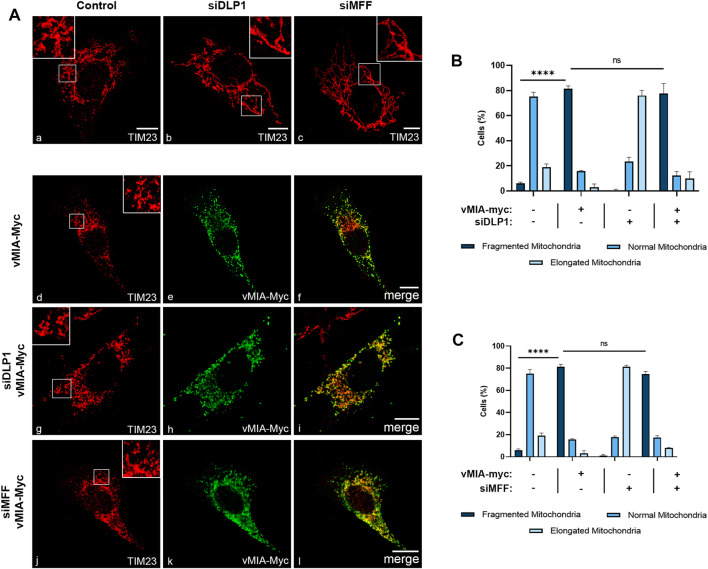
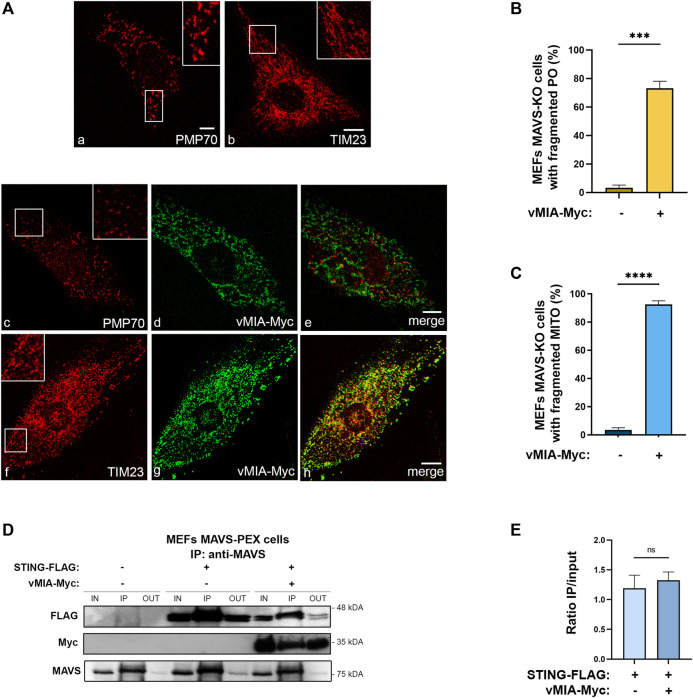
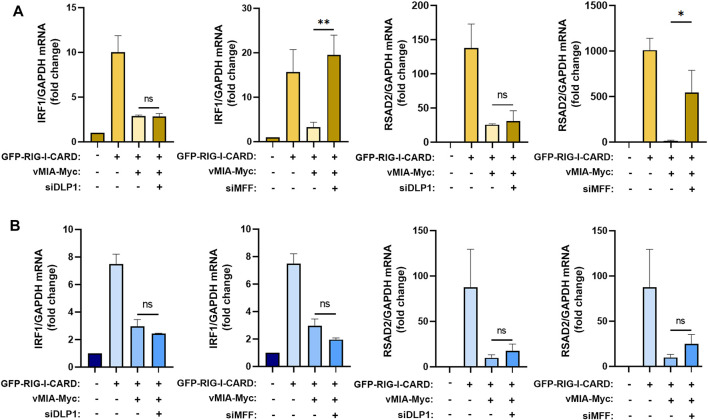
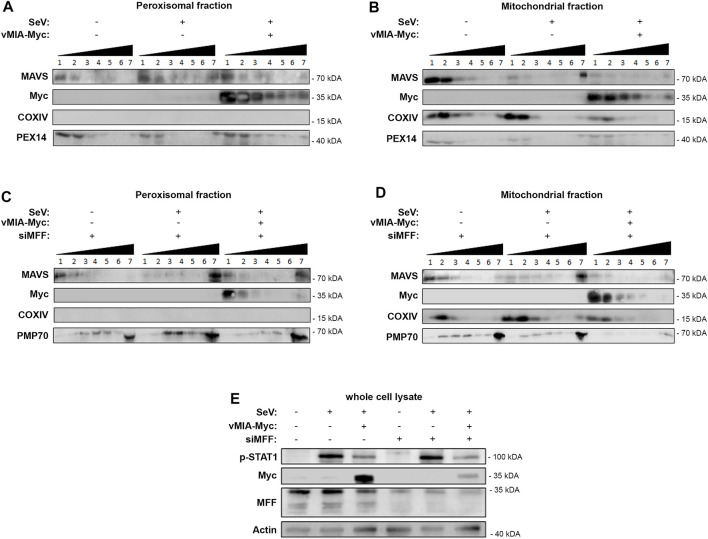
Upon intracellular recognition of viral RNA, RIG-I-like proteins interact with MAVS at peroxisomes and mitochondria, inducing its oligomerization and the downstream production of direct antiviral effectors. The human cytomegalovirus (HCMV) is able to specifically evade this antiviral response, its antiapoptotic protein vMIA. Besides suppressing the programmed cell death of infected cells, vMIA inhibits the antiviral signalling at mitochondria by inducing the organelle's fragmentation, consequently hindering the interaction between MAVS and the endoplasmic reticulum protein STING. Here we demonstrate that vMIA interferes with the peroxisomal antiviral signalling a distinct mechanism that is independent of the organelle's morphology and does not affect STING. vMIA interacts with MAVS at peroxisomes and inhibits its oligomerization, restraining downstream signalling, in an MFF-dependent manner. This study also demonstrates that vMIA is totally dependent on the organelle's fission machinery to induce peroxisomal fragmentation, while this dependency is not observed at mitochondria. Furthermore, although we demonstrate that vMIA is also able to inhibit MAVS oligomerization at mitochondria, our results indicate that this process, such as the whole vMIA-mediated inhibition of the mitochondrial antiviral response, is independent of MFF. These observed differences in the mechanisms of action of vMIA towards both organelles, likely reflect their intrinsic differences and roles throughout the viral infection. This study uncovers specific molecular mechanisms that may be further explored as targets for antiviral therapy and highlights the relevance of peroxisomes as platforms for antiviral signalling against HCMV.
在细胞内识别病毒RNA后,视黄酸诱导基因I样蛋白(RIG-I样蛋白)在过氧化物酶体和线粒体处与线粒体抗病毒信号蛋白(MAVS)相互作用,诱导其寡聚化以及直接抗病毒效应分子的下游产生。人类巨细胞病毒(HCMV)能够通过其抗凋亡蛋白vMIA特异性逃避这种抗病毒反应。除了抑制受感染细胞的程序性细胞死亡外,vMIA还通过诱导细胞器碎片化来抑制线粒体的抗病毒信号传导,从而阻碍MAVS与内质网蛋白干扰素基因刺激蛋白(STING)之间的相互作用。在这里,我们证明vMIA干扰过氧化物酶体的抗病毒信号传导——这是一种独立于细胞器形态且不影响STING的独特机制。vMIA在过氧化物酶体处与MAVS相互作用并抑制其寡聚化,以一种依赖线粒体分裂因子(MFF)的方式抑制下游信号传导。这项研究还表明,vMIA完全依赖于细胞器的裂变机制来诱导过氧化物酶体碎片化,而在线粒体中未观察到这种依赖性。此外,尽管我们证明vMIA也能够抑制线粒体处的MAVS寡聚化,但我们的结果表明,这个过程,就像整个vMIA介导的线粒体抗病毒反应抑制一样,独立于MFF。观察到的vMIA对这两种细胞器作用机制的差异,可能反映了它们在整个病毒感染过程中的内在差异和作用。这项研究揭示了可能作为抗病毒治疗靶点进一步探索的特定分子机制,并强调了过氧化物酶体作为针对HCMV的抗病毒信号平台的相关性。