Department of Neurosurgery, NYU Grossman School of Medicine, New York, New York, USA.
Department of Neurosurgery, NYU Grossman School of Medicine, New York, New York, USA.
J Biol Chem. 2022 Jun;298(6):101949. doi: 10.1016/j.jbc.2022.101949. Epub 2022 Apr 18.
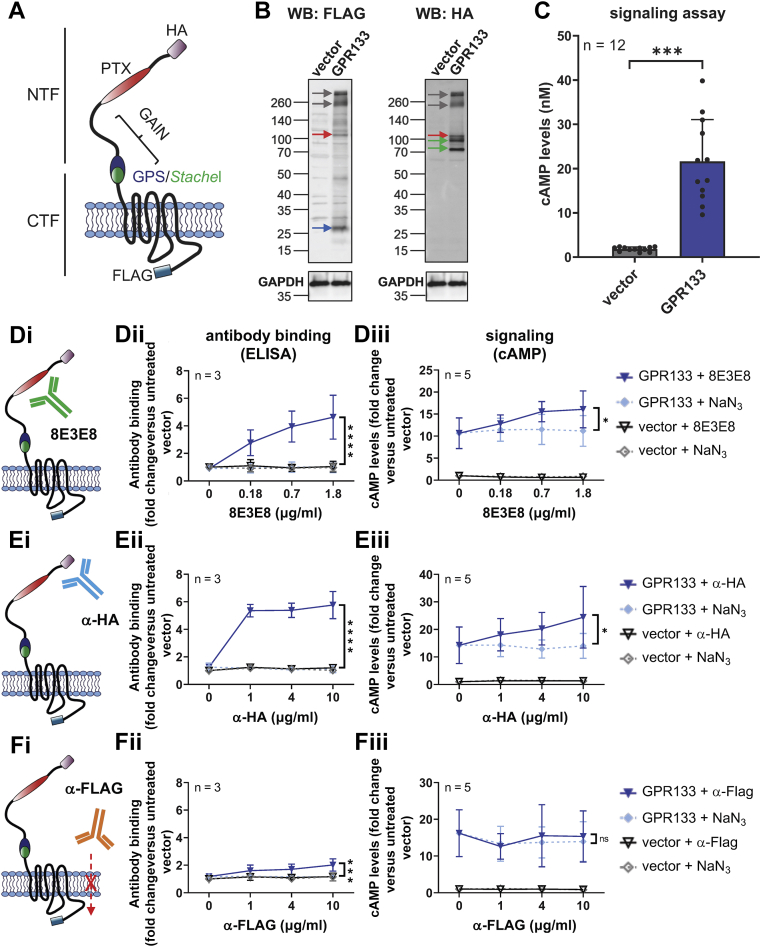
We recently demonstrated that GPR133 (ADGRD1), an adhesion G protein-coupled receptor involved in raising cytosolic cAMP levels, is necessary for growth of glioblastoma (GBM) and is de novo expressed in GBM relative to normal brain tissue. Our previous work suggested that dissociation of autoproteolytically generated N-terminal and C-terminal fragments of GPR133 at the plasma membrane correlates with receptor activation and signaling. To promote the goal of developing biologics that modulate GPR133 function, we investigated the effects of antibodies against the N-terminus of GPR133 on receptor signaling. Here, we show that treatment of HEK293T cells overexpressing GPR133 with these antibodies increased cAMP levels in a concentration-dependent manner. Analysis of culture medium following antibody treatment further indicated the presence of complexes of these antibodies with the autoproteolytically cleaved N-terminal fragments of GPR133. In addition, cells expressing a cleavage-deficient mutant of GPR133 (H543R) did not respond to antibody stimulation, suggesting that the effect is cleavage dependent. Finally, we demonstrate the antibody-mediated stimulation of WT GPR133, but not the cleavage-deficient H543R mutant, was reproducible in patient-derived GBM cells. These findings provide a paradigm for modulation of GPR133 function with biologics and support the hypothesis that the intramolecular cleavage in the N-terminus modulates receptor activation and signaling.
我们最近证明,参与提高细胞浆 cAMP 水平的粘附 G 蛋白偶联受体 GPR133(ADGRD1)对于神经胶质瘤(GBM)的生长是必需的,并且相对于正常脑组织在 GBM 中重新表达。我们之前的工作表明,GPR133 的自蛋白水解生成的 N 端和 C 端片段在质膜上的解离与受体激活和信号转导相关。为了促进开发调节 GPR133 功能的生物制剂的目标,我们研究了针对 GPR133 N 端的抗体对受体信号的影响。在这里,我们表明,用这些抗体处理过表达 GPR133 的 HEK293T 细胞以浓度依赖的方式增加 cAMP 水平。抗体处理后培养基的分析进一步表明,这些抗体与 GPR133 的自蛋白水解裂解的 N 端片段形成复合物。此外,表达 GPR133 无裂解缺陷突变体(H543R)的细胞对抗体刺激没有反应,这表明该作用依赖于裂解。最后,我们证明了抗体介导的 WT GPR133 的刺激,而不是无裂解缺陷的 H543R 突变体,可以在患者来源的 GBM 细胞中重现。这些发现为用生物制剂调节 GPR133 功能提供了范例,并支持这样的假设,即 N 端的分子内裂解调节受体的激活和信号转导。