Buckett Lance, Schönberger Sabrina, Spindler Veronika, Sus Nadine, Schoergenhofer Christian, Frank Jan, Frank Oliver, Rychlik Michael
Analytical Food Chemistry, Technical University of Munich, Maximus-von-Imhof Forum 2, 85354 Freising, Germany.
Department of Food Biofunctionality (140b), Institute of Nutritional Sciences, University of Hohenheim, Garbenstraße 28, 70599 Stuttgart, Germany.
Metabolites. 2022 Apr 12;12(4):345. doi: 10.3390/metabo12040345.
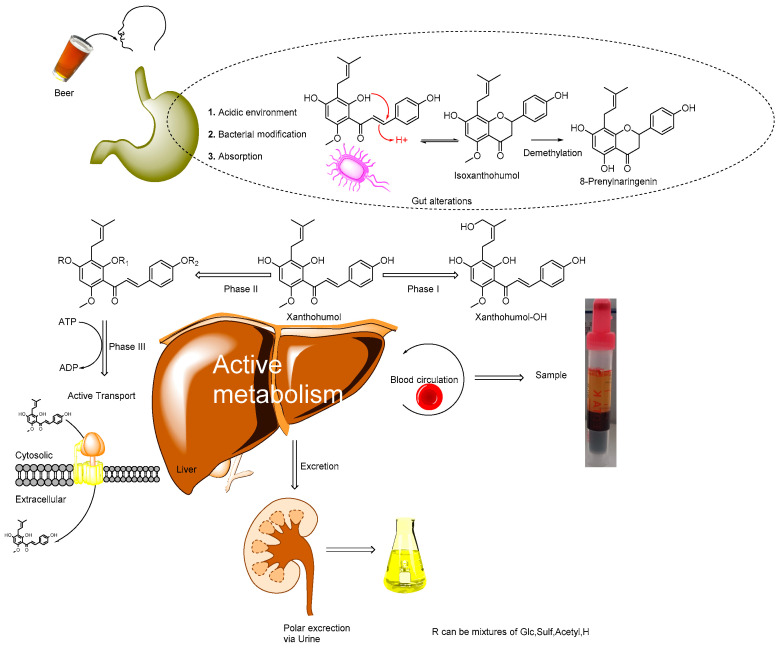
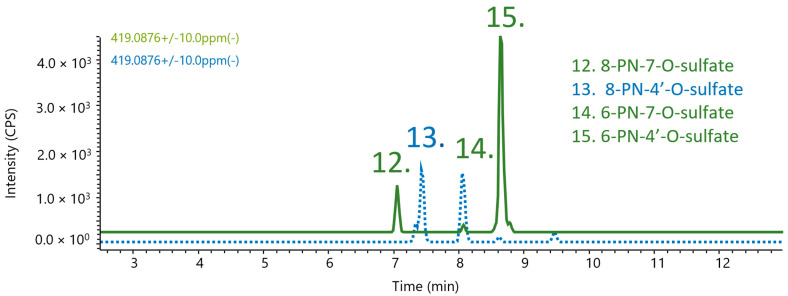
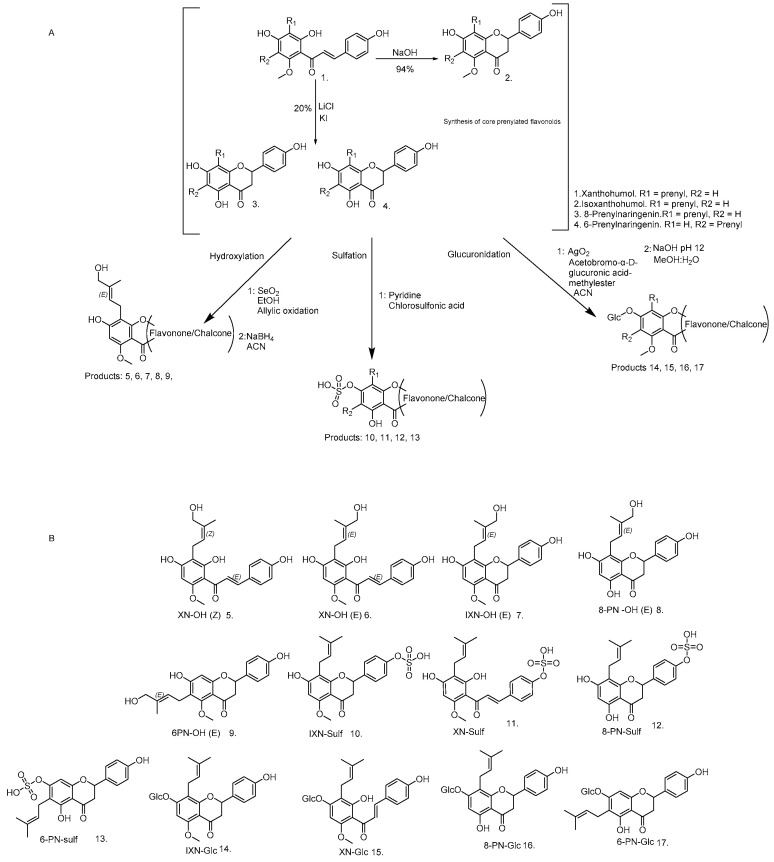
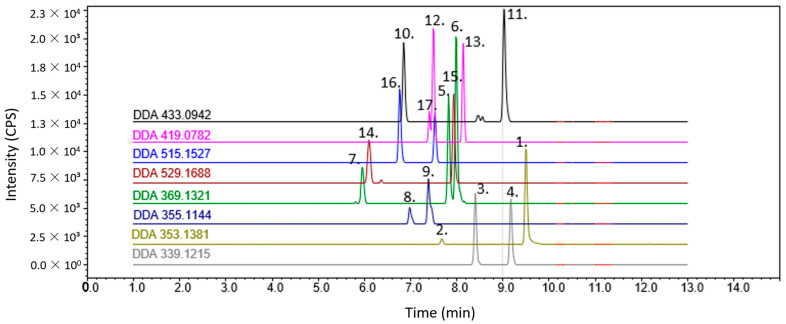
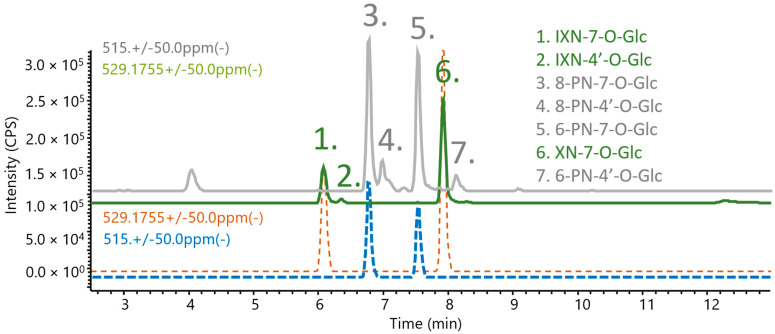
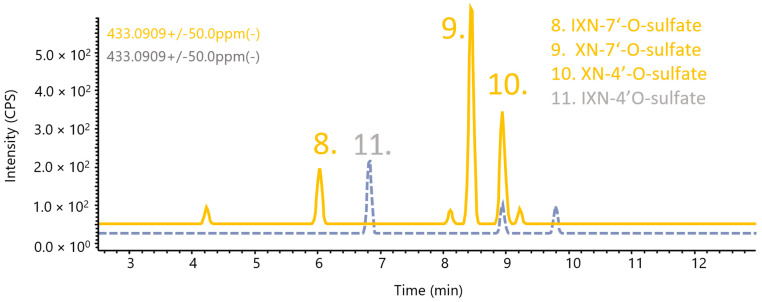
Hop prenylated flavonoids have been investigated for their in vivo activities due to their broad spectrum of positive health effects. Previous studies on the metabolism of xanthohumol using untargeted methods have found that it is first degraded into 8-prenylnaringenin and 6-prenylnaringenin, by spontaneous cyclisation into isoxanthohumol, and subsequently demethylated by gut bacteria. Further combinations of metabolism by hydroxylation, sulfation, and glucuronidation result in an unknown number of isomers. Most investigations involving the analysis of prenylated flavonoids used surrogate or untargeted approaches in metabolite identification, which is prone to errors in absolute identification. Here, we present a synthetic approach to obtaining reference standards for the identification of human xanthohumol metabolites. The synthesised metabolites were subsequently analysed by qTOF LC-MS/MS, and some were matched to a human blood sample obtained after the consumption of 43 mg of micellarised xanthohumol. Additionally, isomers of the reference standards were identified due to their having the same mass fragmentation pattern and different retention times. Overall, the methods unequivocally identified the metabolites of xanthohumol that are present in the blood circulatory system. Lastly, in vitro bioactive testing should be applied using metabolites and not original compounds, as free compounds are scarcely found in human blood.
由于蛇麻素类异戊烯基黄酮具有广泛的积极健康影响,因此对其体内活性进行了研究。以往使用非靶向方法对黄腐酚代谢的研究发现,它首先降解为8-异戊烯基柚皮素和6-异戊烯基柚皮素,通过自发环化生成异黄腐酚,随后被肠道细菌去甲基化。通过羟基化、硫酸化和葡萄糖醛酸化进一步代谢组合会产生数量未知的异构体。大多数涉及异戊烯基黄酮分析的研究在代谢物鉴定中使用替代或非靶向方法,这在绝对鉴定中容易出错。在此,我们提出了一种合成方法来获得用于鉴定人黄腐酚代谢物的参考标准品。随后通过qTOF LC-MS/MS对合成的代谢物进行分析,其中一些与摄入43 mg胶束化黄腐酚后采集的人体血液样本相匹配。此外,由于参考标准品的异构体具有相同的质量碎片模式和不同的保留时间,因此对其进行了鉴定。总体而言,这些方法明确鉴定了血液循环系统中存在的黄腐酚代谢物。最后,体外生物活性测试应使用代谢物而非原始化合物进行,因为在人体血液中几乎找不到游离化合物。