Chemistry Department, Oxford University, Oxford, UK.
Doctoral Training Centre, Oxford University, Oxford, UK.
Nat Chem. 2022 Jun;14(6):650-657. doi: 10.1038/s41557-022-00916-1. Epub 2022 Apr 21.
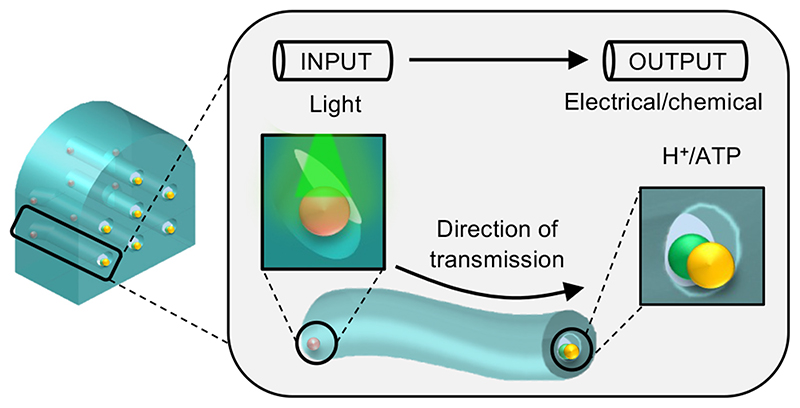
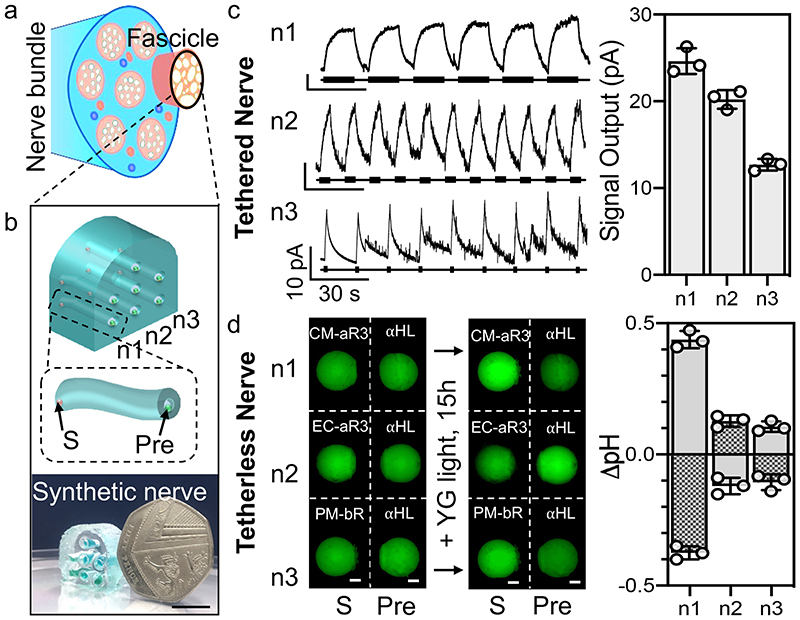
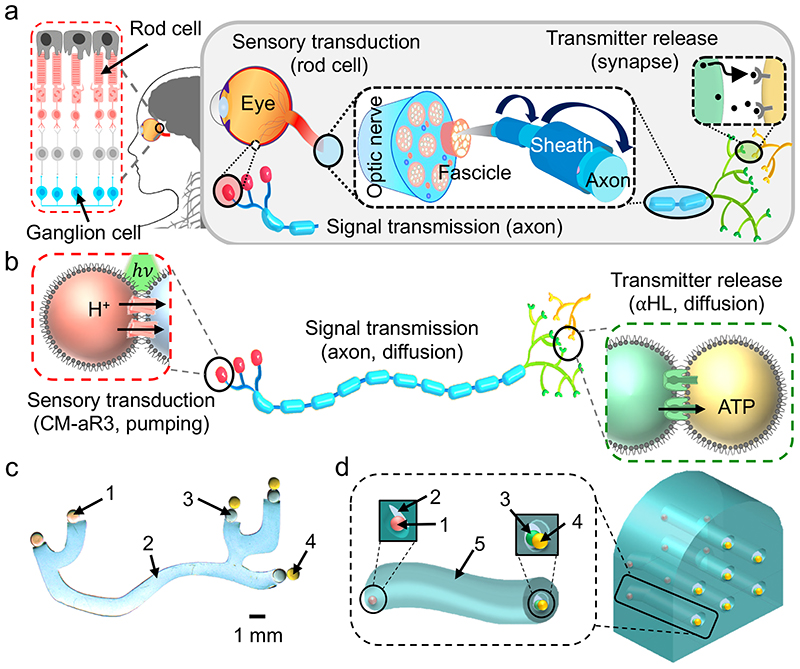
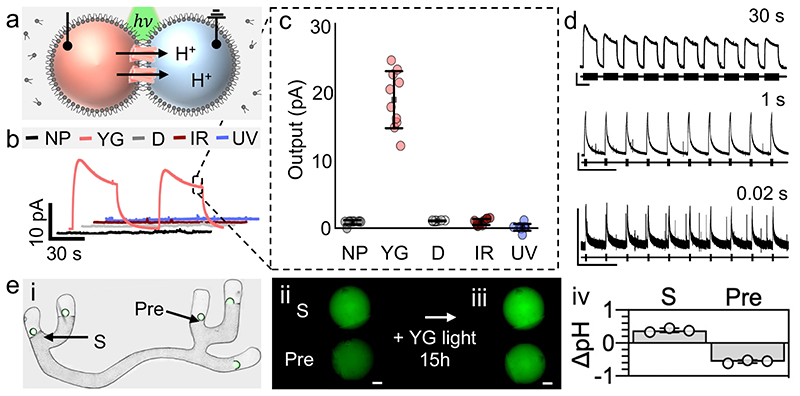
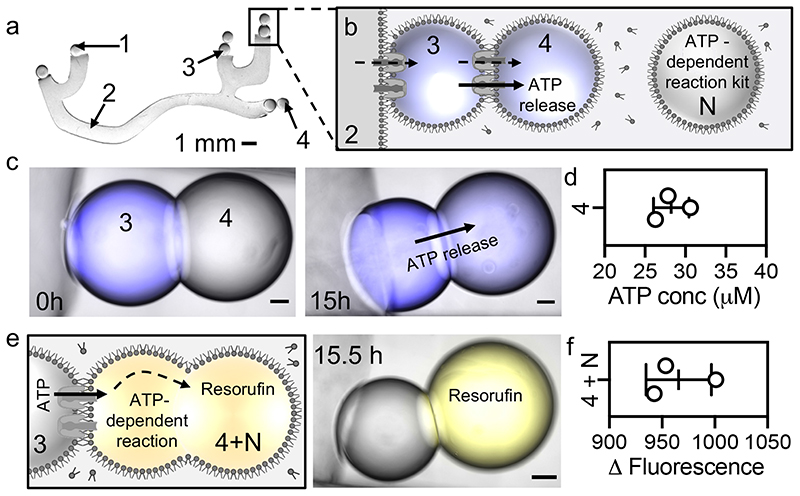
Bioelectronic devices that are tetherless and soft are promising developments in medicine, robotics and chemical computing. Here, we describe bioinspired synthetic neurons, composed entirely of soft, flexible biomaterials, capable of rapid electrochemical signal transmission over centimetre distances. Like natural cells, our synthetic neurons release neurotransmitters from their terminals, which initiate downstream reactions. The components of the neurons are nanolitre aqueous droplets and hydrogel fibres, connected through lipid bilayers. Transmission is powered at these interfaces by light-driven proton pumps and mediated by ion-conducting protein pores. By bundling multiple neurons into a synthetic nerve, we have shown that distinct signals can propagate simultaneously along parallel axons, thereby transmitting spatiotemporal information. Synthetic nerves might play roles in next-generation implants, soft machines and computing devices.
无绳和柔软的生物电子设备是医学、机器人技术和化学计算领域的有前途的发展方向。在这里,我们描述了受生物启发的合成神经元,它们完全由柔软、灵活的生物材料组成,能够在厘米距离内快速进行电化学信号传输。与天然细胞一样,我们的合成神经元从其末端释放神经递质,从而引发下游反应。神经元的组成部分是纳升级别的水相液滴和水凝胶纤维,通过脂质双层连接。这些界面的传输由光驱动质子泵供电,并由离子导电蛋白孔介导。通过将多个神经元捆绑成一个合成神经,我们已经证明不同的信号可以沿着平行的轴同时传播,从而传输时空信息。合成神经可能在下一代植入物、软体机器人和计算设备中发挥作用。