Poorni Saravanan, Nivedhitha M S, Srinivasan Manali, Balasubramaniam Arthi
Conservative Dentistry and Endodontics, Saveetha Dental College and Hospital, Chennai, IND.
Conservative Dentistry and Endodontics, Sri Venkateswara Dental College, Chennai, IND.
Cureus. 2022 Mar 18;14(3):e23282. doi: 10.7759/cureus.23282. eCollection 2022 Mar.
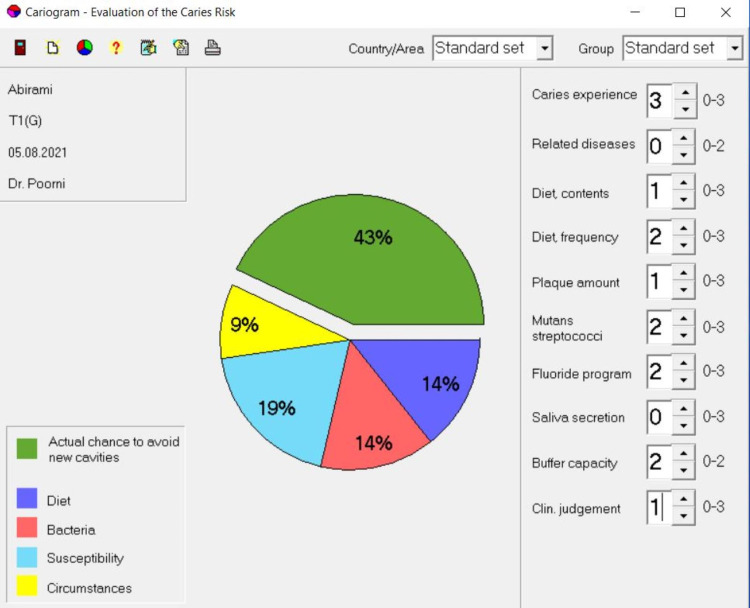
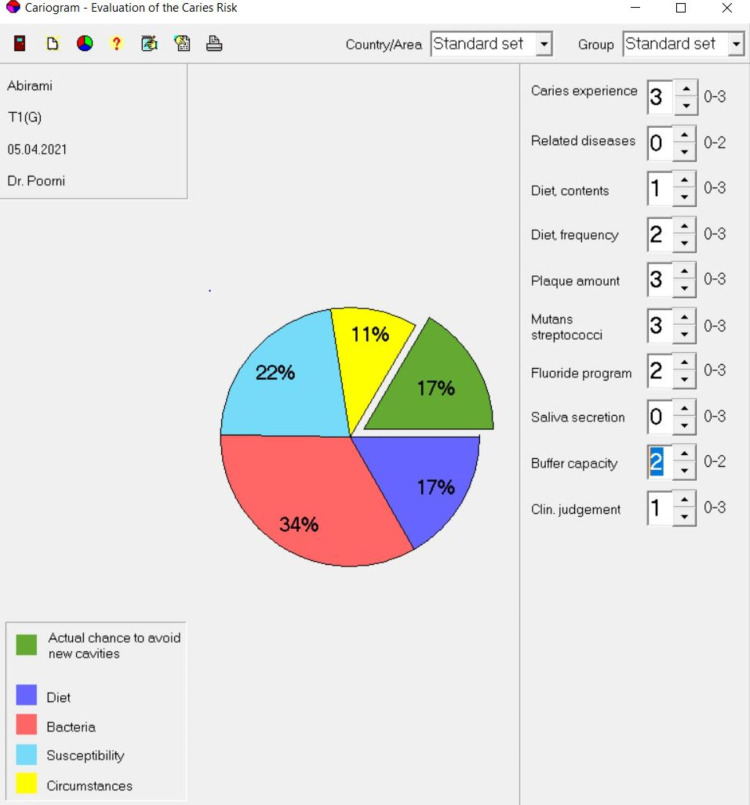
To evaluate the effect of Probiotic K12 and M18 Lozenges on the Cariogram (Cariogram Mobile application Version 1.3 developed by Wong Jung Ming, Faculty of Dentistry, National University of Singapore) parameters of patients with high caries risk.
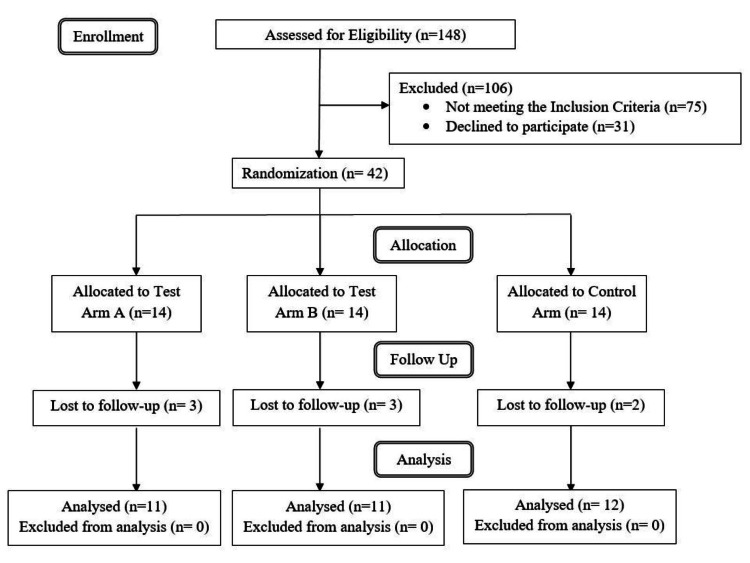
Fourty-two subjects were randomly allocated to Group 1 and 2 who received BLIS K12 and BLIS M18 probiotics (Blis Probiotics, Dunedin, New Zealand) respectively along with oral hygiene instructions and Group 3 (control) received only oral hygiene instructions with 1:1:1 allocation ratio. Subjects were instructed to follow the instructions and use the probiotics for a period of three months. Their caries risk was assessed using Cariogram software at baseline and 30 days after the use of probiotics. Change in the chance to avoid new cavities was recorded and statistically analysed using appropriate statistical tests.
About 38 subjects completed the trial with a drop-out count of eight. Multiple imputations were carried out for the missing data using an expectation-maximization algorithm. The mean percentage of actual chance to avoid new cavities was found to be 47.14 ± 6.837; 41.36 ± 16.04 and 32.50 ± 14.54 among the subjects in Group 1, Group 2, and Group 3 respectively. The mean percentage difference between the three groups was found to be statistically significant (p-value = 0.047). Dunn's pair-wise comparison showed a significant mean percentage difference between Group 1 (BLIS K12) and Group 3 (control) (p=0.020).
It can be concluded that the use of BLIS K12 and BLIS M18 probiotics for three months resulted in a considerable decrease in the caries risk. Further long-term clinical trials are needed to evaluate the difference in caries risk following the use of BLIS K12and BLIS M18 among different age and risk groups.
评估益生菌K12和M18含片对高龋风险患者龋病风险预测软件(由新加坡国立大学牙科学院的Wong Jung Ming开发的龋病风险预测移动应用程序版本1.3)参数的影响。
42名受试者被随机分为1组和2组,分别接受BLIS K12和BLIS M18益生菌(新西兰达尼丁的Blis益生菌公司)以及口腔卫生指导,3组(对照组)仅接受口腔卫生指导,分配比例为1:1:1。受试者被要求遵循指导并使用益生菌三个月。在基线和使用益生菌30天后,使用龋病风险预测软件评估他们的龋病风险。记录避免出现新龋洞几率的变化,并使用适当的统计检验进行统计分析。
约38名受试者完成了试验,有8人退出。使用期望最大化算法对缺失数据进行多次插补。1组、2组和3组受试者中,实际避免出现新龋洞的平均百分比分别为47.14±6.837、41.36±16.04和32.50±14.54。三组之间的平均百分比差异具有统计学意义(p值 = 0.047)。邓恩两两比较显示,1组(BLIS K12)和3组(对照组)之间的平均百分比差异显著(p = 0.020)。
可以得出结论,使用BLIS K12和BLIS M18益生菌三个月可使龋病风险显著降低。需要进一步进行长期临床试验,以评估在不同年龄和风险组中使用BLIS K12和BLIS M18后龋病风险的差异。