Chen I-Chen, Liu Yi-Ching, Wu Yen-Hsien, Lo Shih-Hsing, Wang Shu-Chi, Li Chia-Yang, Dai Zen-Kong, Hsu Jong-Hau, Yeh Chung-Yu, Tseng Yu-Hsin
Department of Pediatrics, Kaohsiung Medical University Hospital, Kaohsiung Medical University, Kaohsiung 80756, Taiwan.
Department of Pediatrics, School of Medicine, College of Medicine, Kaohsiung Medical University, Kaohsiung 80708, Taiwan.
Biomedicines. 2022 Apr 9;10(4):873. doi: 10.3390/biomedicines10040873.
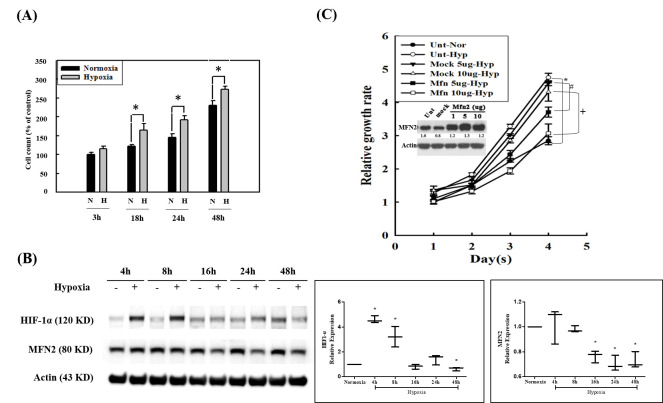
Pulmonary hypertension (PH) is a severe progressive disease, and the uncontrolled proliferation of pulmonary artery smooth muscle cells (PASMCs) is one of the main causes. Mitofusin-2 (MFN2) profoundly inhibits cell growth and proliferation in a variety of tumor cell lines and rat vascular smooth muscle cells. Down-regulation of MFN2 is known to contribute to PH. Proteasome inhibitors have been shown to inhibit the proliferation of PASMCs; however, there is no study on the regulation of proteasome inhibitors through MFN-2 in the proliferation of PASMCs, a main pathophysiology of PH. In this study, PASMCs were exposed to hypoxic conditions and the expression of MFN2 and cleaved-PARP1 were detected by Western blotting. The effects of hypoxia and proteasome inhibitors on the cell viability of PASMC cells were detected by CCK8 assay. The results indicated that hypoxia increases the viability and reduces the expression of MFN2 in a PASMCs model. MFN2 overexpression inhibits the hypoxia-induced proliferation of PASMCs. In addition, proteasome inhibitors, bortezomib and marizomib, restored the decreased expression of MFN2 under hypoxic conditions, inhibited hypoxia-induced proliferation and induced the expression of cleaved-PARP1. These results suggest that bortezomib and marizomib have the potential to improve the hypoxia-induced proliferation of PASMCs by restoring MFN2 expression.
肺动脉高压(PH)是一种严重的进行性疾病,肺动脉平滑肌细胞(PASMCs)的不受控制的增殖是主要原因之一。线粒体融合蛋白2(MFN2)在多种肿瘤细胞系和大鼠血管平滑肌细胞中能显著抑制细胞生长和增殖。已知MFN2的下调会导致肺动脉高压。蛋白酶体抑制剂已被证明可抑制PASMCs的增殖;然而,关于蛋白酶体抑制剂通过MFN-2对PASMCs增殖(肺动脉高压的主要病理生理学特征之一)的调控,尚无相关研究。在本研究中,将PASMCs置于缺氧条件下,并通过蛋白质印迹法检测MFN2和裂解的PARP1的表达。通过CCK8法检测缺氧和蛋白酶体抑制剂对PASMCs细胞活力的影响。结果表明,在PASMCs模型中,缺氧会增加细胞活力并降低MFN2的表达。MFN2的过表达可抑制缺氧诱导的PASMCs增殖。此外,蛋白酶体抑制剂硼替佐米和马立佐米可恢复缺氧条件下MFN2表达的降低,抑制缺氧诱导的增殖并诱导裂解的PARP1的表达。这些结果表明,硼替佐米和马立佐米有可能通过恢复MFN2表达来改善缺氧诱导的PASMCs增殖。