Kim Bo-Ram, Lim Seung-Taek
Department of Physical Education, College of Education, Korea University, Seoul 02841, Korea.
Olympic Studies Center, Kangwon National University, Chuncheon-si 24341, Korea.
Healthcare (Basel). 2022 Apr 15;10(4):737. doi: 10.3390/healthcare10040737.
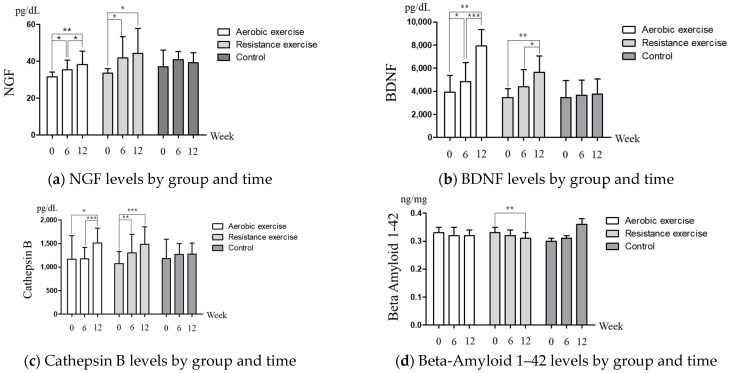
The purpose of this study was to investigate the change in cognitive reserve biomarkers of the pre-diabetic individual according to the types of leisure-time physical activity (aerobic or resistance physical activity). The research subjects (n = 184) who participated in the survey were pre-diabetic and diabetic patients who were visiting university hospitals and welfare centers. The intervention subjects (n = 36) who were elderly females with pre-diabetes volunteered to participate in the study by performing regular physical exercise (aerobic or resistance exercise). The study participants were 65 years of age or older with pre-diabetes defined by a glycated hemoglobin (HbA1c) level of (5.7−6.4)%. All research subjects performed motivation and stress questionnaire survey. All intervention subjects participated in leisure-time physical activity (LTPA) for 12 weeks. Body composition, HbA1c, and cognitive reserve biomarkers were measured at baseline, and at 6 and 12 weeks. LTPA motivation confirmed that the LTPA participants had a high level of motivation. Stress confirmed that the stress level of LTPA participants was low. Two-way within-factor ANOVA revealed significant group × time interaction for weight (p < 0.05), BMI (p < 0.01), % fat (p < 0.001), SBP (p < 0.05), HbA1c (p < 0.001), BDNF (p < 0.001), and Beta-Amyloid 1−42 (p < 0.001). In both physical activity groups, HbA1c (p < 0.001), NGF (p < 0.05), BDNF (p < 0.05), and Cathepsin B (p < 0.05) improved significantly at 12 weeks, compared to baseline and 6 weeks. In the resistance physical activity group, Beta-Amyloid 1−42 (p < 0.01) and Homocysteine (p < 0.05) significantly decreased at 12 weeks, compared to baseline and at 6 weeks. The LTPA showed high levels of integrated and identified regulation among leisure motive types, and the level of stress was found to be low. The LTPA is effective in reducing the HbA1c levels of the pre-diabetes elderly. In addition, the pre-diabetes elderly were found to have increased NGF, BDNF, and cathepsin B, and decreased Beta-Amyloid 1−42 and homocysteine. Regular leisure-time physical activity has a positive effect on cognitive reserve biomarkers through improving glycemic control by reducing weight and % fat in the pre-diabetes elderly.
本研究的目的是根据休闲时间体育活动的类型(有氧运动或抗阻运动),调查糖尿病前期个体认知储备生物标志物的变化。参与调查的研究对象(n = 184)为前往大学医院和福利中心就诊的糖尿病前期和糖尿病患者。干预对象(n = 36)为患有糖尿病前期的老年女性,她们通过进行规律的体育锻炼(有氧运动或抗阻运动)自愿参与本研究。研究参与者年龄在65岁及以上,糖化血红蛋白(HbA1c)水平为(5.7−6.4)%,被定义为糖尿病前期。所有研究对象均进行了动机和压力问卷调查。所有干预对象参与了为期12周的休闲时间体育活动(LTPA)。在基线、第6周和第12周测量了身体成分、HbA1c和认知储备生物标志物。LTPA动机证实LTPA参与者有较高的动机水平。压力证实LTPA参与者的压力水平较低。双向组内方差分析显示,在体重(p < 0.05)、BMI(p < 0.01)、体脂百分比(p < 0.001)、收缩压(p < 0.05)、HbA1c(p < 0.001)、脑源性神经营养因子(BDNF)(p < 0.001)和β-淀粉样蛋白1−42(p < 0.001)方面存在显著的组×时间交互作用。在两个体育活动组中,与基线和第6周相比,HbA1c(p < 0.001)、神经生长因子(NGF)(p < 0.05)、BDNF(p < 0.05)和组织蛋白酶B(p < 0.05)在第12周时均有显著改善。在抗阻体育活动组中,与基线和第6周相比,β-淀粉样蛋白1−42(p < 0.01)和同型半胱氨酸(p < 0.05)在第12周时显著降低。LTPA在休闲动机类型中表现出较高水平的整合和识别调节,且压力水平较低。LTPA对降低糖尿病前期老年人的HbA1c水平有效。此外,发现糖尿病前期老年人的NGF、BDNF和组织蛋白酶B增加,β-淀粉样蛋白1−42和同型半胱氨酸减少。规律的休闲时间体育活动通过减轻糖尿病前期老年人的体重和体脂百分比来改善血糖控制,从而对认知储备生物标志物产生积极影响。