Department of Basic & Translational Sciences, School of Dental Medicine, University of Pennsylvania, Philadelphia, PA 19104, USA.
Center for Innovation & Precision Dentistry, School of Dental Medicine, School of Engineering and Applied Sciences, University of Pennsylvania, Philadelphia, PA 19104, USA.
Cells. 2022 Apr 16;11(8):1361. doi: 10.3390/cells11081361.
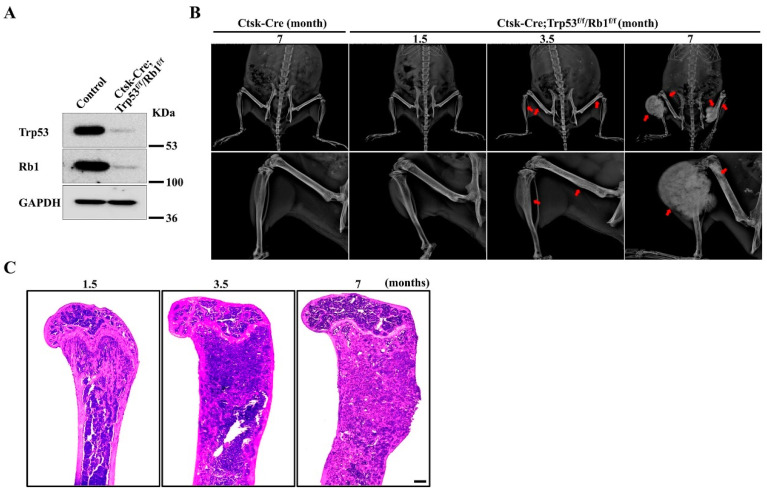
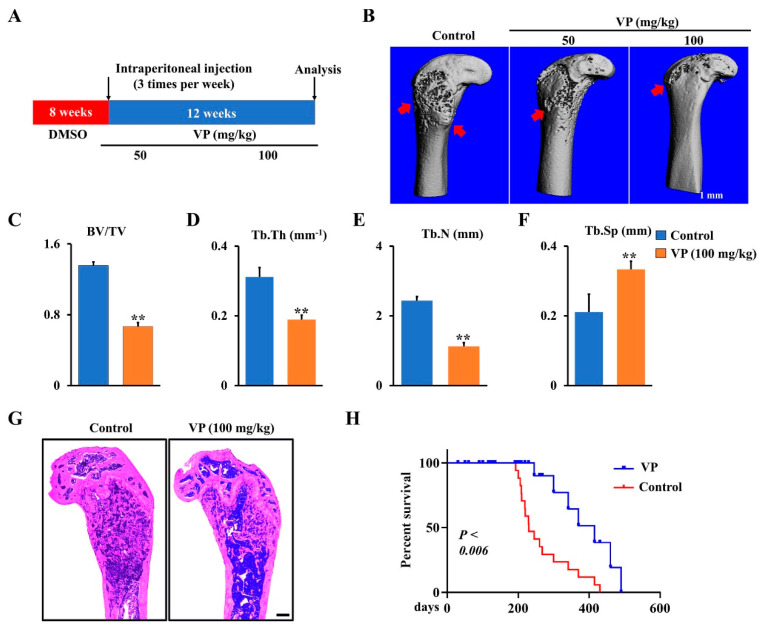
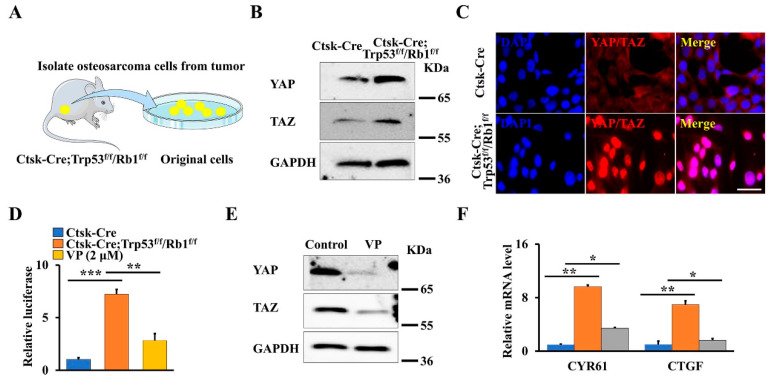
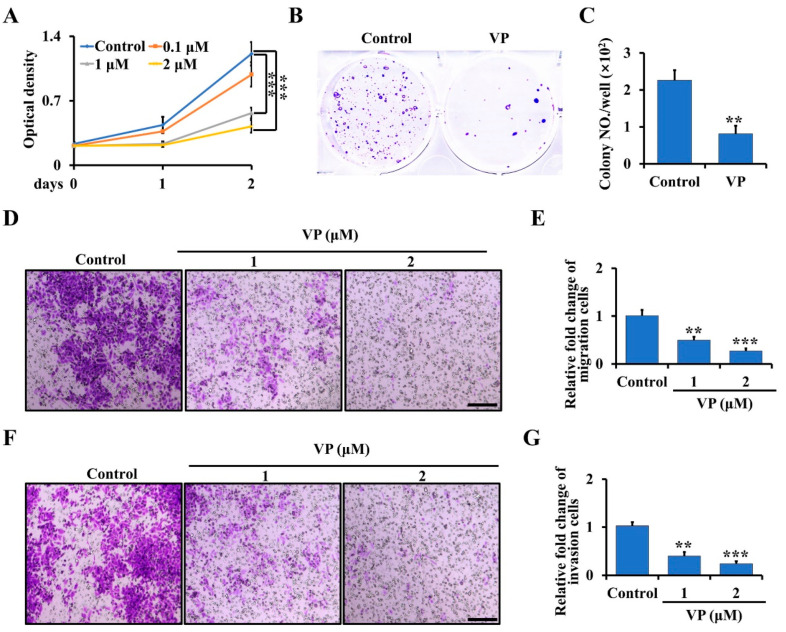
Osteosarcoma is the most common primary malignancy of bone in children and adolescents. Others and our previous studies have shown that Yes-associated protein (YAP)/transcriptional coactivator with PDZ-binding motif (TAZ) as core components of the Hippo pathway are crucial regulators of osteosarcoma formation and progression. Recent studies demonstrated that verteporfin (VP) is an inhibitor of YAP/TAZ signaling in xenograft osteosarcoma. However, whether VP can inhibit primary osteosarcoma in mice is unknown. Mutations of Trp53 and Rb1 occur in approximately 50~70% of human osteosarcoma. In this study, we successfully generated the Ctsk-Cre;Trp53/Rb1 mice in which Trp53/Rb1 was ablated in Ctsk-expressing cells and found that Ctsk-Cre;Trp53/Rb1 mice spontaneously developed osteosarcoma with increased expansive osteoid lesions in the cortical bone with aging. Loss of Trp53/Rb1 in Ctsk-expressing cells significantly promoted the expression and nuclear translocation of YAP/TAZ. Micro-CT results showed that inhibition of YAP/TAZ by VP delays osteosarcoma progression and protected against bone erosion in Ctsk-Cre;Trp53/Rb1 mice. Importantly, the Kaplan-Meier survival curves displayed a significantly longer survival rate after VP treatment in Ctsk-Cre;Trp53/Rb1 mice compared to non-injected groups. In vitro studies further showed that VP inhibited the proliferation, migration and invasion in Trp53/Rb1-mutant Ctsk-expressing cells. Moreover, the results from promoter luciferase activity analysis showed that the transcriptional activity of YAP/TAZ was significantly increased in osteosarcoma tissue from Ctsk-Cre;Trp53/Rb1 mice, which was attenuated by VP treatment. Overall, these findings suggest that targeting Hippo pathway by VP may be a potential therapeutic strategy for osteosarcoma.
骨肉瘤是儿童和青少年中最常见的原发性骨恶性肿瘤。其他研究和我们之前的研究表明,Yes 相关蛋白(YAP)/含 PDZ 结合基序的转录共激活因子(TAZ)作为 Hippo 通路的核心组成部分,是骨肉瘤形成和进展的关键调节剂。最近的研究表明,verteporfin(VP)是异种移植骨肉瘤中 YAP/TAZ 信号的抑制剂。然而,VP 是否能抑制小鼠的原发性骨肉瘤尚不清楚。Trp53 和 Rb1 的突变发生在大约 50~70%的人类骨肉瘤中。在这项研究中,我们成功地生成了 Ctsk-Cre;Trp53/Rb1 小鼠,其中 Ctsk 表达细胞中的 Trp53/Rb1 被消融,并且随着年龄的增长,在皮质骨中发现 Ctsk-Cre;Trp53/Rb1 小鼠自发地发展出骨肉瘤,伴有扩张性骨样病变增加。Ctsk 表达细胞中 Trp53/Rb1 的缺失显著促进了 YAP/TAZ 的表达和核易位。Micro-CT 结果显示,VP 抑制 YAP/TAZ 可延迟骨肉瘤进展并防止 Ctsk-Cre;Trp53/Rb1 小鼠的骨质侵蚀。重要的是,Kaplan-Meier 生存曲线显示,与未注射组相比,VP 治疗后 Ctsk-Cre;Trp53/Rb1 小鼠的存活率显著提高。体外研究进一步表明,VP 抑制了 Trp53/Rb1 突变的 Ctsk 表达细胞的增殖、迁移和侵袭。此外,启动子荧光素酶活性分析的结果表明,Ctsk-Cre;Trp53/Rb1 小鼠骨肉瘤组织中 YAP/TAZ 的转录活性显著增加,VP 处理可减弱其活性。总之,这些发现表明,VP 靶向 Hippo 通路可能是骨肉瘤的一种潜在治疗策略。