Department of Psychology, The University of Hong Kong, Pokfulam, Hong Kong.
Division of Psychology and Language Sciences, University College London, Gower Street, London WC1E 6BT, UK.
Int J Environ Res Public Health. 2022 Apr 12;19(8):4621. doi: 10.3390/ijerph19084621.
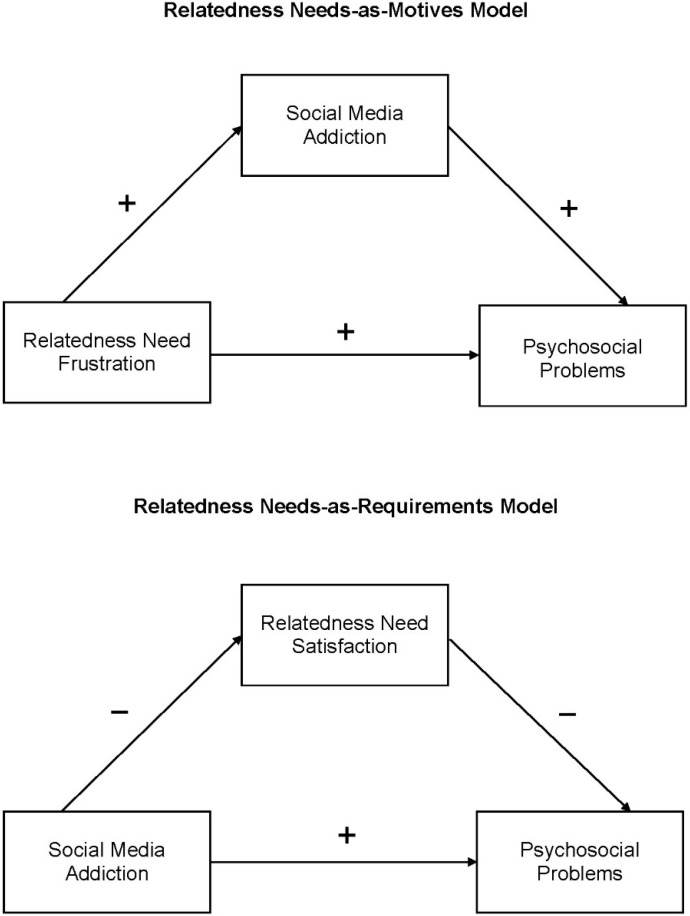
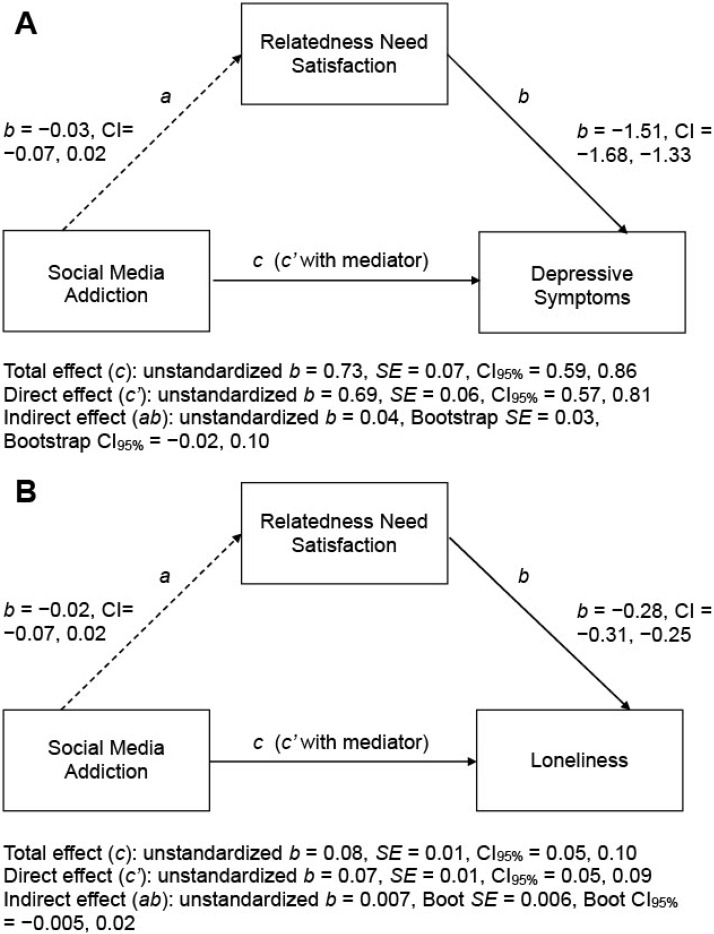
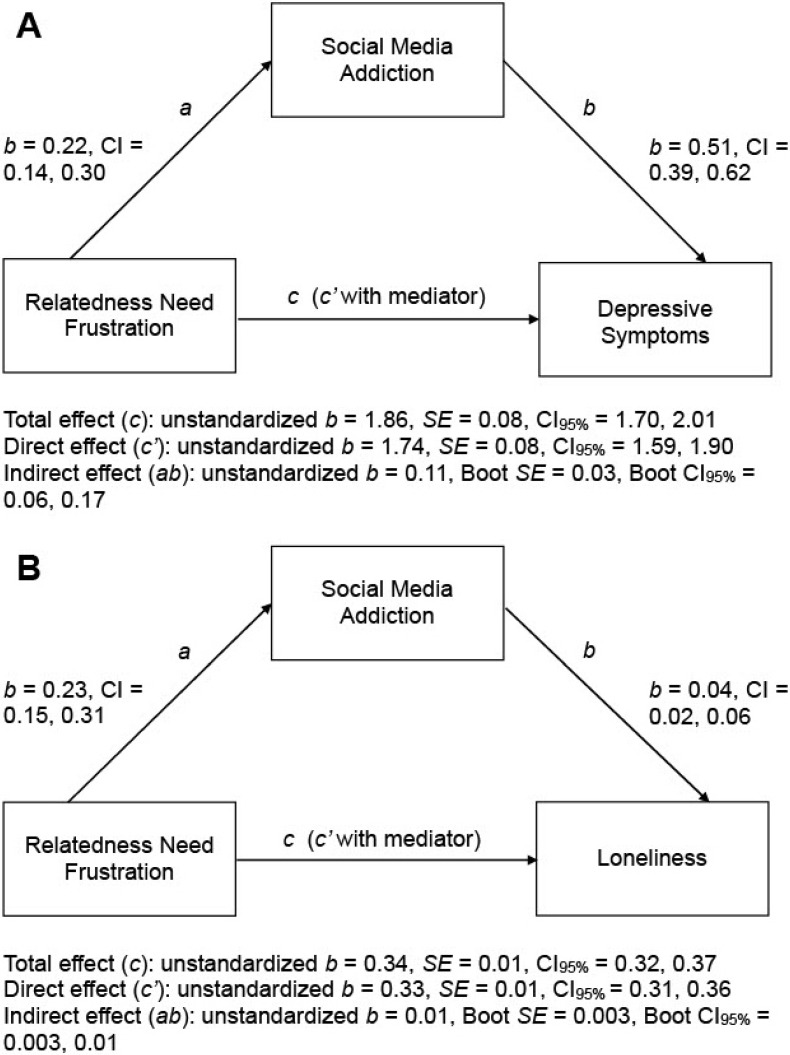
In the early stages of the coronavirus disease 2019 (COVID-19) pandemic, national lockdowns and stay-at-home orders were implemented by many countries to curb the rate of infection. An extended stay-at-home period can frustrate people's need for relatedness, with many turning to social media to interact with others in the outside world. However, social media use may be maladaptive due to its associations with social media addiction and psychosocial problems. Our study was set at this special context to examine the associations among social media addiction, two aspects of relatedness needs (i.e., satisfaction and frustration), and two prominent psychosocial problems (i.e., depressive symptoms and loneliness). The participants were 1048 residents of the U.K. or U.S. (46% men, mean age = 44.10 years, = 12.59, age range: 18-65). The results indicated significant positive associations between relatedness need frustration and social media addiction as well as significant positive associations between social media addiction and the two types of psychosocial problems. More importantly, both of these significant associations were strong enough to partially explain the significant positive associations between relatedness need frustration and the two types of psychosocial problems. These findings provided some support for relatedness need frustration as a motivation of social media addiction.
在 2019 年冠状病毒病(COVID-19)大流行的早期阶段,许多国家实施了全国封锁和居家令,以遏制感染率。延长居家时间会挫败人们对关联性的需求,许多人会转向社交媒体与外界的其他人互动。然而,由于社交媒体与社交媒体成瘾和心理社会问题有关,因此其使用可能是不合适的。我们的研究是在这种特殊背景下进行的,旨在研究社交媒体成瘾、关联性需求的两个方面(即满足感和挫败感)以及两个突出的心理社会问题(即抑郁症状和孤独感)之间的关联。参与者是来自英国或美国的 1048 名居民(46%为男性,平均年龄为 44.10 岁, = 12.59,年龄范围为 18-65 岁)。结果表明,关联性需求挫败感与社交媒体成瘾之间存在显著的正相关关系,以及社交媒体成瘾与两种心理社会问题之间存在显著的正相关关系。更重要的是,这两个显著的关联足以部分解释关联性需求挫败感与两种心理社会问题之间的显著正相关关系。这些发现为关联性需求挫败感作为社交媒体成瘾的动机提供了一些支持。