Pathogenesis and Control of Chronic and Emerging Infections, University of Montpellier, INSERM, EFS, 34000 Montpellier, France.
National Reference Laboratory for Viral Zoonoses, National Public Health Center, 1097 Albert Flórián Road 2-6, 1097 Budapest, Hungary.
Viruses. 2022 Apr 4;14(4):756. doi: 10.3390/v14040756.
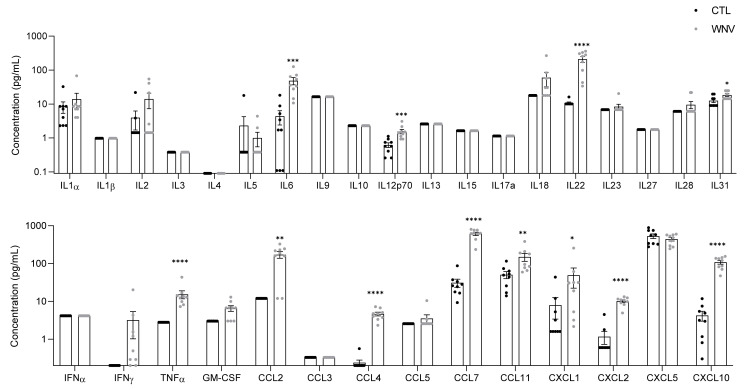
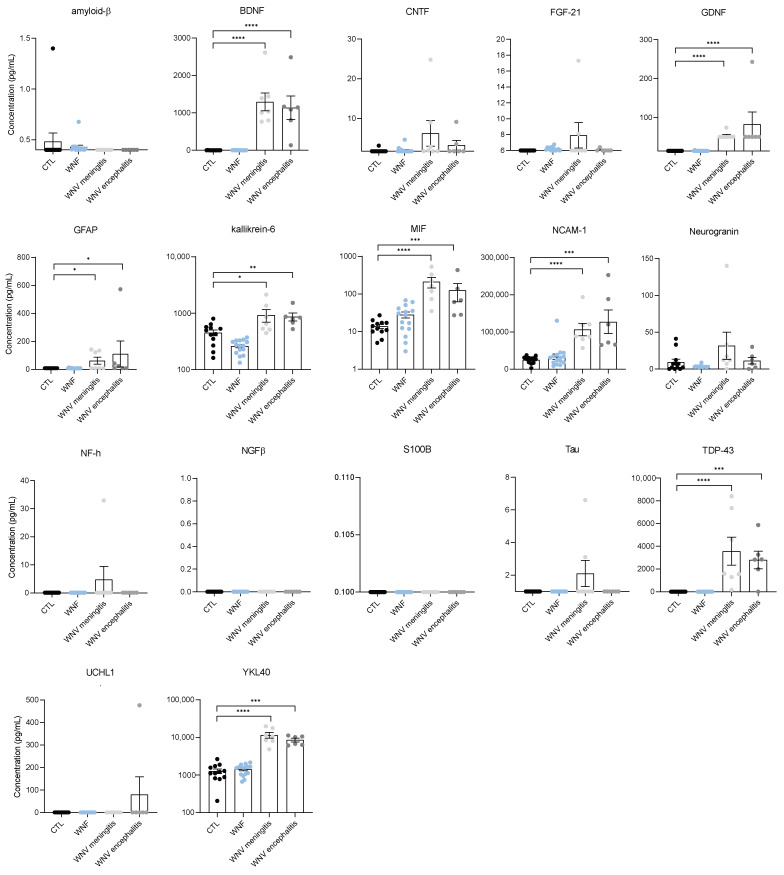
Among emerging arthropod-borne viruses (arbovirus), West Nile virus (WNV) is a flavivirus that can be associated with severe neuroinvasive infections in humans. In 2018, the European WNV epidemic resulted in over 2000 cases, representing the most important arboviral epidemic in the European continent. Characterization of inflammation and neuronal biomarkers released during WNV infection, especially in the context of neuronal impairments, could provide insight into the development of predictive tools that could be beneficial for patient outcomes. We first analyzed the inflammatory signature in the serum of WNV-infected mice and found increased concentrations of several inflammatory cytokines. We next analyzed serum and cerebrospinal-fluid (CSF) samples from a cohort of patients infected by WNV between 2018 and 2019 in Hungary to quantify a large panel of inflammatory cytokines and neurological factors. We found higher levels of inflammatory cytokines (e.g., IL4, IL6, and IL10) and neuronal factors (e.g., BDNF, GFAP, MIF, TDP-43) in the sera of WNV-infected patients with neuroinvasive disease. Furthermore, the serum inflammatory profile of these patients persisted for several weeks after initial infection, potentially leading to long-term sequelae and having a deleterious effect on brain neurovasculature. This work suggests that early signs of increased serum concentrations of inflammatory cytokines and neuronal factors could be a signature underlying the development of severe neurological impairments. Biomarkers could play an important role in patient monitoring to improve care and prevent undesirable outcomes.
在新兴的虫媒病毒(arbovirus)中,西尼罗河病毒(WNV)是一种黄病毒,可导致人类严重的神经侵袭性感染。2018 年,欧洲的 WNV 疫情导致超过 2000 例病例,是欧洲大陆最重要的虫媒病毒疫情之一。WNV 感染期间释放的炎症和神经元生物标志物的特征,特别是在神经元损伤的背景下,可以深入了解开发预测工具的情况,这些工具可能对患者的结果有益。我们首先分析了感染 WNV 的小鼠血清中的炎症特征,发现几种炎症细胞因子的浓度增加。接下来,我们分析了 2018 年至 2019 年期间匈牙利感染 WNV 的患者的血清和脑脊液(CSF)样本,以定量分析大量炎症细胞因子和神经因子。我们发现,患有神经侵袭性疾病的 WNV 感染患者的血清中炎症细胞因子(例如,IL4、IL6 和 IL10)和神经元因子(例如,BDNF、GFAP、MIF 和 TDP-43)水平更高。此外,这些患者的血清炎症特征在初次感染后持续数周,可能导致长期后遗症,并对大脑神经血管造成有害影响。这项工作表明,炎症细胞因子和神经元因子血清浓度升高的早期迹象可能是导致严重神经损伤发展的特征。生物标志物在患者监测中可能发挥重要作用,以改善护理并预防不良后果。