Department of Computer Engineering, School of Information and Communication Technology, University of Phayao, Phayao 56000, Thailand.
Department of Mathematics, Faculty of Applied Science, King Mongkut's University of Technology North Bangkok, Bangkok 10800, Thailand.
Sensors (Basel). 2022 Apr 18;22(8):3094. doi: 10.3390/s22083094.
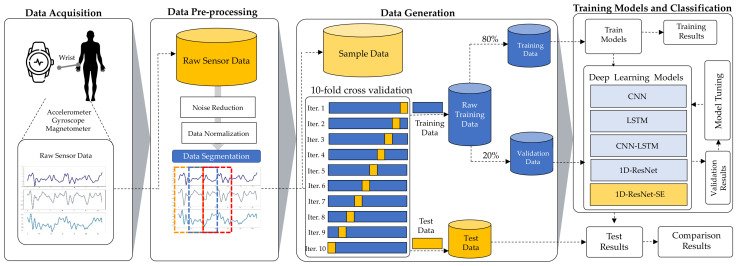
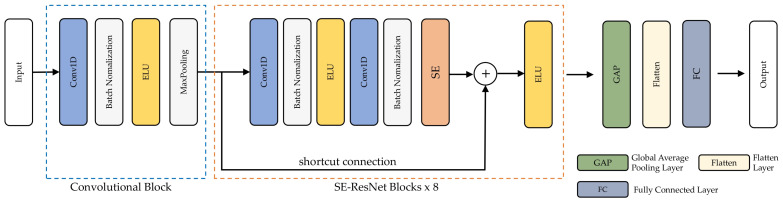
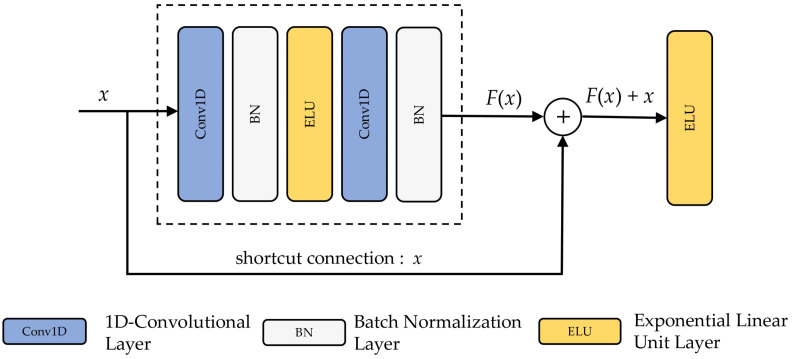
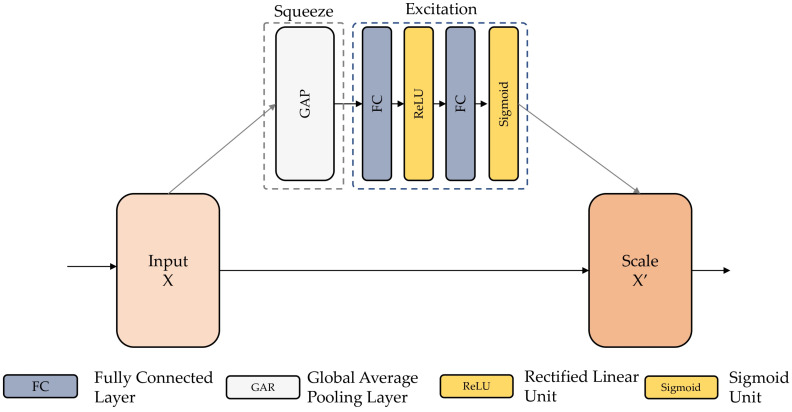
Wearable technology has advanced significantly and is now used in various entertainment and business contexts. Authentication methods could be trustworthy, transparent, and non-intrusive to guarantee that users can engage in online communications without consequences. An authentication system on a security framework starts with a process for identifying the user to ensure that the user is permitted. Establishing and verifying an individual's appearance usually requires a lot of effort. Recent years have seen an increase in the usage of activity-based user identification systems to identify individuals. Despite this, there has not been much research into how complex hand movements can be used to determine the identity of an individual. This research used a one-dimensional residual network with squeeze-and-excitation (SE) configurations called the 1D-ResNet-SE model to investigate hand movements and user identification. According to the findings, the SE modules have enhanced the one-dimensional residual network's identification ability. As a deep learning model, the proposed methodology is capable of effectively identifying features from the input smartwatch sensor and could be utilized as an end-to-end model to clarify the modeling process. The 1D-ResNet-SE identification model is superior to the other models. Hand movement assessment based on deep learning is an effective technique to identify smartwatch users.
可穿戴技术已经取得了显著进展,现在被广泛应用于各种娱乐和商业场景中。身份验证方法需要具有可信度、透明度和非侵入性,以确保用户能够在不承担后果的情况下进行在线通信。安全框架上的身份验证系统首先需要一个识别用户的过程,以确保用户被允许访问。建立和验证个人的身份通常需要付出很多努力。近年来,人们越来越多地使用基于活动的用户识别系统来识别个人。尽管如此,对于如何利用复杂的手部动作来确定个人身份,研究还不多。这项研究使用了一种称为 1D-ResNet-SE 模型的具有挤压和激励(SE)配置的一维残差网络来研究手部运动和用户识别。根据研究结果,SE 模块提高了一维残差网络的识别能力。作为一种深度学习模型,所提出的方法能够有效地从输入的智能手表传感器中识别特征,并且可以作为端到端模型来简化建模过程。1D-ResNet-SE 识别模型优于其他模型。基于深度学习的手部运动评估是识别智能手表用户的有效技术。