Center for Research in Global Mental Health, National Institute of Psychiatry Ramon de la Fuente Muñiz, Calzada México-Xochimilco 101, Col. San Lorenzo Huipulco, Alc. Tlalpan, 14370, Mexico City, Mexico.
Instituto Nacional de Infectologia Evandro Chagas, Fundação Oswaldo Cruz (INI-Fiocruz), Rio de Janeiro, RJ, Brazil.
BMC Health Serv Res. 2022 Apr 22;22(1):532. doi: 10.1186/s12913-022-07900-y.
In order to end the HIV epidemic by 2030, combination HIV prevention including pre-exposure prophylaxis (PrEP) should be widely available, especially for the most vulnerable populations. In Latin America and the Caribbean (LAC), only 14 out of 46 countries have access to PrEP. In Brazil and Mexico, PrEP has been provided at no cost through the Public Health System since 2017 and 2021, respectively. Thus, HIV physicians' perspectives about PrEP and other prevention strategies may differ. This study aimed to compare awareness, knowledge, and attitudes related to PrEP and other prevention strategies among HIV physicians from Brazil and Mexico.
Cross-sectional, web-based survey targeting physicians who prescribe antiretrovirals from both countries. Participants answered questions on socio-demographic, medical experience, awareness, knowledge, and attitudes towards PrEP and other HIV prevention strategies. We stratified all variables per country and compared frequencies using Chi-square, Fisher exact, and Wilcoxon-Mann-Whitney tests, as appropriate.
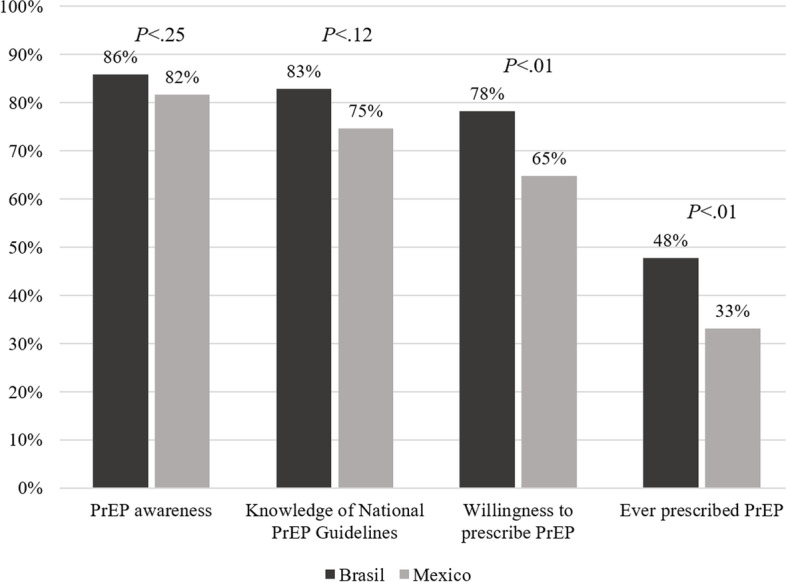
From January-October 2020, 481 HIV physicians were included: 339(70.5%) from Brazil, 276(57.4%) male, and median age was 43 years (IQR = 36-53). Awareness of PrEP did not differ between Brazil and Mexico (84.6%), while awareness of other prevention strategies, including post-exposure prophylaxis and new PrEP technologies, was higher in Brazil. More Brazilians perceived U=U as completely accurate compared to Mexicans (74.0% vs. 62.0%, P < .001). Willingness to prescribe PrEP was 74.2%, higher among Brazilians (78.2%, P = .01). Overall, participants had concerns about consistent access to PrEP medication and the risk of antiretroviral resistance in case of acute HIV infection or seroconversion. The main barriers reported were assumptions that users could have low PrEP knowledge (62.0%) or limited capacity for adherence (59.0%). Compared to Brazilians, Mexicans reported more concerns and barriers to PrEP prescription (all; P ≤ .05), except for consistent access to PrEP medication and the lack of professionals to prescribe PrEP (both; P ≤ .01).
Although awareness of PrEP was similar in Brazil and Mexico, differences in knowledge and attitudes may reflect the availability and stage of PrEP implementation in these countries. Strengthening and increasing information on PrEP technologies and other HIV prevention strategies among HIV physicians could improve their comfort to prescribe these strategies and facilitate their scale-up in LAC.
为了在 2030 年终结艾滋病流行,应广泛提供包括暴露前预防(PrEP)在内的综合艾滋病预防措施,尤其应面向最脆弱人群。在拉丁美洲和加勒比地区(LAC),46 个国家中仅有 14 个国家可以获得 PrEP。巴西和墨西哥分别自 2017 年和 2021 年起通过公共卫生系统免费提供 PrEP。因此,巴西和墨西哥的 HIV 医生对 PrEP 和其他预防策略的看法可能存在差异。本研究旨在比较巴西和墨西哥 HIV 医生对 PrEP 和其他预防策略的认知、知识和态度。
这是一项针对两国开具抗逆转录病毒药物的医生的横断面、基于网络的调查。参与者回答了有关社会人口统计学、医疗经验、对 PrEP 和其他 HIV 预防策略的认知、知识和态度的问题。我们按国家对所有变量进行分层,并使用卡方检验、Fisher 确切检验和 Wilcoxon-Mann-Whitney 检验(视情况而定)比较频率。
2020 年 1 月至 10 月期间,共纳入 481 名 HIV 医生:339 名(70.5%)来自巴西,276 名(57.4%)为男性,中位年龄为 43 岁(IQR=36-53)。巴西和墨西哥对 PrEP 的认知率无差异(84.6%),但对其他预防策略的认知率更高,包括暴露后预防和新的 PrEP 技术。与墨西哥人相比,更多的巴西人认为 U=U 完全准确(74.0%比 62.0%,P<.001)。愿意开具 PrEP 的比例为 74.2%,巴西人更高(78.2%,P=.01)。总体而言,参与者对 PrEP 药物持续获得和急性 HIV 感染或血清转化时抗逆转录病毒耐药的风险存在担忧。报告的主要障碍是使用者可能 PrEP 知识水平低(62.0%)或遵医嘱能力有限(59.0%)的假设。与巴西人相比,墨西哥人报告的对 PrEP 处方的担忧和障碍更多(均为 P≤.05),但 PrEP 药物持续获得和缺乏开具 PrEP 的专业人员(均为 P≤.01)除外。
尽管巴西和墨西哥对 PrEP 的认知相似,但知识和态度的差异可能反映了这些国家 PrEP 的可及性和实施阶段。加强和增加 HIV 医生对 PrEP 技术和其他 HIV 预防策略的了解,可以提高他们开具这些策略的舒适度,并促进在 LAC 推广这些策略。