Moeller Julia
Leipzig University, Germany.
J Pers Oriented Res. 2022 Jan 7;7(2):53-77. doi: 10.17505/jpor.2021.23795. eCollection 2021.
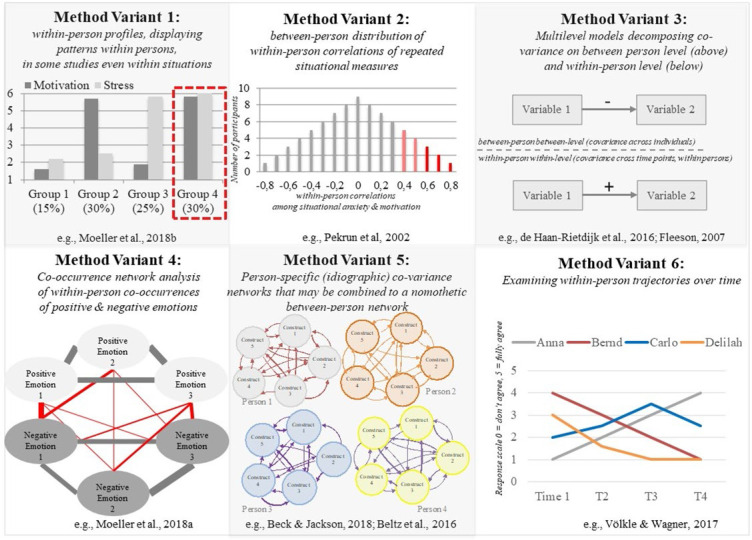
Personalizing assessments, predictions, and treatments of individuals is currently a defining trend in psychological research and applied fields, including personalized learning, personalized medicine, and personalized advertisement. For instance, the recent pandemic has reminded parents and educators of how challenging yet crucial it is to get the right learning task to the right student at the right time. Increasingly, psychologists and social scientists are realizing that the between-person methods that we have long relied upon to describe, predict, and treat individuals may fail to live up to these tasks (e.g., Molenaar, 2004). Consequently, there is a risk of a credibility loss, possibly similar to the one seen during the replicability crisis (Ioannides, 2005), because we have only started to understand how many of the conclusions that we tend to draw based on between-person methods are based on a misunderstanding of what these methods can tell us and what they cannot. An imminent methodological revolution will likely lead to a change of even well-established psychological theories (Barbot et al., 2020). Fortunately, methodological solutions for personalized descriptions and predictions, such as many within-person analyses, are available and undergo rapid development, although they are not yet embraced in all areas of psychology, and some come with their own limitations. This article first discusses the extent of the theory-method gap, consisting of theories about within-person patterns being studied with between-person methods in psychology, and the potential loss of trust that might follow from this theory-method gap. Second, this article addresses advantages and limitations of available within-person methods. Third, this article discusses how within-person methods may help improving the individual descriptions and predictions that are needed in many applied fields that aim for tailored individual solutions, including personalized learning and personalized medicine.
对个体的评估、预测和治疗进行个性化,是当前心理学研究及应用领域的一个决定性趋势,包括个性化学习、个性化医疗和个性化广告。例如,最近的疫情让家长和教育工作者意识到,在正确的时间为正确的学生提供正确的学习任务是多么具有挑战性但又至关重要。越来越多的心理学家和社会科学家意识到,我们长期以来依赖的用于描述、预测和治疗个体的人之间的方法可能无法胜任这些任务(例如,莫伦纳尔,2004)。因此,存在信誉丧失的风险,可能类似于在可重复性危机期间看到的情况(约阿尼迪斯,2005),因为我们才刚刚开始理解,我们倾向于基于人之间的方法得出的许多结论,有多少是基于对这些方法能告诉我们什么和不能告诉我们什么的误解。一场迫在眉睫的方法学革命可能会导致即使是成熟的心理学理论也发生变化(巴尔博特等人,2020)。幸运的是,用于个性化描述和预测的方法学解决方案,比如许多个体内部分析方法,已经存在并且正在迅速发展,尽管它们尚未在心理学的所有领域得到应用,而且有些方法也有其自身的局限性。本文首先讨论理论 - 方法差距的程度,即在心理学中用研究人之间模式的方法来研究个体内部模式所导致的差距,以及这种理论 - 方法差距可能带来的信任丧失风险。其次,本文阐述现有个体内部方法的优点和局限性。第三,本文讨论个体内部方法如何有助于改进许多旨在提供量身定制的个体解决方案的应用领域(包括个性化学习和个性化医疗)所需 的个体描述和预测。