Wongvibulsin Shannon, Frech Tracy M, Chren Mary-Margaret, Tkaczyk Eric R
Department of Dermatology, Johns Hopkins University School of Medicine, Baltimore, Maryland, USA.
Department of Medicine, University of Pittsburgh Medical Center, Pittsburgh, Pennsylvania, USA.
JID Innov. 2022 Feb 1;2(3):100105. doi: 10.1016/j.xjidi.2022.100105. eCollection 2022 May.
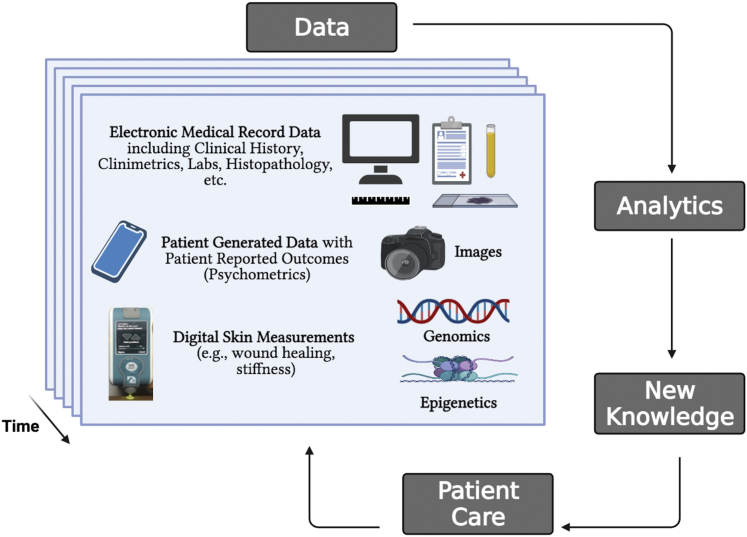
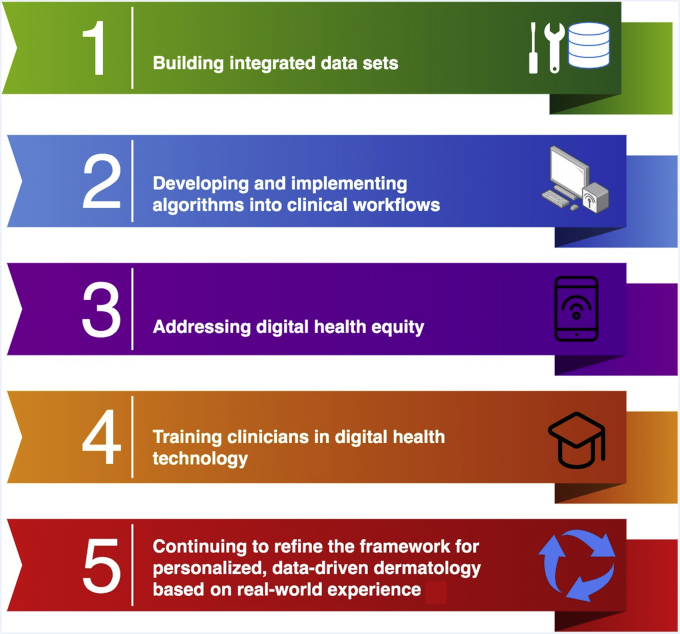
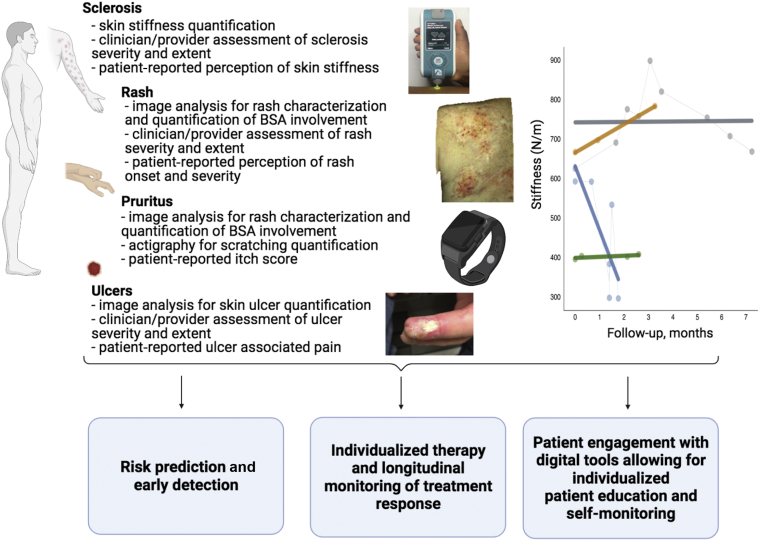
The current revolution of digital health technology and machine learning offers enormous potential to improve patient care. Nevertheless, it is essential to recognize that dermatology requires an approach different from those of other specialties. For many dermatological conditions, there is a lack of standardized methodology for quantitatively tracking disease progression and treatment response (clinimetrics). Furthermore, dermatological diseases impact patients in complex ways, some of which can be measured only through patient reports (psychometrics). New tools using digital health technology (e.g., smartphone applications, wearable devices) can aid in capturing both clinimetric and psychometric variables over time. With these data, machine learning can inform efforts to improve health care by, for example, the identification of high-risk patient groups, optimization of treatment strategies, and prediction of disease outcomes. We use the term personalized, data-driven dermatology to refer to the use of comprehensive data to inform individual patient care and improve patient outcomes. In this paper, we provide a framework that includes data from multiple sources, leverages digital health technology, and uses machine learning. Although this framework is applicable broadly to dermatological conditions, we use the example of a serious inflammatory skin condition, chronic cutaneous graft-versus-host disease, to illustrate personalized, data-driven dermatology.
当前数字健康技术和机器学习的变革为改善患者护理提供了巨大潜力。然而,必须认识到皮肤病学需要一种不同于其他专科的方法。对于许多皮肤病,缺乏用于定量跟踪疾病进展和治疗反应的标准化方法(临床计量学)。此外,皮肤病以复杂的方式影响患者,其中一些只能通过患者报告来衡量(心理计量学)。使用数字健康技术的新工具(如智能手机应用程序、可穿戴设备)可以帮助随着时间推移捕获临床计量和心理计量变量。利用这些数据,机器学习可以通过例如识别高危患者群体、优化治疗策略和预测疾病结果等方式,为改善医疗保健的努力提供信息。我们使用“个性化、数据驱动的皮肤病学”一词来指代利用综合数据为个体患者护理提供信息并改善患者结局。在本文中,我们提供了一个框架,该框架包括来自多个来源的数据,利用数字健康技术,并使用机器学习。尽管这个框架广泛适用于各种皮肤病,但我们以一种严重的炎症性皮肤病——慢性皮肤移植物抗宿主病为例,来说明个性化、数据驱动的皮肤病学。