Hospital Clínico Universitario Santiago de Compostela, A Coruña, Spain.
Hospital Clínic, Institut d'investigacions Biomèdiques August Pi i Sunyer, Barcelona, Spain.
Blood Cancer J. 2022 Apr 25;12(4):76. doi: 10.1038/s41408-022-00647-z.
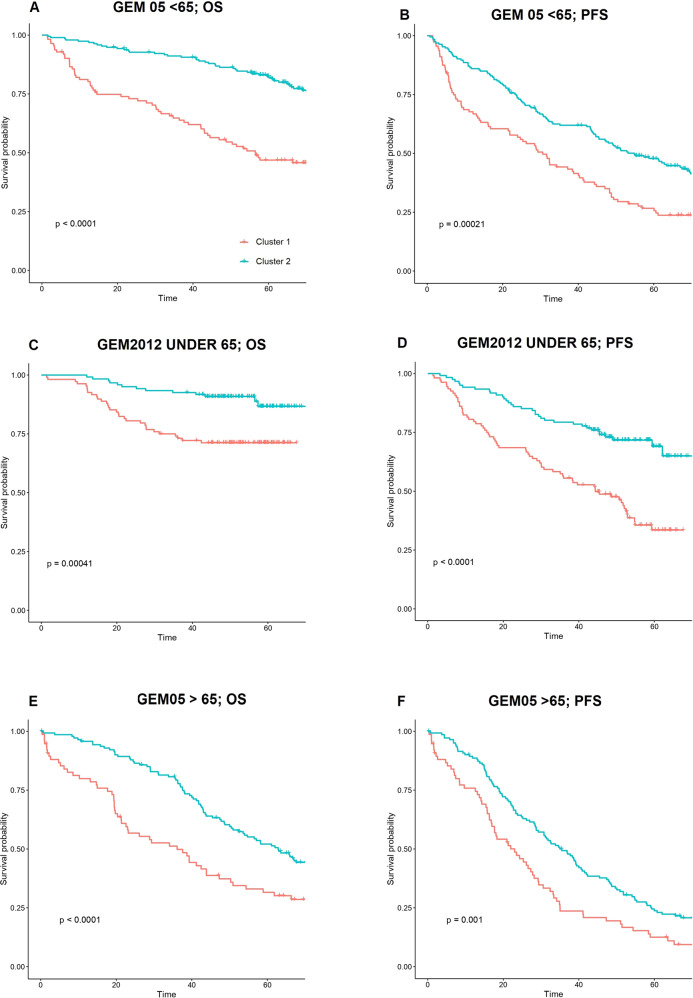
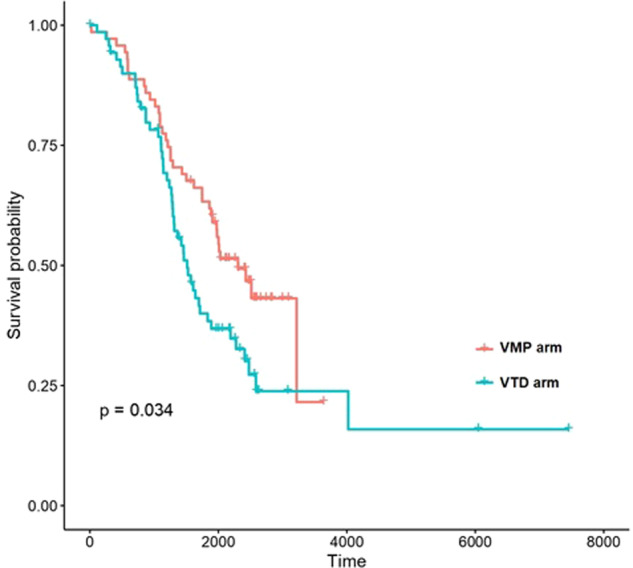
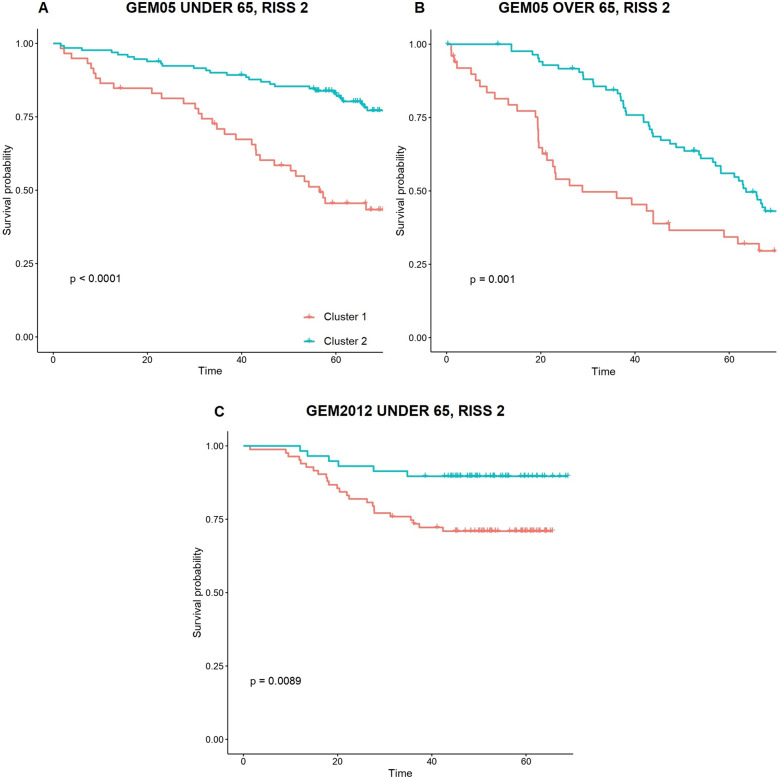
The International Staging System (ISS) and the Revised International Staging System (R-ISS) are commonly used prognostic scores in multiple myeloma (MM). These methods have significant gaps, particularly among intermediate-risk groups. The aim of this study was to improve risk stratification in newly diagnosed MM patients using data from three different trials developed by the Spanish Myeloma Group. For this, we applied an unsupervised machine learning clusterization technique on a set of clinical, biochemical and cytogenetic variables, and we identified two novel clusters of patients with significantly different survival. The prognostic precision of this clusterization was superior to those of ISS and R-ISS scores, and appeared to be particularly useful to improve risk stratification among R-ISS 2 patients. Additionally, patients assigned to the low-risk cluster in the GEM05 over 65 years trial had a significant survival benefit when treated with VMP as compared with VTD. In conclusion, we describe a simple prognostic model for newly diagnosed MM whose predictions are independent of the ISS and R-ISS scores. Notably, the model is particularly useful in order to re-classify R-ISS score 2 patients in 2 different prognostic subgroups. The combination of ISS, R-ISS and unsupervised machine learning clusterization brings a promising approximation to improve MM risk stratification.
国际分期系统(ISS)和修订的国际分期系统(R-ISS)是多发性骨髓瘤(MM)中常用的预后评分。这些方法存在显著的差距,特别是在中危组中。本研究的目的是使用西班牙骨髓瘤组开发的三项不同试验的数据来改善新诊断的 MM 患者的风险分层。为此,我们在一组临床、生化和细胞遗传学变量上应用了无监督机器学习聚类技术,并确定了两组具有显著不同生存的新型患者群。这种聚类的预后精度优于 ISS 和 R-ISS 评分,并且似乎特别有助于改善 R-ISS 2 患者的风险分层。此外,在 GEM05 年龄大于 65 岁的试验中,与 VTD 相比,接受 VMP 治疗的低危组患者的生存获益显著。总之,我们描述了一种用于新诊断 MM 的简单预后模型,其预测结果独立于 ISS 和 R-ISS 评分。值得注意的是,该模型特别有助于将 R-ISS 评分 2 的患者重新分类为 2 个不同的预后亚组。ISS、R-ISS 和无监督机器学习聚类的结合为改善 MM 风险分层带来了有前途的方法。