Department of Urology, Klinikum der Universität München, Munich, Germany.
Urologie und Andrologie am Promenadeplatz, Munich, Germany.
Infection. 2022 Dec;50(6):1499-1505. doi: 10.1007/s15010-022-01828-5. Epub 2022 Apr 26.
To determine the impact of asymptomatic bacteriospermia on semen quality in subfertile men.
We conducted a retrospective, single-centre cohort study in 1300 subfertile men. In those diagnosed with asymptomatic bacteriospermia we performed univariate and multivariate logistic regression models to evaluate the strain-specific association with semen parameters.
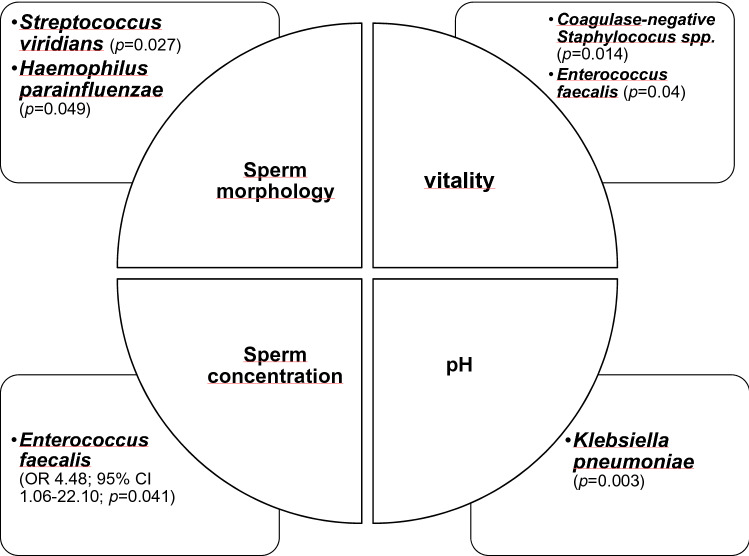
Asymptomatic bacteriospermia was diagnosed in 3.2% of patients. The microbiological semen analysis revealed a poly-microbial result in 60%. The most common bacterial species were coagulase-negative Staphylococci species (71.4%), Streptococcus viridans (50.0%) and Enterococcus faecalis (26.2%). Sexually transmitted pathogens were identified in 11.9% of semen samples. The detection of Streptococcus viridians or Haemophilus parainfluenzae correlated with impaired sperm morphology (p < 0.05). The presence of coagulase-negative Staphylococci species or Enterococcus faecalis was associated with pathological low counts of live spermatozoa (p < 0.05). In multivariate analysis only Enterococcus faecalis showed a significant impact on sperm concentration (OR 4.48; 95% CI 1.06-22.10; p = 0.041).
Asymptomatic bacteriospermia has always been a subject of great controversy. There is still an ongoing debate whether to treat or not to treat. Here, we demonstrate that asymptomatic bacteriospermia is clearly associated with impaired semen quality. Our findings speak in favour of strain-specific interactions with semen parameters. Especially Enterococcus faecalis seriously affects sperm concentration.
确定无症状菌尿症对不育男性精液质量的影响。
我们对 1300 名不育男性进行了回顾性单中心队列研究。在诊断为无症状菌尿症的患者中,我们进行了单变量和多变量逻辑回归模型分析,以评估菌株与精液参数的特定关联。
3.2%的患者被诊断为无症状菌尿症。微生物精液分析显示 60%的结果为多微生物。最常见的细菌种类是凝固酶阴性葡萄球菌(71.4%)、草绿色链球菌(50.0%)和粪肠球菌(26.2%)。11.9%的精液样本中检测到性传播病原体。发现草绿色链球菌或副流感嗜血杆菌与精子形态受损相关(p<0.05)。凝固酶阴性葡萄球菌或粪肠球菌的存在与活精子计数病理性降低相关(p<0.05)。多变量分析仅显示粪肠球菌对精子浓度有显著影响(OR 4.48;95%CI 1.06-22.10;p=0.041)。
无症状菌尿症一直是一个极具争议的话题。是否治疗仍存在争议。在这里,我们证明无症状菌尿症与精液质量受损明显相关。我们的研究结果表明,菌株与精液参数之间存在特定的相互作用。特别是粪肠球菌严重影响精子浓度。