Department of Palliative Medicine, West China School of Public Health and West China Fourth Hospital, Sichuan University, No. 18, Section 3, South Renmin Road, Wuhou District, Chengdu, Sichuan province, China.
Department of Palliative Medicine, West China School of Public Health and West China Fourth Hospital, Sichuan University; West China - PUMC C.C. Chen Institute of Health, Sichuan University, No. 18, Section 3, South Renmin Road, Wuhou District, Chengdu, Sichuan province, China.
BMC Palliat Care. 2022 Apr 27;21(1):57. doi: 10.1186/s12904-022-00947-y.
Palliative sedation is consciously reducing the patient's consciousness to alleviate the refractory symptoms. However, studies on palliative sedation for children are scarce. We aimed to survey the symptom control and risks for children with sedative therapy in end of life.
This study was a single center retrospective cohort study. Children who died in the Department of Palliative Medicine were divided into palliative sedation (Group A) and non-palliative sedation group (Group B). The symptoms relief, survival time, and last hospitalization time were compared between two groups.
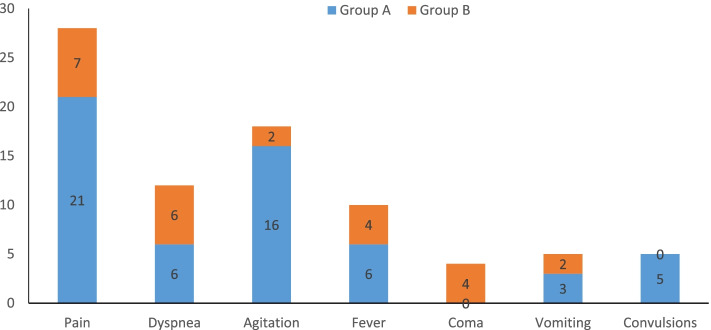
From January 2012 to November 2019, 41 children died in department of palliative care. 24 children were sedated (Group A), meanwhile 17 children were not (Group B). The symptoms in Group A were more complex than Group B (p = 0.013). Overall symptom relief in Group A was higher than that in Group B (24/24, 10/15 p = 0.041). Pain relief rates (7/7, 20/21 p = 0.714), maximum/pre-death opioid dose [30(20, 77.5), 18(9, 45) p = 0.175, 30(20, 60), 18(9, 45) p = 0.208] and pain intensity difference [5(4,6.5), 4(2,6) p = 0.315] did not differ significantly in either groups. After diagnosis, the survival time of the Group A was longer than the Group B (p = 0.047). However, the length of hospitalization before death was similar in two groups (p = 0.385).
Palliative sedation controls complicated, painful symptoms at the end of life and does not shorten the hospitalization time in children.
缓和镇静是有意识地降低患者的意识水平以缓解难治性症状。然而,关于儿童缓和镇静的研究很少。我们旨在调查生命终末期接受镇静治疗的儿童的症状控制和风险。
本研究为单中心回顾性队列研究。在姑息治疗科死亡的儿童分为姑息镇静组(A 组)和非姑息镇静组(B 组)。比较两组患儿的症状缓解、生存时间和最后住院时间。
2012 年 1 月至 2019 年 11 月,共有 41 名儿童在姑息治疗科死亡。24 名儿童接受镇静治疗(A 组),17 名儿童未接受镇静治疗(B 组)。A 组患儿的症状比 B 组更复杂(p=0.013)。A 组总体症状缓解率高于 B 组(24/24,10/15,p=0.041)。两组疼痛缓解率(7/7,20/21,p=0.714)、最大/死亡前阿片类药物剂量[30(20,77.5),18(9,45),p=0.175;30(20,60),18(9,45),p=0.208]和疼痛强度差异[5(4,6.5),4(2,6),p=0.315]差异均无统计学意义。诊断后,A 组的生存时间长于 B 组(p=0.047)。然而,两组的死亡前住院时间相似(p=0.385)。
姑息镇静可控制生命终末期复杂、疼痛的症状,且不会缩短儿童的住院时间。