Pattenden Trent A, Raleigh Rachael A, Pattenden Elle R, Thangasamy Isaac A
Department of Urology Ipswich Hospital Ipswich QLD Australia.
School of Medicine Griffith University QLD Australia.
BJUI Compass. 2021 May 6;2(6):412-418. doi: 10.1002/bco2.87. eCollection 2021 Nov.
To investigate the quality and readability of online patient information on treatment for erectile dysfunction using a Google search.
The results of a Google search for "erectile dysfunction treatment" were reviewed. Webpages that contained written information on erectile dysfunction except those containing scientific publications and paywall protected webpages were included in further analysis. Typographic and treatment information were recorded. Readability was assessed using the Fleisch-Kincaid grade level, the Gunning-Fog index, the Coleman-Liau index, and Simple Measure of Gobbledygook. Website quality was assessed using the DISCERN instrument, Journal of the American Medical Association (JAMA) benchmark criteria, and presence of Health on the net (HON) code certification. Website typography, discussed treatment types, readability scores, and quality measures were reported. Parametric and nonparametric statistical tests were used to compare the data as appropriate dependent on the normality of data.
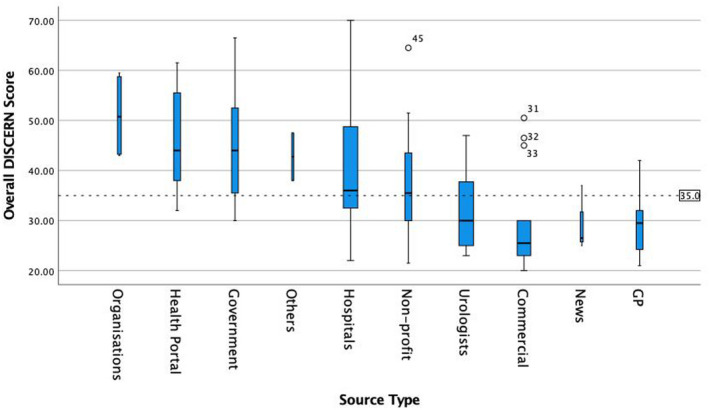
Eighty-one webpages were included. Urologists and hospitals were the most common producers with 15 (18%) each. Seventy-four (91%) webpages contained specific information on treatment for erectile dysfunction and 15 (19%) contained advertisements. Seventeen (21%) webpages were HON code certified. The median DISCERN score was 35 (IQR 26.5-44) out of 80. The mean combined readability score was 12.32 (SD 1.91). The median JAMA benchmark score was 1 (IQR 1-2) out of 4. Google rank had a small negative correlation with DISCERN score ( = -0.16, = .036). HON code certified webpages had higher DISCERN scores (median of 44 [IQR 35-58.5] vs 32.5 [IQR 25.25-42.25], U = 832, Z = 6561, < .001). A linear regression was used to predict DISCERN score based on meeting each JAMA benchmark criterion (F(2, 78) = 22.7, < .001) = 0.368, < .001. Within this model the effects of meeting attribution ( = 11.09) and currency ( = 8.79) criterion were significant.
The quality of online information on treatment for erectile dysfunction is generally poor. However, easy to identify markers of quality like HON code certification, or meeting JAMA benchmark criterion for attribution and currency may help patients to navigate to better quality online information on treatment for erectile dysfunction. Webpages are written at senior high school level, above any recommendations for patient medical information. Health professionals should use validated instruments to assess the quality of online information on treatment for erectile dysfunction prior to publication to improve their utility for patients.
通过谷歌搜索调查在线患者勃起功能障碍治疗信息的质量和可读性。
回顾谷歌搜索“勃起功能障碍治疗”的结果。进一步分析包含勃起功能障碍书面信息的网页,但不包括科学出版物和付费墙保护的网页。记录排版和治疗信息。使用弗莱施-金凯德年级水平、冈宁-福格指数、科尔曼-廖指数和简单费解度测量法评估可读性。使用DISCERN工具、《美国医学会杂志》(JAMA)基准标准和健康网(HON)代码认证来评估网站质量。报告网站排版、讨论的治疗类型、可读性得分和质量指标。根据数据的正态性,酌情使用参数和非参数统计检验来比较数据。
纳入81个网页。泌尿科医生和医院是最常见的信息提供者,各占15个(18%)。74个(91%)网页包含勃起功能障碍治疗的具体信息,15个(19%)包含广告。17个(21%)网页获得了HON代码认证。DISCERN评分中位数为80分中的35分(四分位间距26.5 - 44)。平均综合可读性得分为12.32(标准差1.91)。JAMA基准评分中位数为4分中的1分(四分位间距1 - 2)。谷歌排名与DISCERN评分呈微弱负相关(r = -0.16,P = 0.036)。获得HON代码认证的网页DISCERN评分更高(中位数44分[四分位间距35 - 58.5]对32.5分[四分位间距25.25 - 42.25],U = 832,Z = 6561,P < 0.001)。使用线性回归根据满足每个JAMA基准标准来预测DISCERN评分(F(2, 78) = 22.7,P < 0.001),β = 0.368,P < 0.001。在此模型中,满足归因(β = 11.09)和时效性(β = 8.79)标准的影响显著。
在线勃起功能障碍治疗信息的质量普遍较差。然而,易于识别的质量标志,如HON代码认证,或满足JAMA归因和时效性基准标准,可能有助于患者找到质量更高的在线勃起功能障碍治疗信息。网页的写作水平为高中水平,高于患者医疗信息的任何建议。医疗专业人员在发布前应使用经过验证的工具来评估在线勃起功能障碍治疗信息的质量,以提高其对患者的实用性。