Max-Planck-Institut für Kohlenforschung, Mülheim an der Ruhr, Germany.
Max-Planck-Institut für Chemische Energiekonversion, Mülheim an der Ruhr, Germany.
Nature. 2022 Apr;604(7907):677-683. doi: 10.1038/s41586-022-04516-4. Epub 2022 Apr 27.
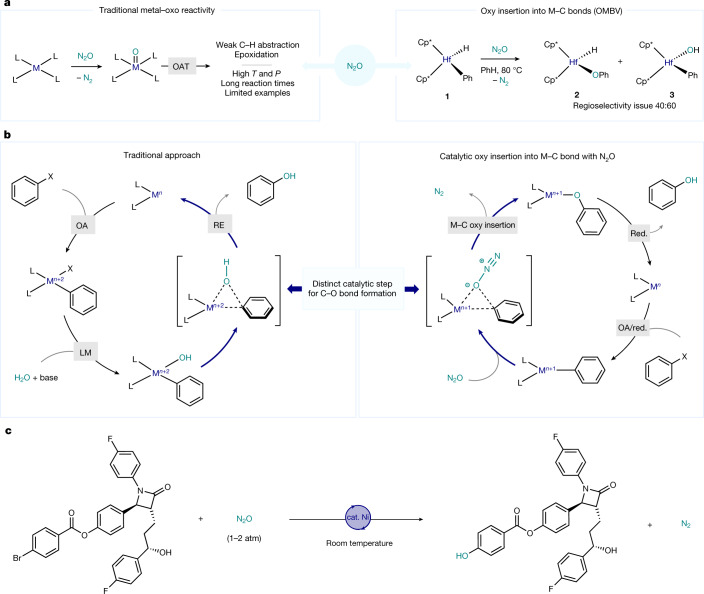
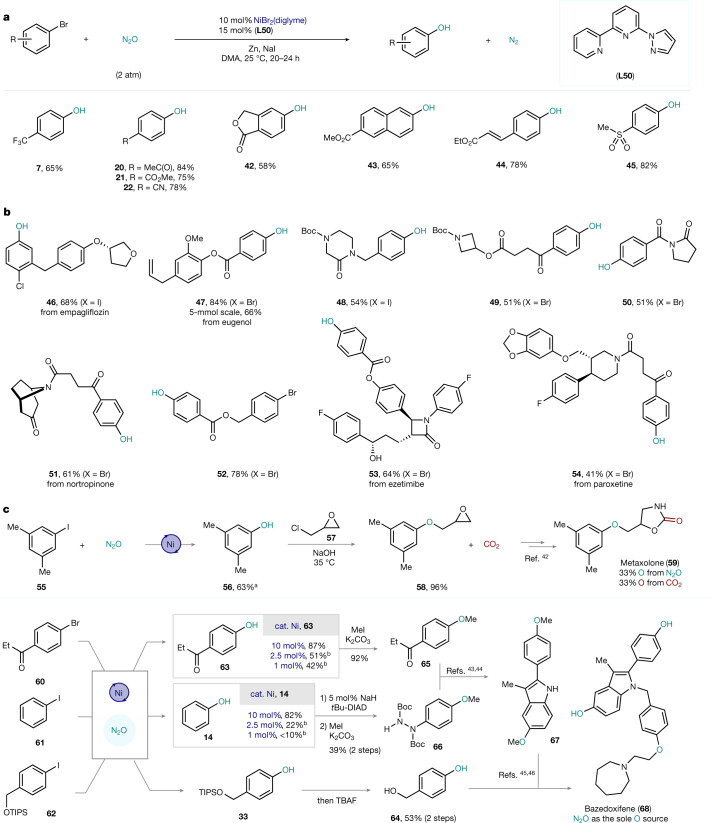
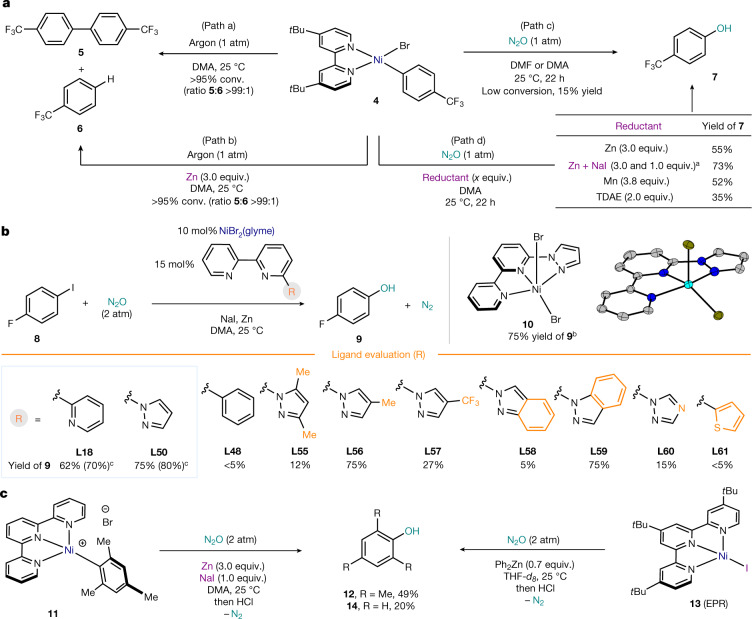
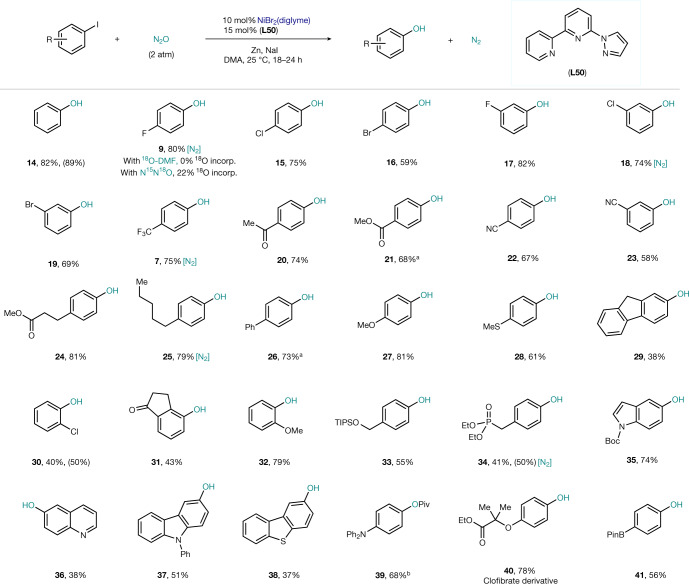
The development of catalytic chemical processes that enable the revalorization of nitrous oxide (NO) is an attractive strategy to alleviate the environmental threat posed by its emissions. Traditionally, NO has been considered an inert molecule, intractable for organic chemists as an oxidant or O-atom transfer reagent, owing to the harsh conditions required for its activation (>150 °C, 50‒200 bar). Here we report an insertion of NO into a Ni‒C bond under mild conditions (room temperature, 1.5-2 bar NO), thus delivering valuable phenols and releasing benign N. This fundamentally distinct organometallic C‒O bond-forming step differs from the current strategies based on reductive elimination and enables an alternative catalytic approach for the conversion of aryl halides to phenols. The process was rendered catalytic by means of a bipyridine-based ligands for the Ni centre. The method is robust, mild and highly selective, able to accommodate base-sensitive functionalities as well as permitting phenol synthesis from densely functionalized aryl halides. Although this protocol does not provide a solution to the mitigation of NO emissions, it represents a reactivity blueprint for the mild revalorization of abundant NO as an O source.
发展催化化学过程以实现一氧化二氮 (NO) 的再利用是缓解其排放对环境造成威胁的一种有吸引力的策略。传统上,由于需要苛刻的条件才能激活 NO(>150°C,50-200 巴),因此 NO 被认为是一种惰性分子,对有机化学家来说难以用作氧化剂或 O-原子转移试剂。在这里,我们报告了在温和条件下(室温,1.5-2 巴 NO)将 NO 插入 Ni‒C 键中,从而提供有价值的酚类化合物并释放良性的 N。这种从根本上不同的金属有机 C‒O 键形成步骤与基于还原消除的现有策略不同,并为芳基卤化物转化为酚类化合物提供了一种替代的催化方法。该过程通过基于联吡啶的配体实现了 Ni 中心的催化。该方法具有稳健、温和和高选择性的特点,能够适应碱性敏感官能团,并允许从高度官能化的芳基卤化物中合成酚类化合物。尽管该方案不能解决减少 NO 排放的问题,但它代表了温和再利用丰富的 NO 作为 O 源的反应性蓝图。