Clough Sophie E, Jousset Alexandre, Elphinstone John G, Friman Ville-Petri
Department of Biology, University of York, York, UK.
Department of Biosciences Chemistry, Durham University, Durham, UK.
Microbiologyopen. 2022 Apr;11(2):e1283. doi: 10.1002/mbo3.1283.
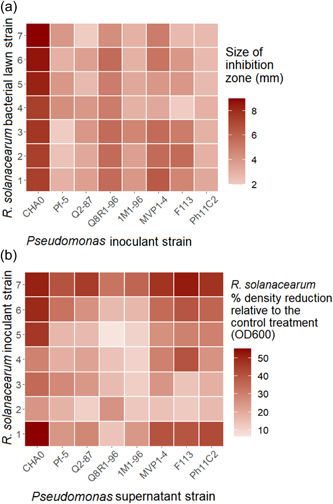
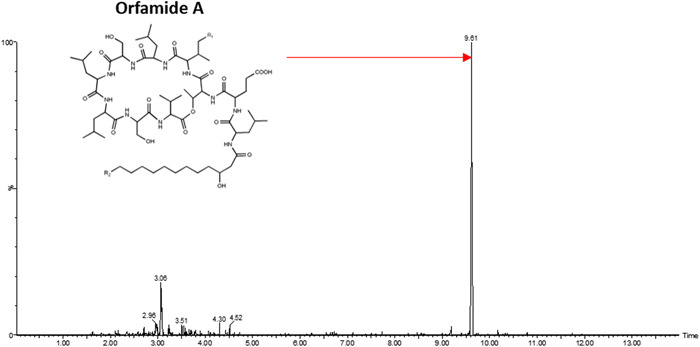
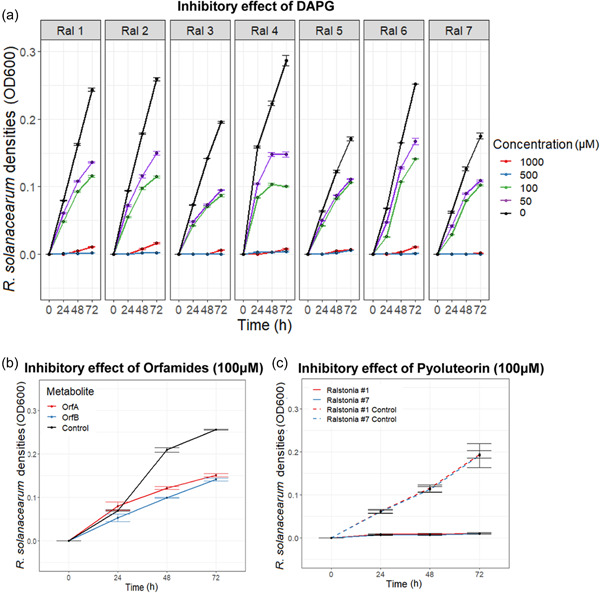
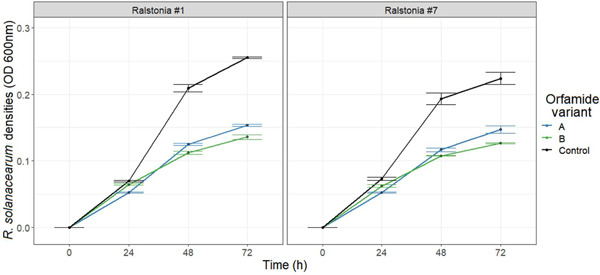
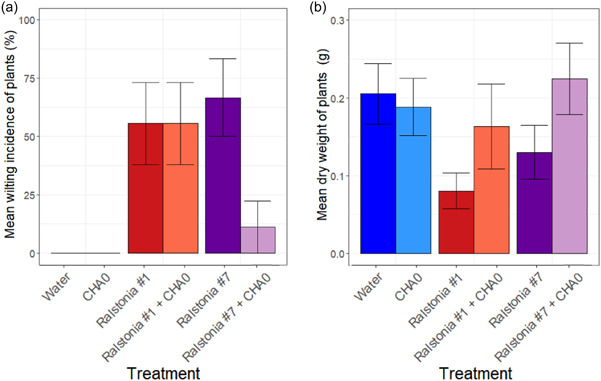
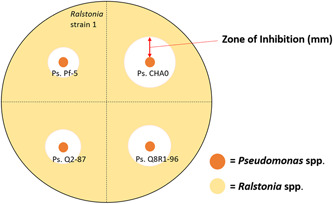
Although plant pathogens are traditionally controlled using synthetic agrochemicals, the availability of commercial bactericides is still limited. One potential control strategy could be the use of plant growth-promoting bacteria (PGPB) to suppress pathogens via resource competition or the production of antimicrobial compounds. This study aimed to conduct in vitro and in vivo screening of eight Pseudomonas strains against Ralstonia solanacearum (the causative agent of bacterial wilt) and to investigate underlying mechanisms of potential pathogen suppression. We found that inhibitory effects were Pseudomonas strain-specific, with strain CHA0 showing the highest pathogen suppression. Genomic screening identified 2,4-diacetylphloroglucinol, pyoluteorin, and orfamides A and B secondary metabolite clusters in the genomes of the most inhibitory strains, which were investigated further. Although all these compounds suppressed R. solanacearum growth, only orfamide A was produced in the growth media based on mass spectrometry. Moreover, orfamide variants extracted from Pseudomonas cultures showed high pathogen suppression. Using the "Micro-Tom" tomato cultivar, it was found that CHA0 could reduce bacterial wilt disease incidence with one of the two tested pathogen strains. Together, these findings suggest that a better understanding of Pseudomonas-Ralstonia interactions in the rhizosphere is required to successfully translate in vitro findings into agricultural applications.
虽然传统上使用合成农药来控制植物病原体,但商业杀菌剂的供应仍然有限。一种潜在的控制策略可能是利用植物促生细菌(PGPB)通过资源竞争或产生抗菌化合物来抑制病原体。本研究旨在对8株假单胞菌菌株针对青枯雷尔氏菌(细菌性枯萎病的病原体)进行体外和体内筛选,并研究潜在病原体抑制的潜在机制。我们发现抑制作用具有假单胞菌菌株特异性,其中CHA0菌株对病原体的抑制作用最强。基因组筛选在最具抑制性的菌株基因组中鉴定出2,4-二乙酰基间苯三酚、绿脓菌素以及orfamide A和B的次生代谢物簇,并对其进行了进一步研究。尽管所有这些化合物都能抑制青枯雷尔氏菌的生长,但基于质谱分析,生长培养基中仅产生了orfamide A。此外,从假单胞菌培养物中提取的orfamide变体对病原体具有高度抑制作用。使用“Micro-Tom”番茄品种,发现CHA0可以降低两种测试病原体菌株之一引起的细菌性枯萎病发病率。总之,这些发现表明,要成功地将体外研究结果转化为农业应用,需要更好地了解根际中假单胞菌与青枯雷尔氏菌的相互作用。