Xia Min, He Qien, Ying Guanghui, Fei Xiapei, Zhou Wenjing, He Xuelin
Department of Nephrology, Beilun People's Hospital, Ningbo, China.
Kidney Disease Center, The First Affiliated Hospital, Zhejiang University School of Medicine, Hangzhou, China.
Front Psychiatry. 2022 Apr 11;13:843263. doi: 10.3389/fpsyt.2022.843263. eCollection 2022.
We conducted this meta-analysis to evaluate the clinical efficacy and safety of massage for the treatment of hemodialysis patients with restless leg syndrome (RLS).
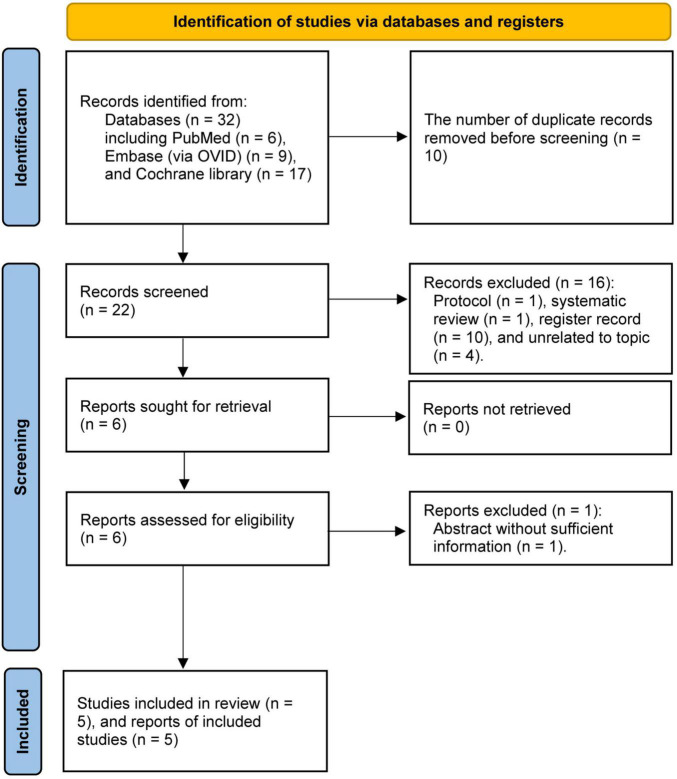
A comprehensive literature search was performed using the PubMed database, EMBASE database ( OVID), and the Cochrane Library in order to identify eligible randomized controlled trials (RCTs) published before August 31, 2021. After extracted essential data and assessed risk of bias of each eligible study, we calculated the pooled estimate of RLS score and safety after treatment. Statistical analysis was performed by using Review Manager 5.3.
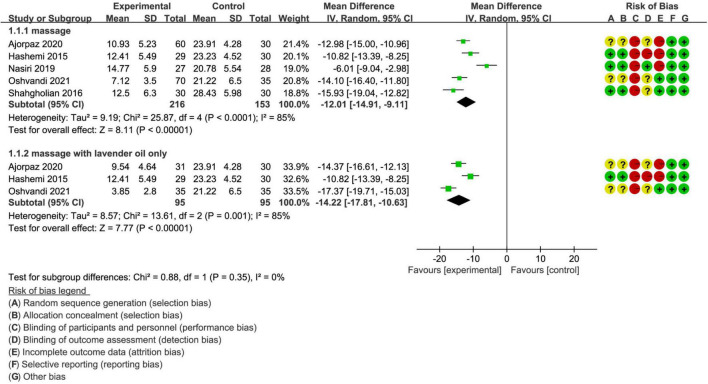
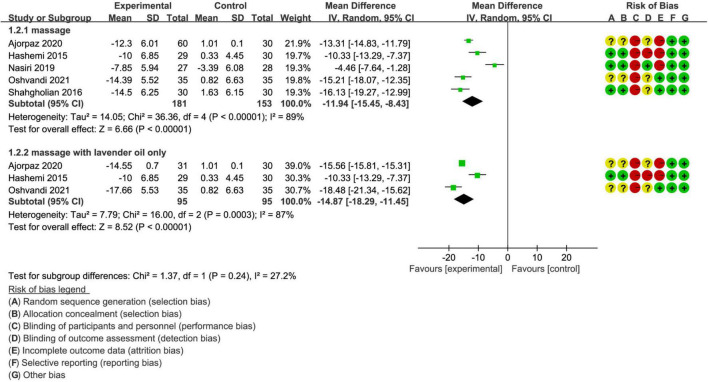
Five studies involving 369 hemodialysis patients with RLS were analyzed. The RLS score after treatment [mean difference (MD), -12.01; 95% confidence interval (CI), -14.91 to -9.11] and mean difference of RLS score at the beginning and end of treatment [mean difference (MD), -11.94; 95% confidence interval (CI), -15.45 to -8.43] in a massage group was significantly better than that in route care group. Subgroup analysis suggested that massage with lavender oil also significantly reduced the RLS score after treatment (MD, -14.22; 95% CI, -17.81 to -10.63) and mean difference of RLS score at the beginning and end of treatment (MD, -14.87; 95% CI, -18.29 to -11.45) compared with route care. Meanwhile, massage regime significantly relieved RLS severity compared with route care but did not increase adverse events.
Massage may be a preferred treatment modality for hemodialysis patients with RLS because it effectively reduces RLS symptoms, relieves RLS severity, and does not increase the risk of adverse events. However, future study with a larger sample size is warranted due to the fact that only limited number of eligible studies with small sample size are enrolled.
我们进行这项荟萃分析以评估按摩治疗血液透析不安腿综合征(RLS)患者的临床疗效和安全性。
使用PubMed数据库、EMBASE数据库(OVID)和Cochrane图书馆进行全面的文献检索,以识别2021年8月31日前发表的符合条件的随机对照试验(RCT)。在提取每个符合条件研究的基本数据并评估偏倚风险后,我们计算了治疗后RLS评分和安全性的合并估计值。使用Review Manager 5.3进行统计分析。
分析了五项涉及369例血液透析RLS患者的研究。按摩组治疗后的RLS评分[平均差(MD),-12.01;95%置信区间(CI),-14.91至-9.11]以及治疗开始和结束时RLS评分的平均差[平均差(MD),-11.94;95%置信区间(CI),-15.45至-8.43]均显著优于常规护理组。亚组分析表明,与常规护理相比,薰衣草油按摩也显著降低了治疗后的RLS评分(MD,-14.22;95%CI,-17.81至-10.63)以及治疗开始和结束时RLS评分的平均差(MD,-14.87;95%CI,-18.29至-11.45)。同时,与常规护理相比,按摩方案显著缓解了RLS严重程度,但未增加不良事件。
按摩可能是血液透析RLS患者的首选治疗方式,因为它能有效减轻RLS症状,缓解RLS严重程度,且不增加不良事件风险。然而,由于仅纳入了数量有限且样本量较小的符合条件研究,未来需要进行更大样本量的研究。