Sisubalan Natarajan, Karthikeyan Chandrasekaran, Senthil Kumar Venugopal, Varaprasad Kokkarachedu, Haja Hameed Abdulrahman Syed Ahamed, Vanajothi Ramar, Sadiku Rotimi
Department of Botany, Bishop Heber College, Affiliated to Bharathidasan University Trichy 620017 Tamil Nadu India.
Centro de Investigaciòn de Polimeros Avanzados (CIPA) Avendia Collao 1202, Edificio de Laboratorios de CIPA Concepciòn Chile
RSC Adv. 2021 Sep 15;11(49):30623-30634. doi: 10.1039/d1ra05948c. eCollection 2021 Sep 14.
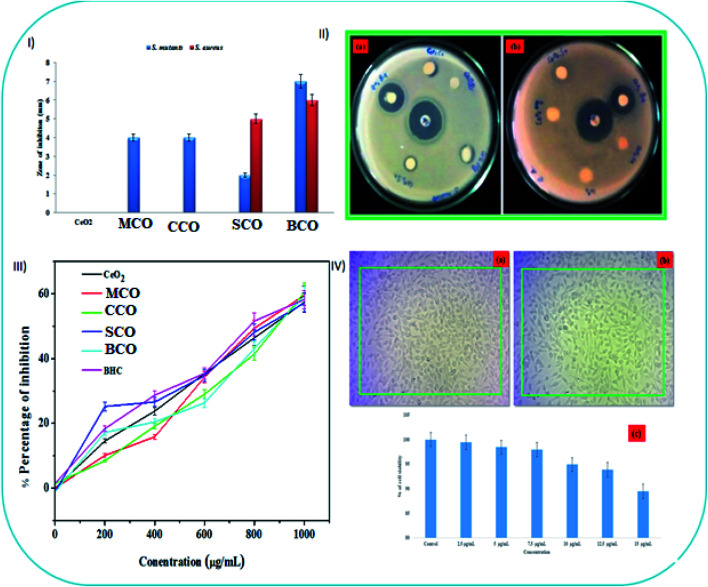
Mishandling of antibiotics often leads to the development of multiple drug resistance (MDR) among microbes, resulting in the failure of infection treatments and putting human health at great risk. As a response, unique nanomaterials with superior bioactivity must be developed to combat bacterial infections. Herein, CeO-based nanomaterials (NMs) were synthesized by employing cerium(iii) nitrate and selective alkaline ions. Moreover, the influence of alkaline ions on CeO was investigated, and their characteristics, : biochemical, structural, and optical properties, were altered. The size of nano Ba-doped CeO (BCO) was ∼2.3 nm, relatively smaller than other NMs and the antibacterial potential of CeO, Mg-doped CeO (MCO), Ca-doped CeO (CCO), Sr-doped CeO (SCO), and Ba-doped CeO (BCO) NMs against () and () strains was assessed. BCO outperformed all NMs in terms of antibacterial efficacy. In addition, achieving the enhanced bioactivity of BCO due to reduced particle size facilitated the easy penetration into the bacterial membrane and the presence of a sizeable interfacial surface. In this study, the minimum quantity of BCO required to achieve the complete inhibition of bacteria was determined to be 1000 μg mL and 1500 μg mL for and , respectively. The cytotoxicity test with L929 fibroblast cells demonstrated that BCO was less toxic to healthy cells. Furthermore, BCO did not show any toxicity and cell morphological changes in the L929 fibroblast cells, which is similar to the control cell morphology. Overall, the results suggest that nano BCO can be used in biomedical applications, which can potentially help improve human health conditions.
抗生素的不当使用常常导致微生物产生多重耐药性(MDR),致使感染治疗失败,并给人类健康带来巨大风险。作为应对措施,必须研发具有卓越生物活性的独特纳米材料来对抗细菌感染。在此,通过使用硝酸铈(III)和选择性碱性离子合成了基于CeO的纳米材料(NMs)。此外,研究了碱性离子对CeO的影响,其生化、结构和光学特性均发生了改变。纳米Ba掺杂CeO(BCO)的尺寸约为2.3纳米,相对小于其他纳米材料,并且评估了CeO、Mg掺杂CeO(MCO)、Ca掺杂CeO(CCO)、Sr掺杂CeO(SCO)和Ba掺杂CeO(BCO)纳米材料对()和()菌株的抗菌潜力。BCO在抗菌效果方面优于所有纳米材料。此外,由于粒径减小实现了BCO生物活性的增强,这有利于其轻松穿透细菌膜并具有相当大的界面表面积。在本研究中,对于和,实现细菌完全抑制所需的BCO最小量分别确定为1000μg/mL和1500μg/mL。对L929成纤维细胞的细胞毒性测试表明,BCO对健康细胞的毒性较小。此外,BCO在L929成纤维细胞中未显示出任何毒性和细胞形态变化,这与对照细胞形态相似。总体而言,结果表明纳米BCO可用于生物医学应用,这可能有助于改善人类健康状况。