Louis Hitler, Onyebuenyi Izubundu B, Odey Joseph O, Igbalagh Azuaga T, Mbonu MaryJane T, Eno Ededet A, Pembere Anthony M S, Offiong Offiong E
Computational and Bio-Simulation Research Group, Department of Pure and Applied Chemistry, University of Calabar Calabar Nigeria
Department of Pure and Applied Chemistry, Faculty of Physical Sciences, University of Calabar Calabar Nigeria.
RSC Adv. 2021 Sep 9;11(45):28433-28446. doi: 10.1039/d1ra05075c. eCollection 2021 Aug 16.
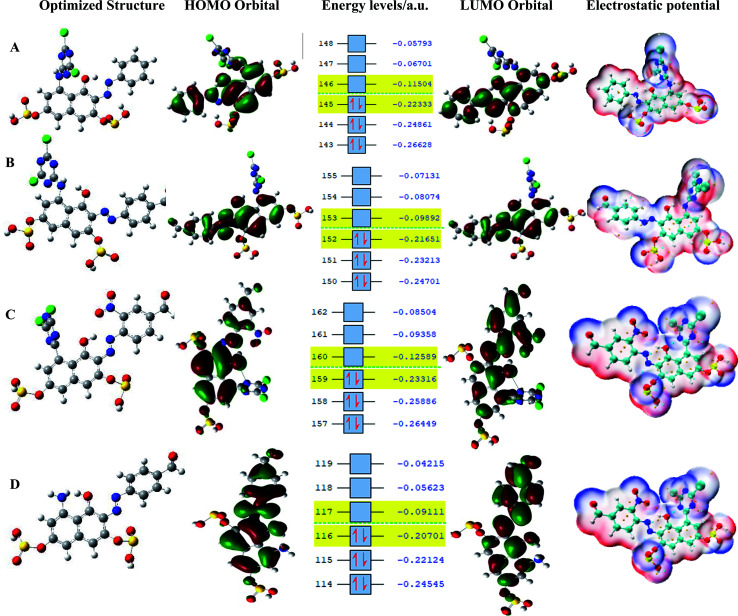
All dyes conduct but at different degrees of absorption; it is interesting to study the degree of conductivity and absorptivity of novel reactive azo-dyes in respect to dye-sensitized solar cells (DSSCs) to ascertain their viability for such applications. In this study, four novel reactive azo-dyes were experimentally synthesized from -aminobenzaldehyde, 4-amino-3-nitrobenzaldehyde, and aniline through series of condensation and coupling reactions. The various functional groups, molecular connectivities, and molecular weight of the various fragments of the synthesized dyes were elucidated using the GC-MS, FT-IR, UV-vis, and NMR respectively. The experimentally determined structures were modeled and investigated using density functional theory (DFT) and time-dependent density functional theory (TD-DFT) approaches to computationally compute the electronic structure properties, reactivity, absorption and solvatochromism in four different phases: gas, ethanol, acetone, and water, and the photovoltaic properties for possible applications in dye-sensitized solar cells (DSSCs). By comparing the HOMO ( ) and the LUMO ( ) energies from the results obtained demonstrates that dye D has the highest energy value of -2.48 eV with a relatively lowest energy value of -5.63 eV such that it lies underneath the conduction band edge of TiO which is necessary to enable charge regeneration. Pi-electron delocalization was observed from the natural bond orbital (NBO) calculations between the different aromatic rings with dye B and A having the relatively highest and least second-order stabilization energies between σ* → σ* and LP* → LP interacting orbitals respectively. It is also observed in all the solvents that the Gibbs free energy of injection (Δ ) is greater than 0.2 eV and hence, all the studied azo structures in the four phases provided efficient electron injection and light harvesting efficiency (LHE), however, the value of Δ for dyes B and D is greatest in all the four phases and thus, provided the highest electron injection of all the dyes. From the fact-findings of quantum theory of atoms-in-molecules (QTAIM), dyes A and C have extra-stability due to their relatively high numbers of intramolecular H-bond interactions along with some additional intra-atomic bonding between atoms within the studied compounds. Hence, all the four dyes are good for DSSCs applications.
所有染料都具有导电性,但吸收程度不同;研究新型活性偶氮染料在染料敏化太阳能电池(DSSC)方面的导电率和吸收率,以确定它们在此类应用中的可行性,是很有趣的。在本研究中,通过一系列缩合和偶联反应,由对氨基苯甲醛、4-氨基-3-硝基苯甲醛和苯胺实验合成了四种新型活性偶氮染料。分别使用气相色谱-质谱联用仪(GC-MS)、傅里叶变换红外光谱仪(FT-IR)、紫外可见光谱仪(UV-vis)和核磁共振仪(NMR)阐明了合成染料各片段的各种官能团、分子连接性和分子量。使用密度泛函理论(DFT)和含时密度泛函理论(TD-DFT)方法对实验测定的结构进行建模和研究,以计算四种不同相(气相、乙醇、丙酮和水)中的电子结构性质、反应活性、吸收和溶剂化显色作用,以及在染料敏化太阳能电池(DSSC)中可能应用的光伏性质。通过比较所得结果中的最高占据分子轨道(HOMO)和最低未占分子轨道(LUMO)能量表明,染料D具有最高的HOMO能量值-2.48 eV和相对最低的LUMO能量值-5.63 eV,使其位于二氧化钛导带边缘之下,这对于实现电荷再生是必要的。从自然键轨道(NBO)计算中观察到不同芳香环之间的π电子离域,染料B和A在σ*→σ和孤对电子→孤对电子相互作用轨道之间分别具有相对最高和最低的二阶稳定能。在所有溶剂中还观察到注入吉布斯自由能(ΔG)大于0.2 eV,因此,四个相中所有研究的偶氮结构都提供了有效的电子注入和光捕获效率(LHE),然而,染料B和D的ΔG值在所有四个相中最大,因此,提供了所有染料中最高的电子注入。根据分子中原子的量子理论(QTAIM)的研究结果,染料A和C由于其分子内氢键相互作用数量相对较多,以及所研究化合物内原子之间的一些额外原子内键合而具有额外稳定性。因此,所有四种染料都适用于DSSC应用。