
利用水合电子降解全氟和多氟烷基物质:从头算计算得到的新机制。
Degradation of Per- and Polyfluoroalkyl Substances with Hydrated Electrons: A New Mechanism from First-Principles Calculations.
机构信息
Department of Chemical & Environmental Engineering, Materials Science & Engineering Program, Department of Physics & Astronomy, and Department of Chemistry, University of California-Riverside, Riverside, California 92521, United States.
Department of Chemistry and Center for Atomistic Modelling and Materials Design, Indian Institute of Technology-Madras, Chennai 6000036, India.
出版信息
Environ Sci Technol. 2022 Jun 21;56(12):8167-8175. doi: 10.1021/acs.est.2c01469. Epub 2022 Apr 28.
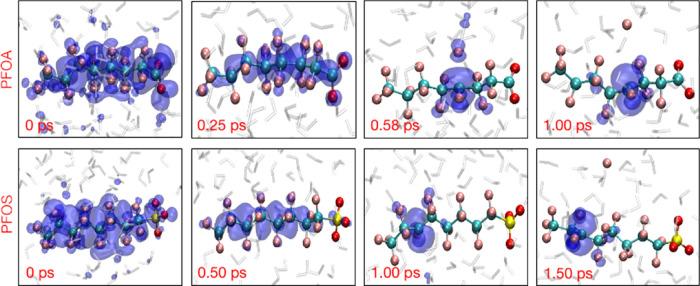
Per- and polyfluoroalkyl substances (PFASs) are synthetic contaminants found in drinking groundwater sources and a wide variety of consumer products. Because of their adverse environmental and human health effects, remediation of these persistent compounds has attracted significant recent attention. To gain mechanistic insight into their remediation, we present the first ab initio study of PFAS degradation via hydrated electrons─a configuration that has not been correctly considered in previous computational studies up to this point. To capture these complex dynamical effects, we harness ab initio molecular dynamics (AIMD) simulations to probe the reactivities of perfluorooctanoic (PFOA) and perfluorooctane sulfonic acid (PFOS) with hydrated electrons in explicit water. We complement our AIMD calculations with advanced metadynamics sampling techniques to compute free energy profiles and detailed statistical analyses of PFOA/PFOS dynamics. Although our calculations show that the activation barrier for C-F bond dissociation in PFOS is three times larger than that in PFOA, all the computed free energy barriers are still relatively low, resulting in a diffusion-limited process. We discuss our results in the context of recent studies on PFAS degradation with hydrated electrons to give insight into the most efficient remediation strategies for these contaminants. Most importantly, we show that the degradation of PFASs with hydrated electrons is markedly different from that with excess electrons/charges, a common (but largely incomplete) approach used in several earlier computational studies.
全氟和多氟烷基物质 (PFASs) 是在饮用水源和各种消费产品中发现的合成污染物。由于它们对环境和人类健康的不利影响,这些持久性化合物的修复引起了最近的广泛关注。为了深入了解它们的修复机制,我们首次进行了全氟辛烷磺酸 (PFOA) 和全氟辛烷磺酸 (PFOS) 通过水合电子降解的从头算研究——到目前为止,这在以前的计算研究中尚未正确考虑到这种构型。为了捕捉这些复杂的动力学效应,我们利用从头算分子动力学 (AIMD) 模拟在显式水中探测水合电子与全氟辛烷磺酸 (PFOA) 和全氟辛烷磺酸 (PFOS) 的反应性。我们用先进的元动力学抽样技术补充我们的 AIMD 计算,以计算 PFOA/PFOS 动力学的自由能曲线和详细的统计分析。尽管我们的计算表明 PFOS 中 C-F 键的离解活化能比 PFOA 高三倍,但所有计算出的自由能势垒仍然相对较低,导致扩散受限过程。我们在最近关于水合电子降解 PFAS 的研究背景下讨论我们的结果,以深入了解这些污染物的最有效修复策略。最重要的是,我们表明水合电子降解 PFASs 的过程与过量电子/电荷降解过程明显不同,这是几个早期计算研究中常用的方法(但很大程度上并不完整)。



 Zotero 插件