Wilhelm Jan, VandeVondele Joost, Rybkin Vladimir V
Department of Chemistry, University of Zurich, Winterthurerstrasse 190, CH-8057, Zurich, Switzerland.
Current address: BASF SE, Ludwigshafen, Germany.
Angew Chem Int Ed Engl. 2019 Mar 18;58(12):3890-3893. doi: 10.1002/anie.201814053. Epub 2019 Feb 18.
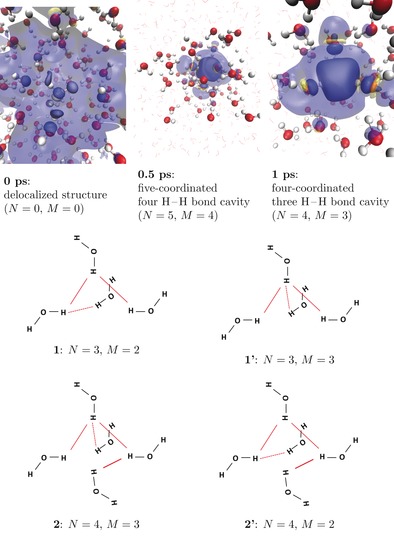
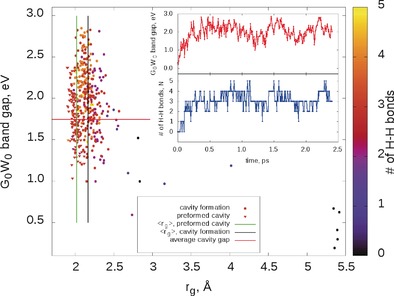
The structure of the hydrated electron is a matter of debate as it evades direct experimental observation owing to the short life time and low concentrations of the species. Herein, the first molecular dynamics simulation of the bulk hydrated electron based on correlated wave-function theory provides conclusive evidence in favor of a persistent tetrahedral cavity made up by four water molecules, and against the existence of stable non-cavity structures. Such a cavity is formed within less than a picosecond after the addition of an excess electron to neat liquid water, with less regular cavities appearing as intermediates. The cavities are bound together by weak H-H bonds, the number of which correlates well with the number of coordinated water molecules, each type of cavity leaving a distinct spectroscopic signature. Simulations predict regions of negative spin density and a gyration radius that are both in agreement with experimental data.
水合电子的结构是一个存在争议的问题,因为由于该物种的寿命短和浓度低,它难以通过直接实验观察到。在此,基于相关波函数理论对大量水合电子进行的首次分子动力学模拟提供了确凿证据,支持由四个水分子组成的持久四面体空穴的存在,并反对稳定的非空穴结构的存在。在向纯液态水添加一个多余电子后不到一皮秒的时间内就会形成这样一个空穴,同时会出现不太规则的空穴作为中间产物。这些空穴通过弱H-H键结合在一起,其数量与配位水分子的数量密切相关,每种类型的空穴都有独特的光谱特征。模拟预测的负自旋密度区域和回转半径均与实验数据一致。