Centre for Health Outcomes Research, Institute for Health Systems Research, National Institutes of Health, Ministry of Health Malaysia, Block B2, No. 1, Jalan Setia Murni U13/52, Seksyen U13 Bandar Setia Alam, 40170, Shah Alam, Selangor, Malaysia.
School of Pharmacy, Monash University Malaysia, Jalan Lagoon Selatan, 47500, Bandar Sunway, Selangor, Malaysia.
BMC Health Serv Res. 2022 Apr 29;22(1):576. doi: 10.1186/s12913-022-07917-3.
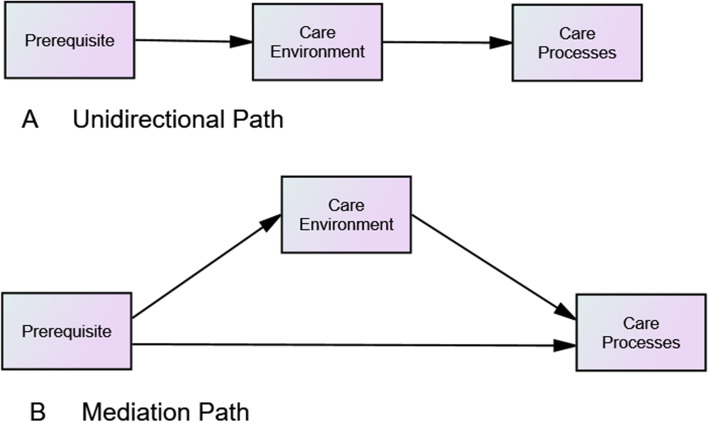
The translation of person-centred care concepts into practice requires fulfilment of necessary components, including person-centred values and practice held by the employees and having a supportive system. The objectives of this study were multifold: firstly, to evaluate the measurement model, secondly, to examine the roles of prerequisite or attributes of healthcare providers and care environment and how they affect delivery of person-centred processes; and finally, to examine the mediating effect of care environment towards the relationship between prerequisite and care processes.
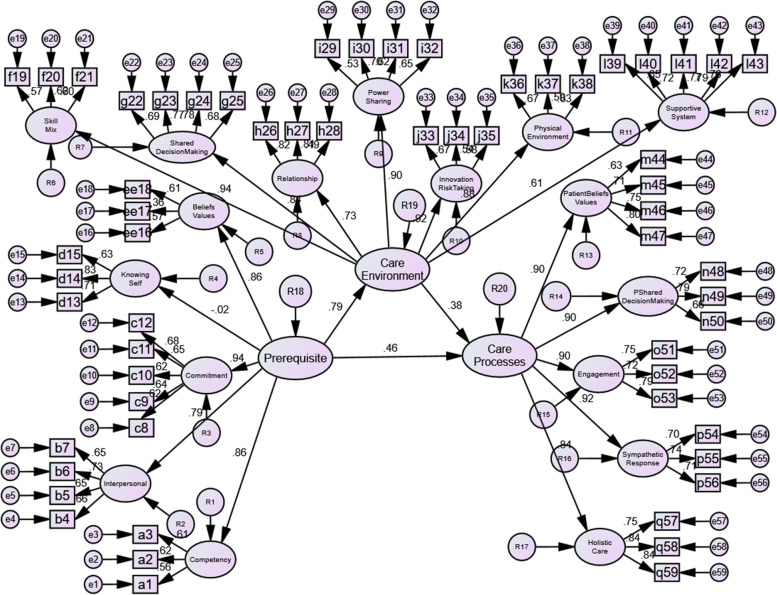
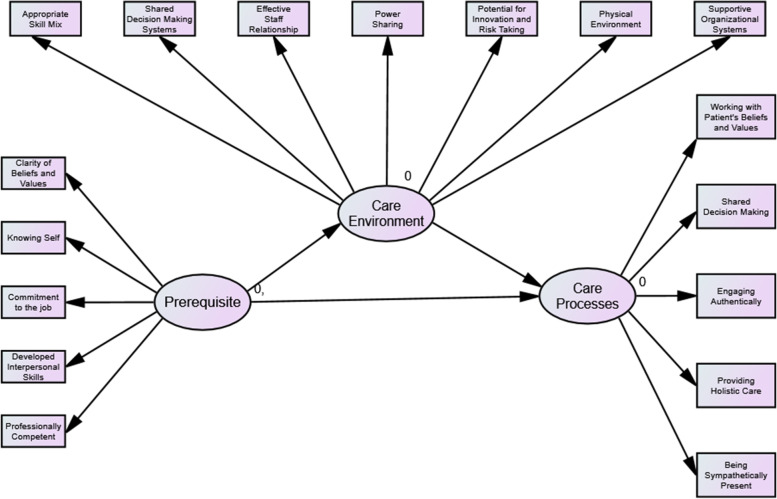
A cross sectional study was conducted among healthcare providers working in primary care facilities in a state in Malaysia. The Person-centred Practice Inventory-Staff instrument (PCPI-S) was distributed and completed by respondents. The instrument structure, reliability and validity were assessed through confirmatory factor analysis, while the framework's unidirectional hypothesis and the mediation path hypothesis were analysed using structural equation modelling.
The overall goodness of fit verifies the original Person-centred Practice Framework, allowing some correlation errors. There were significant relationships between prerequisites of healthcare providers and care environment (β = 0.826, p < 0.001), as well as between care environment and care processes (β = 0.785, p < 0.001). This analysis also proved that care environment plays a partial mediating role in the relationship between prerequisites and care processes.
In order to successfully move towards delivering person-centred practice, it is imperative to equip healthcare providers with person-centred values and beliefs, while at the same time transform current work culture to align with person-centred care. This will allow successful delivery of person-centred processes.
NMRR-18-309-40,447.
将以患者为中心的护理理念转化为实践需要满足必要的组成部分,包括员工所秉持的以患者为中心的价值观和实践以及具有支持性的系统。本研究的目的是多方面的:首先,评估测量模型;其次,研究医疗保健提供者和护理环境的先决条件或属性的作用,以及它们如何影响以患者为中心的护理过程的实施;最后,检验护理环境对先决条件与护理过程之间关系的中介效应。
在马来西亚一个州的基层医疗设施中,进行了一项横断面研究。护理人员完成了以患者为中心的实践框架员工工具(PCPI-S)。通过验证性因子分析评估工具结构、信度和效度,同时使用结构方程模型分析框架的单向假设和中介路径假设。
整体拟合优度验证了原始的以患者为中心的实践框架,允许存在一些相关误差。医疗保健提供者的先决条件与护理环境(β=0.826,p<0.001)以及护理环境与护理过程(β=0.785,p<0.001)之间存在显著关系。分析还证明,护理环境在先决条件与护理过程之间的关系中起着部分中介作用。
为了成功地向以患者为中心的实践迈进,必须使医疗保健提供者具备以患者为中心的价值观和信念,同时将当前的工作文化转变为以患者为中心的护理,从而实现以患者为中心的护理过程的成功实施。
NMRR-18-309-40,447。