March Christine, Omari Jazan, Surov Alexey, Thormann Maximilian, Hass Peter, Pech Maciej, Damm Robert
Department of Radiology and Nuclear Medicine, Otto-von-Guericke-University Magdeburg, Germany.
Department of Radiotherapy, Otto-von-Guericke-University Magdeburg, Germany.
J Contemp Brachytherapy. 2022 Apr;14(2):169-175. doi: 10.5114/jcb.2022.115377. Epub 2022 Apr 7.
Image-guided brachytherapy with a single-fraction irradiation (high-dose-rate brachytherapy - HDR-BT) is a promising local ablation technique for unresectable liver metastases. The occurrence of needle track seeding after biopsy and microwave ablation (MWA) has been documented primarily in hepatocellular carcinoma (HCC). Comprehensive data on colorectal metastases and treatment with HDR-BT is missing. The aim of this study was to investigate the incidence of extra- and intra-hepatic track seeding after HDR-BT in patients with colorectal metastases of the liver, and the identification of possible risk factors.
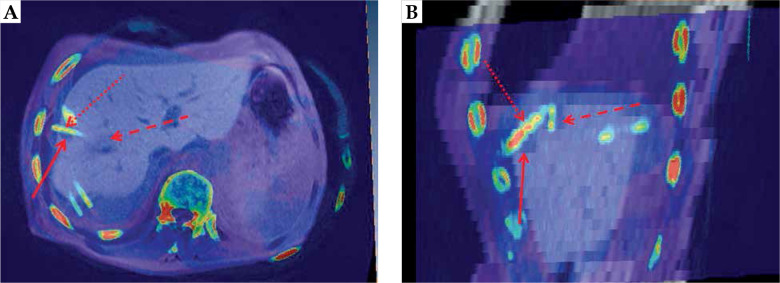
Patients with at least one treatment of HDR-BT were included. Two readers identified possible track seeding after at least 3 months of follow-up. For verification, we used image fusion of CT/MRI images from 3D irradiation plan and follow-up. Intra- and extra-hepatic seeding were included. As possible risk factors, demographics, tumor grading, and aspects of catheter placement were identified, and generalized linear mixed model for evaluation was applied.
On total, 138 patients were included in the study (85 males). We treated 472 liver lesions with 1,107 catheter placements. Sixteen needle track lesions were identified with a catheter-based risk of 1.5% and patient-based risk of 10.9% during a median follow-up of 543 days. Extra-hepatic track seeding (patient-based risk of 1.4%) was found in two patients only. Possible risk factors were tumor grading ( = 0.01) and using MRI-guidance ( = 0.02). There was also a correlation with a high number of interventions per patient ( = 0.009) and number of treated lesions ( = 0.04).
Brachytherapy for treatment of colorectal metastases is associated with a similar risk for extra-hepatic track seeding compared to radio-frequency ablation (RFA). Intra-hepatic seeding, which has not been studied extensively before, occurs more often with seeding frequency comparable to biopsy of colorectal metastases. Possible risk factors could be tumor grading and using MRI-guidance.
图像引导下的单次分割照射近距离放射治疗(高剂量率近距离放射治疗-HDR-BT)是一种有前景的用于不可切除肝转移瘤的局部消融技术。活检和微波消融(MWA)后针道种植的发生主要在肝细胞癌(HCC)中被记录。关于结直肠癌肝转移及HDR-BT治疗的综合数据缺失。本研究的目的是调查肝转移结直肠癌患者接受HDR-BT后肝内和肝外针道种植的发生率,并确定可能的危险因素。
纳入至少接受过一次HDR-BT治疗的患者。两名阅片者在至少3个月的随访后确定可能的针道种植。为进行验证,我们使用了来自三维照射计划和随访的CT/MRI图像的图像融合。纳入肝内和肝外种植。确定人口统计学、肿瘤分级和导管放置方面作为可能的危险因素,并应用广义线性混合模型进行评估。
本研究共纳入138例患者(85例男性)。我们对472个肝脏病灶进行了1107次导管放置。在中位随访543天期间,发现16个针道病灶,基于导管的风险为1.5%,基于患者的风险为10.9%。仅在两名患者中发现肝外针道种植(基于患者的风险为1.4%)。可能的危险因素为肿瘤分级(P = 0.01)和使用MRI引导(P = 0.02)。还与每位患者的干预次数多(P = 0.009)和治疗病灶数(P = 0.04)相关。
与射频消融(RFA)相比,近距离放射治疗用于结直肠癌肝转移的肝外针道种植风险相似。肝内种植此前尚未得到广泛研究,其发生频率与结直肠癌肝转移活检相当。可能的危险因素可能是肿瘤分级和使用MRI引导。